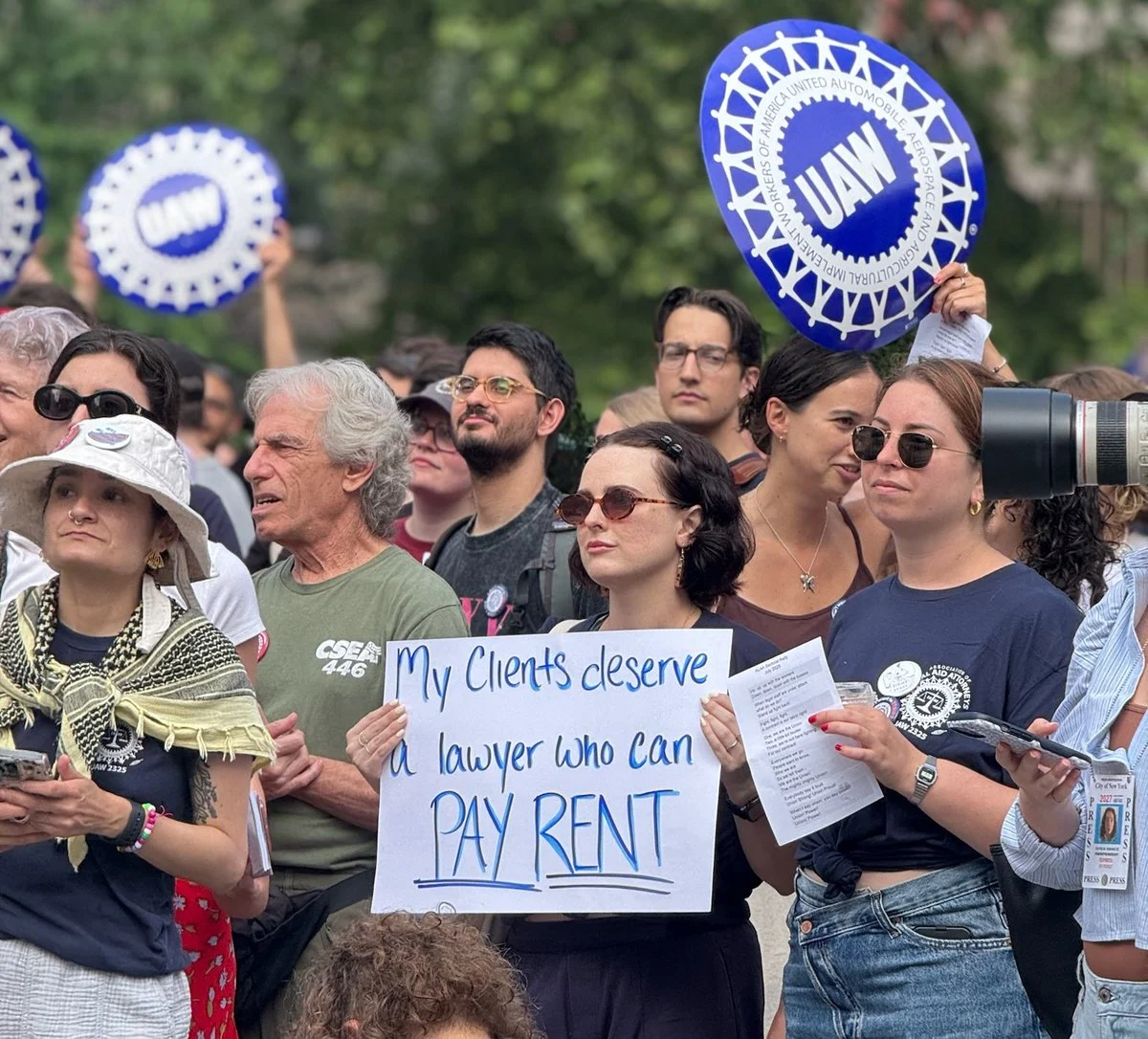
Above photo: Legal services workers with ALAA-UAW 2325 rally in solidarity with striking members to demand the funding, staffing, and support they need to continue delivering justice for low-income New Yorkers. UAW via X.
The workers say their pay and workloads keep them from providing the best possible representation for their clients.
In a historic coordinated campaign, hundreds of nonprofit legal services workers in New York City are currently on strike, demanding both better employment conditions and better legal representation for their clients navigating everything from the criminal legal system to housing and immigration courts.
Eleven chapters of the Association of Legal Advocates and Attorneys (ALAA), representing almost 2,000 workers, voted in 2023 to commit to sectoral bargaining — a strategy in which unions across multiple workplaces bargain collectively to raise standards for an entire industry. To maximize union leverage, the shops aligned their contracts to expire at the same time this year on June 30. Now, for the first time, workers are making the full power of their sectoral approach known: For months, they negotiated with the management of each of their nonprofits, which are largely dependent on public funding. After failing to reach fair agreements, shops began launching strikes on July 10.
“We’re striking along with all these other shops and together trying to improve the landscape for legal representation in New York City,” Ryan Acquaotta, a campaign coordinator and shop steward at Urban Justice Center, told Truthout. ”When everybody’s doing it together, it’s a lot harder to break the strike.”
As the city’s largest public defender organization, The Legal Aid Society received the bulk of media attention for its vote to authorize a strike. On July 24, the union reached a last-minute tentative deal with management, averting a looming walk-out that would have sent more than 1,000 attorneys to the picket line. Bronx Defenders and the New York Legal Assistance Group launched strikes but returned to work this week after reaching tentative agreements with management. Despite these early victories, as of July 24, Urban Justice Center remains on strike alongside five other shops and hundreds of workers.
Workers engaged in ALAA sectoral bargaining are united in their demands for higher wages, more manageable workloads, and transparent disciplinary processes, while also pushing for changes unique to their respective organizations. Jane Fox, chair of The Legal Aid Society attorneys’ union, said in a statement to Gothamist that their tentative contract did not meet the union’s demands for salaries and pensions, but they achieved new workload protections, a student loan fund, 20 weeks of parental leave, and retiree health benefits.
A member of the Urban Justice Center bargaining committee noted that, as part of the collective bargaining approach, the unions agreed to push for a sectoral salary floor of around $70,000, regardless of each organization’s starting floor. Some unions with tentative agreements compromised to achieve lower wage floors of around $65,000, but the Urban Justice Center worker said their organization’s executives were still only offering $50,700, a slight increase from their current meager floor of $45,000. According to MIT’s Living Wage calculator, a living wage for one person with no children in New York City in 2025 is $68,328.
“It’s deeply ironic that we’re helping people fight evictions and maintain their housing, and many of our employees working for that project can’t afford New York City rent and are struggling to maintain their own housing situations,” said Acquaotta.
Indeed, legal aid workers have long emphasized that low wages and heavy workloads prevent them from providing the best legal representation possible for their vulnerable clients. Urban Justice Center, for instance, runs projects providing legal services for sex workers, street vendors, domestic violence survivors, people experiencing homelessness and housing insecurity, and more. “The quality of representation that we can provide to people is stronger when the rules governing that representation help workers show up well,” said Acquaotta. A June 2025 review of union data by the ALAA found that roughly one in six New York City legal service workers have left their jobs in the past year. That turnover means vulnerable clients must relay potentially traumatizing information to new people charged with representing them in cases that could keep them in their homes or out of jail.
Union members know that striking can help them achieve their demands. In 1973 and 1974, the ALAA went on strike twice and won salary increases, new workload grievance mechanisms, improved office spaces, and vertical continuity in attorneys’ cases — meaning a lawyer assigned to a case would be able to work on it from start to finish, a benefit for both lawyer and client.
The last time the ALAA hit the picket line was 1994, but former New York Mayor Rudy Giuliani responded with intense strike-breaking and union-busting. The Legal Aid Society was the only public defender organization in the city at the time, and so Giuliani attempted to replace the organization’s work with that of newly formed nonprofits, soliciting city contracts from so-called scab shops. Giuliani was clear about his aims to diminish The Legal Aid Society’s union power, telling The New York Times in 1995 that the city would “no longer be at the mercy of one group that could decide in the future to go out on strike.”
But organized labor wasn’t going away that easily. It took time, but the ALAA was able to fold many of the nonprofits Giuliani contracted with during the last strike right back into its union. Now, with power consolidated once more, the units launched their first strike in more than three decades.
Through city contracts, a large chunk of the nonprofit legal organizations’ budget comes from public funding. Twyla Carter, the attorney-in-chief and CEO of The Legal Aid Society, said in a statement to Queens Daily Eagle that “for too long, [The Legal Aid Society team’s] pay has not reflected the complexity or importance of their work — the result of decades of underfunding by state and city government.” The most recent city budget added $20 million for legal services, but union members say this is insufficient to cover much-needed salary increases.
Acquaotta noted that right-to-counsel has expanded in New York City, and attorneys’ caseloads along with it. Lawyers are representing clients not only in criminal court, but also in housing and immigration courts — work that is especially urgent in light of President Donald Trump’s mass deportation agenda. “When ICE [Immigration and Customs Enforcement] is flooding the zone and arresting tons of people and funneling them through the courts, it really matters,” said Acquaotta. “The conditions that we work in are the conditions that people are served in, if we want to protect people from these oppressive forces in our society.”
On July 15, hundreds of people rallied in Manhattan’s Foley Square to show support for the striking workers, including New York State Attorney General Letitia James and New York City mayoral candidate and New York State Assemblymember Zohran Mamdani.
“We are facing an authoritarian administration in Washington, D.C. We are facing a president who is seeking to attack the very fabric of this city,” Mamdani said during a rousing speech at the rally. “In a moment like this, we have to use every single tool at our disposal to protect this city, to protect its people. And I look at all of you as the people on the front lines of that protection. You are the people that keep New Yorkers in their homes. You are the people that keep families together. And so it is incumbent upon every single one of us to stand with you so that you can continue to afford to do this work.”
Mamdani then called up a member of the crowd to display his sign. It read: “My clients deserve a lawyer who can afford groceries.”