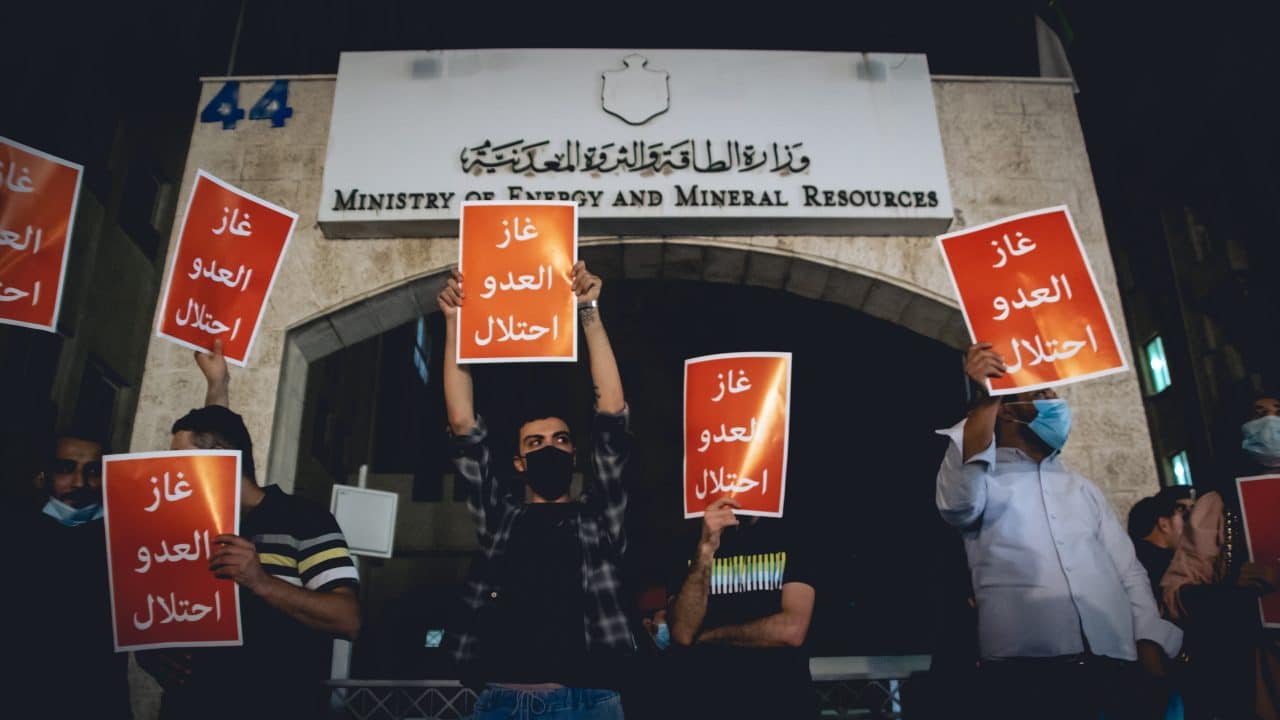
Above photo: Jordanian protest against Jordan’s natural gas deal with Israel held in front of the Ministry of Energy and Mineral Resources in Amman, Jordan, September 26, 2021. Wikimedia Commons, by Raya Sharbain.
The tools of boycott and public protest are inherited from the colonial period.
We need to adapt these methods to focus on where power is concentrated today in our region: Arab capital.
Under the urgency of the ongoing genocide in Gaza, many of the public tactics adopted by grassroots Arab movements to pressure their governments to boycott Israel and reflect the will of their people simply aren’t working. After nearly two years of genocide, the conventional tools of the Arab boycott campaign are hitting a wall.
This failure is not only about tactics — it is also about a deeper misreading of where the centers of power lie in Arab countries. This has led to the inability to pressure governments into taking action. Power is no longer centralized in a colonial regime that directly governs us, but is rather scattered and diffused everywhere. But if we understand hegemonic power in this way, then how can we channel our energies strategically into where the boycott movement can have a larger impact?
The answer to that question is Arab capital.
While the diffusion of control in modern Arab societies means that power operates through many channels, the diversity of those channels offers us a wider array of tools for resistance — as multiple as the mechanisms of control themselves.
During the era of colonialism and imperial expansion in the Arab world throughout the early twentieth century, it was easy to identify the enemy. The world was divided into two camps, and it was clear which side we were on. But with the erosion of the Arab liberation movements of the 1960s and the rise of neoliberal domination in the Arab world, we entered the era of hegemonic colonialism. Previous colonial powers did not move away from their relationship with their colonies, but metamorphosed: colonial domination was no longer direct, but was exercised through local Arab elites.
Yet the tools employed by grassroots Arab boycott movements have not caught up. One of the most active and major boycotts to take place among the Arab public following the genocide in Gaza was the boycott of Western companies and chains in the region, and it was even effective in injuring those companies: in Jordan, a widespread boycott of American companies like McDonald’s and Starbucks over U.S. complicity in the genocide led to the closure of branches following a sharp decline in slaes. Yet the genocide continues.
One of the main reasons is that many in the Arab public are still using the tools inherited from the colonial period, including the tools used in South Africa under apartheid and Palestine under the British Mandate. The boycott, the public protest, and the general strike were tools popularized by the 1936 Palestinian revolution, aimed and directed at the British Mandate and the Zionist movement in Palestine. The global BDS movement, with its own local variation in the Arab world, was inspired by the international solidarity shown for the South African anti-apartheid struggle. Widespread social legitimacy undergirded these movements against an external foe.
The Foe From Within
But what happens when the foe is no longer from the outside? Today, public protests against Arab governments have proven ineffectual, especially in light of the heavy security measures imposed by local regimes under the pretext of public security and preventing violence — a pretext that often legitimizes harsh crackdowns.
Unable to influence these authoritarian regimes, which all but proscribe public protest, people turned to boycotting the multinational corporations and international brands that have announced their support for Israel. And while these actions are understandable as collective acts of condemnation, these boycotts have not risen above the level of the symbolic — even when they were able to cause real material harm to multinational corporations. Simply put, it is because those corporations, while implicated in the hegemonic web of domination in the entire region, are not the British East India Company — in other words, they are not direct colonizers, against whom boycotts were most effective.
Since people are no longer directly governed by colonial systems, this shift in the form of domination must be met with a corresponding shift in the forms of resistance. Clearly, Arab governments are, to a great extent, partners in the genocide through both official and unofficial normalization with Israel. At the same time, they have positioned themselves not as defenders of their populations, but as intermediaries of power and brokers whose political and economic interests are increasingly aligned with the broader architecture of Western hegemony. From the genocide in Palestine to the killings in Lebanon and Yemen, Arab governments have a hand in the Western carnage in our region.
As mentioned, these authoritarian governments have cracked down harshly on local protest movements, rendering direct protest short of a revolution ineffective. But there is another way to target their power: to direct our attention toward their affiliated elites, who own vast networks of businesses not just within their borders, but across the Arab world.
These moneyed elites have consistently proven themselves to be efficient influencers of state policies and decision-makers. They are not only involved in the production of essential goods like food and water, but also dominate the entertainment and leisure sectors, which are far easier to boycott without causing hardship among the population. Malls, cinemas, restaurants, hotels, cafes, concerts, and other platforms of entertainment that generate profit for regime-linked figures are a tangible starting point for an effective and targeted boycott movement — one that could build real pressure from below and contribute to ending the violence in Palestine.
In a world where Arab capital only cares about its own enrichment at the expense of all else, we have to target the economic projects they rely on to maintain their wealth. The “economy” has been a keyword used by Arab regimes to justify violence. Trump set the tone when he spoke of Gaza in real estate terms, viewing its population and geography as an obstacle to redevelopment and investment. This discourse was echoed, both explicitly and implicitly, by Arab leaders, who framed the Palestine issue not in the language of justice and liberation, but through the vocabulary of investment potential, market stability, and geopolitical profit.
Even if we aren’t able to protest the governments directly, we can still target what matters most to them, forcing them to deliver what matters most to us: the freedom and liberation of the people of Gaza, Palestine, and the Arab world.