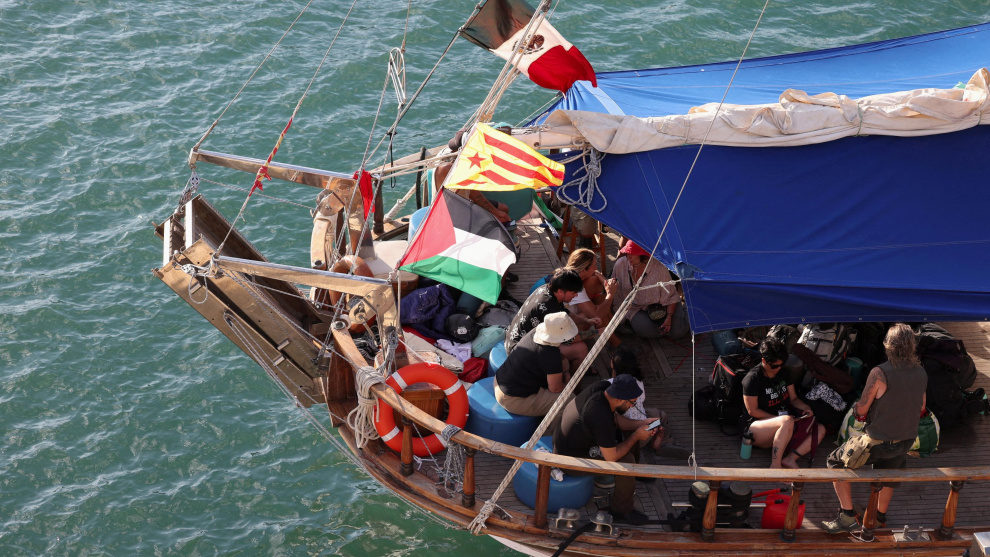
NOTE: One way to support this historic flotilla is by keeping an eye on the tracker and letting others know about it. You can follow the progress of all of the boats on GlobalSumudFlotilla.org/tracker. You can follow the Veterans for Peace boat here.
The Global Sumud Flotilla is advancing towards Gaza and is already sailing towards Tunisia, divided into two large groups. Both expeditions will meet in Tunisia at the end of the week, when they will be joined by another twenty boats in what the organizers consider to be the “largest humanitarian mission in solidarity with Palestine.”
Technical problems and bad weather have significantly delayed the flotilla’s schedule, which set sail on August 31 from Barcelona and has so far only been able to cover a handful of nautical miles. Harsh sea conditions forced several boats to be repaired, and after a particularly violent storm on Monday, September 1, the expedition was divided between the ports of Mahón (Menorca) and Barcelona.
On Thursday, September 5, all the ships resumed their journey to Tunisia with the aim of breaking the blockade on the Gaza Strip and bringing humanitarian aid to the Palestinian population. “We are moving forward, prioritizing the safety of our ships and our crew, but without losing our sense of urgency,” the flotilla summarized.
The organization has once again justified the delay in the mission by pointing out that “it is the governments who should be doing this, but they have failed, and it is us, simple volunteers, who have to do it with limited resources and experience.”
The Flotilla also points out that it does not receive any funding from “large corporations, governments, or political parties.” They assert that they are a “grassroots organization” made up of “doctors, humanitarian workers, activists, lawyers, artists, and ordinary citizens united by a common conviction: that Palestinians deserve to live with dignity, freedom, and humanity.”
Drones fly over the flotilla
The flotilla moves forward divided but with a common destination. “A mission of this magnitude always faces technical and mechanical problems, and when this happens we have to make decisions,” explained Thiago Ávila, a member of the Flotilla’s organizing committee. “As we are a large group, we can split into two and continue safely to Tunisia, but what we didn’t want was to repeat the situation of previous days, with ships sailing alone.”
Ávila justified his decision to group the mission into large groups by citing precedents involving other flotillas: “A few months ago, Israel bombed our ships,” he said, referring to the attack on May 2, when unidentified drones struck the bow of the Conscience off Malta, forcing the mission to be suspended. Shortly afterwards, in June, the ship Madleen was surrounded by drones that released an irritant substance before the Israeli army intercepted the ship.
After 10 p.m. last Tuesday, for the first time since the Global Sumud Flotilla began, the organization reported that several drones flew over the ships. A flashing white light remained in the sky for several minutes, in a maneuver typical of surveillance drones. According to visual reports from several volunteers, at least three small devices flew over the area for about ten minutes, systematically scanning the boats. “Although their origin could not be confirmed, the incident raises serious concerns about the safety of a civilian, peaceful, and nonviolent mission sailing to Gaza to denounce genocide and demand a humanitarian corridor,” they said.
Surveillance drones—capable of capturing images and video in real time—have limited autonomy, which suggests that they were launched from somewhere relatively close to the flotilla’s route.
The organizers consider this to be a “pattern of harassment” and urged the Spanish government to “assume its political and legal responsibility.” “It is not enough to announce consular protection after a possible boarding; Spain must offer diplomatic protection in advance and publicly guarantee the free navigation of the flotilla to Gaza, as protected by the United Nations Convention on the Law of the Sea (UNCLOS),” they assert.
The hypothesis of sabotage remains very much alive among activists. Although the organization has already established a strict selection process for participants, in recent days it has announced the implementation of “enhanced security controls and operational protocols as the flotilla prepares for the next stage of its journey.”
Despite everything, the mood on the flotilla is one of optimism. On board the Adara, the last ship to leave the port of Barcelona after numerous repairs, the crew celebrated their departure for the high seas with songs and Palestinian flags. “We’re going to get there no matter what. If this ship fails us again, we’ll swim to Gaza,” joked one of the crew members.
The flotilla will have a rescue ship thanks to an Italian NGO
The Italian NGO Emergency, which provides medical support to war victims, will join the Global Sumud Flotilla with one of its large rescue ships.
Nicknamed ‘Life Support’, this 52-meter vessel, adapted to cover rescue emergencies, will be made available to the mission in order to open a humanitarian corridor in Gaza and deliver the necessary aid.
Accustomed to working in the Mediterranean to save migrants, it will be able to provide medical assistance. This is a function that the organization already performs in two medical centers in Khan Younis (Gaza Strip).