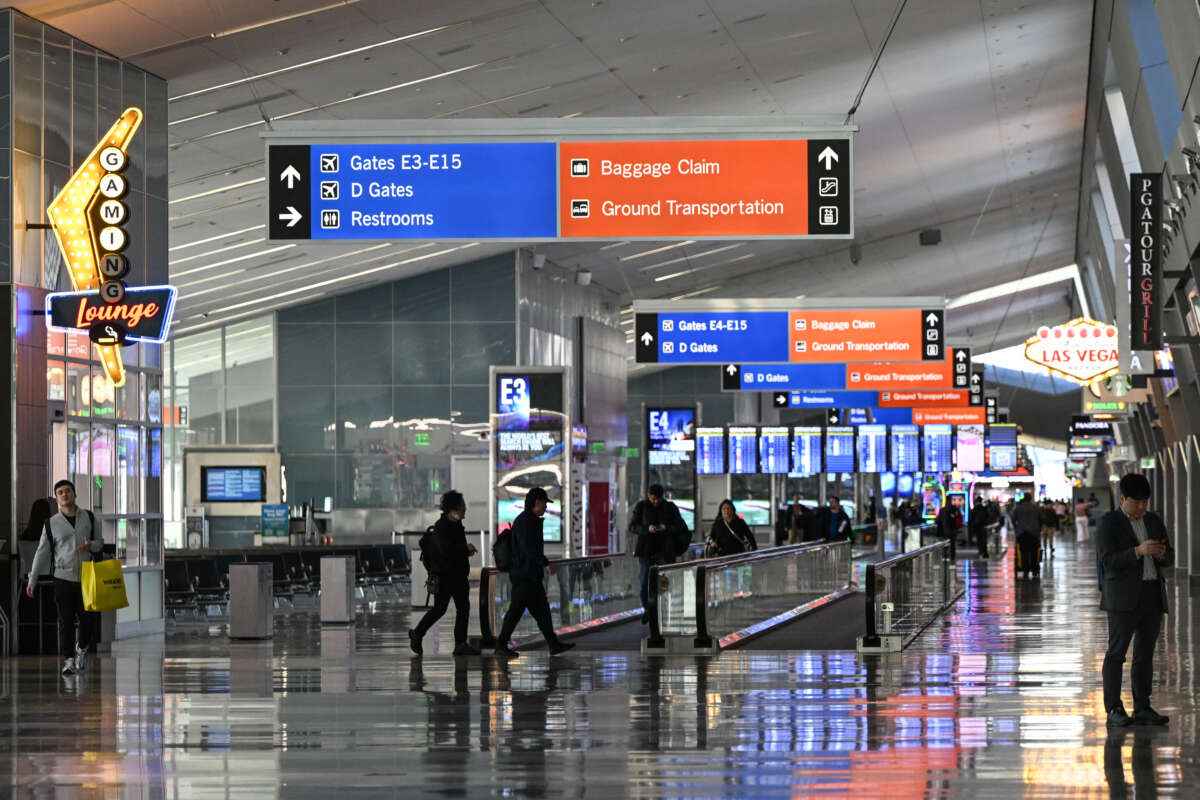
Above photo: A general view of the departure area at Terminal 3 at Las Vegas’s Harry Reid International Airport, one of the busiest air travel hubs in the U.S., in Paradise, Las Vegas, Nevada, on January 10, 2025. Artur Widak / NurPhoto via Getty Images.
Service work now dominates the economy.
That changes how we build worker power, scholar Annie McClanahan says.
Nearly 400 food service workers are set to go on strike at Harry Reid International Airport in Las Vegas this week over wage disputes. They are underpaid and haven’t seen a raise in many years. This is the predicament facing many workers in the service industry, even though they play a critical key role in the contemporary capitalist economy. Gig and service sector workers are indeed among the most overexploited segments of the working class — struggling with low pay, lack of legal protection, and insecure employment. Moreover, as Marxist-feminist scholar Annie McClanahan has explored in her research on the struggles of service workers, “The absence of legal regulation in service work has also kept the sector tethered to racialized, gendered, xenophobic, and ableist logics.” In the Truthout interview that follows, McClanahan — who is associate professor of English at the University of California, Irvine, and author of the forthcoming book Beneath the Wage: Tips, Tasks, and Gigs in the Age of Service Work — shares her analysis of the impending airport strike and the conditions of service workers in the U.S. more broadly.
C. J. Polychroniou: Airport food service workers across 20 outlets at Harry Reid International Airport in Las Vegas have set a November 14 strike deadline because they claim they haven’t received a raise in years. Workers in the food industry earn some of the lowest wages in the U.S. economy and are also overworked. Why is that?
Annie McClanahan: Those workers are totally typical of how service work works: low wages, long hours. Compared to other forms of work, service work is labor intensive: you can’t speed it up with an assembly line or increase its output using economies of scale. As a result, you don’t see the big gains in productivity that are possible with technologies of innovation like the assembly line. Instead, service work squeezes out profits and productivity from the marginal gains that come from techniques of intensification, from long hours and precarious methods of wage payment to informalization and deregulation.
One of the important terms in my book that’s particularly relevant to this case is the idea of super-exploitation. This term comes from the radical theorist and activist Claudia Jones, who used it to describe the labor of Black domestic workers; it was also taken up by Marxist development economists writing about labor in the underdeveloped world. Basically, it means a situation in which workers’ compensation does not cover their cost of living, or in which workers are simply compelled to work harder during a shift, driving themselves toward extreme exhaustion and overwork. Service workers who are paid in tips or in some other insecure “performance-based” wage, service workers forced to work highly variable shifts with little job security, and service workers unprotected by minimum wage or maximum hours regulations are all subject to super-exploitation, which bears down with particular force on non-white and non-citizen workers. The result is that a lot of workers in the service sector are trapped in a situation where they can’t afford the necessary reproductive services they provide: daycare workers who can’t afford daycare; care workers who can’t afford health insurance; food service workers who can’t ensure a wage adequate to their basic subsistence.
Advanced capitalist economies have entered a stage in which the service sector has become increasingly important, to the detriment of the industrial sector. Indeed, the service sector is the largest employment sector in the United States and the same holds true for other advanced capitalist economies, such as those of Germany and France. How should we view the growth of the service sector and the role of service workers in capitalism? Do we need to reconceptualize capitalism itself?
I wouldn’t say that the service sector has risen “to the detriment” of the industrial sector. Instead, I’d say that the rise of the service sector is the effect of the collapse of industrial manufacturing in the advanced economies. When manufacturing employment started its precipitous decline beginning the early 1970s, the so-called “family wage” vanished, as did much governmentally funded social welfare provisioning. One consequence was that more middle- and upper-middle class white women entered waged work, which meant they had to rely on the low-waged care work and service work of others (mostly non-white working-class women). And of course there was also a massive shift in the labor market, with the service sector absorbing a lot of the cast-off labor from deindustrialization.
But the rise of the service economy wasn’t just a solution to economic stagnation; it was also a cause of it. As I said before, service work is fundamentally different from manufacturing: it’s labor-intensive with low labor-productivity growth. As a result, the service sector contributes pretty minimally to overall economic growth, which is why we’re decades into a “long downturn.”
Even though we’re now in a situation where 80 percent of the workforce labors in the service sector, a lot of our assumptions about what capitalist labor looks like in the advanced economies still come from the world of manufacturing. We assume that workers are paid a time-based wage, that they are subject to a very regimented and standardized form of time discipline, that they are directly overseen by scientific managers, that they have working days of a predictable length, that their work is highly mediated by technology, that their working conditions are regulated by the state. Very few of those things are true of contemporary service workers.
That said, it’s also not as if service workers are an entirely new phenomenon. My book traces a genealogy from 18th-century domestic servants to early-20th-century Pullman porters to today’s gig workers. Those workers have always been with us; we’ve just paid relatively little attention to them. From classical political economy to 20th-century debates about regulation and unionization, service work has often been treated as an anomaly or anachronism. Instead of treating low-wage service work as marginal or exceptional, I want to understand it as an enduring and structuring form in the history of wage labor. It’s not a footnote in the story of modern capitalism but an indispensable shadow history of labor exploitation.
The service sector workforce includes a significant proportion of women, people of color, and young people, and the service sector economy is also a site of insecure and informalized wage as well as of high employment turnover. How does exploitation function in a sector of the economy where nothing of physical value is produced for capitalists to sell for a profit?
Because service work is so labor-intensive, its labor process is very different from that of industrial labor. Today’s service workers regularly toil for non-hourly methods of wage payment. They are often “indirectly” managed and dominated. Their work is less likely to be protected by maximum-hour and minimum-wage laws. And they are a test case for the ways that even jobs resistant to full automation can still be transformed by technologies of speed-up and intensification. In all these ways, service work requires us to rethink our basic understanding of wages, management, labor-saving technology, and regulation.
The exclusion of service work from labor regulation is particularly important. Service and retail workers were initially exempted from federal regulations like the Fair Labor Standards Act (FLSA) because they did not make “vendible goods.” Even when the FLSA and other New Deal reforms were expanded in the mid-1960s, large portions of the service sector were exempted from reform.
The absence of legal regulation in service work has also kept the sector tethered to racialized, gendered, xenophobic, and ableist logics. Non-regulation secures the idea of service work as exceptional, whether in the sense that it is mostly performed by women and non-white workers or in the sense that it is pre-modern. Service work has never been understood as free labor; instead, like unwaged reproductive work, it has been perceived as the natural domain of women and non-white subjects whose “substandard” productivity or skill did not make them fit for “real” work. These were some of the reasons that service work was exempted from contracts and labor laws; then, in a perverse cycle, the absence of contracts and labor laws became yet another sign of service work’s exceptionalism or anachronism.
Gig workers are considered those who are classified as self-employed, freelancers, and independent contractors. How does the gig economy differ from the service sector economy? Is it built on the same organizing principles? Does it function on the same platform of exploitation as that of the service sector economy?
We often think of the gig economy as a particularly contemporary phenomenon, something unique to the 21st century labor market and dependent on 21st-century technology. To some extent that’s true. Certainly the last few decades have seen a significant rise in the numbers of independent contractors, especially those who are performing this kind of work as a second or even third shift on top of other more traditional forms of employment. Most of the job growth since the financial crisis of 2007-2008 has been in this sector. And as I argue in the book, technologies of surveillance and deskilling from algorithms to apps are making the exploitation of gig workers easier than ever before.
But the category of “independent contractor” also has a far longer history, one intimately related to the deregulation and informalization of service work as a whole. The initial distinction between “employees” and “independent contractors” was based on the difference between goods-producing manufacturing workers — centralized in one space and controlled by scientific managers — and goods-circulating service workers, whose work was ostensibly more independent and autonomous and who were thus excluded from the legal rights granted to formally waged workers. I thus argue that we can only understand contemporary gig work by looking to labor histories outside of manufacturing. For instance, we typically associate scientific management and technologies of worker surveillance with factory labor, but in fact both were innovated for circulation workers, from passenger train conductors to long-haul truckers. Gig work also relies heavily on the exploitation of migrant workers in ways that recall programs like the mid-century Bracero scheme, which exploited migrant farm workers, or the efforts to bring migrant women into the U.S. to perform superexploited domestic work in the 1970s and ’80s.
The shift to a service economy has not been accompanied by the strong unionization rates that were seen during the era of industrial capitalism, let alone the political struggles that shaped the nature of much of the working-class movement of the 19th and 20th centuries. How can worker advocacy gain traction in the gig and service sector economies?
There are a lot of factors that make contemporary unionization far harder than it was at the high-point of industrialized manufacturing, from the rise of right-to-work laws and the steady erosion of rights for public-sector workers to the intense union-busting efforts of monopoly corporations like Walmart, Amazon, and Starbucks. Historically, the same things that made service work seem hard to regulate — its irregular hours, its non-transferrable products, its labor-intensity, its decentralization — also made service work seem difficult to unionize. To some extent those challenges are real: gig workers, for instance, are indeed spread out from one another and work in a largely solitary way. But I also think that there’s historically been a failure of imagination on the part of “traditional” unions, which have often been unable or unwilling to organize service workers, especially when those workers were predominantly female, non-white, or non-citizens.
That said, there’s also a powerful history of radical service worker unions reimagining what unionization means, a tradition that remains vital to contemporary service worker organizing. The mid-century Domestic Workers Union (DWU), for instance, was international, intersectional, and radically multi-issue.
Radical rank-and-file service workers are today similarly making demands not just for higher wages or better working conditions, but also for the rights of workers with disabilities; for gender-affirming health care; for police abolition, immigration reform, ecological justice, and divestment from the military-industrial complex.
The amazing feminist labor historian Dorothy Sue Cobble describes these kinds of organizing as “relational unionism,” a form of labor struggle that isn’t just about wages but is also about how workers reproduce themselves. I see examples of that kind of relational politics in the rise of “tenants unions,” which allow service workers and others to organize around the demand for access to affordable and quality housing.
I’m also inspired by the way labor groups like Gig Workers Rising and One Fair Wage are organizing around shared legal status (independent contracting) or shared subjection to a particular form of wage (tips). And I think there’s some really exciting labor radicalism among sex workers, who have historically been entirely marginalized and ignored by the labor movement — I’m thinking about groups like Soldiers of Pole, Haymarket Pole Collective, and Sex Workers Organizing Project, whose practices build on the DWU’s tactics for communal survival.
As Marx argued, there is a difference between a class “in itself” and a class “for itself.” Do you see the potential for a transition from a class-in-itself to a class-for-itself among workers in the service sector of the economy?
Absolutely, yes. I think in terms of consciousness, low-wage service workers are already there; what remains is for them to continue to organize, and to build solidarity across those organizing campaigns. But to answer this question in a more experiential way, I’ll turn to my own sector, the university. Most of my book is about the low-waged, non-professionalized portion of the service sector, but I’m also interested in how deskilling, automation, intensification, and informalization shape labor in the higher-waged part of the service sector, which has historically been fairly immune to those processes.
Tenured university professors like me have never had much class consciousness — despite major union wins among graduate students as well as a strong labor movement among contingently employed faculty over the last few decades, tenured faculty have been much more reluctant to see ourselves as part of working-class struggles, or even to see ourselves as “workers” at all! But I think that’s changing pretty dramatically.
The wave of federal attacks on the public sector in general and higher ed in particular is demonstrating the need for collective bargaining to protect our jobs and our academic freedom. The erosion of shared governance and the massive increase in centralized administration proves daily that we need a stronger and more autonomous voice in decision-making. And the breathtaking rise in labor-replacing technology — from online classes to generative AI — is showing faculty that we are just as vulnerable to deskilling and automation as other workers before us. So while we still have a way to go before we’re fully prepared to take action as members of the service-working class, I think we’re closer to that point than ever before.