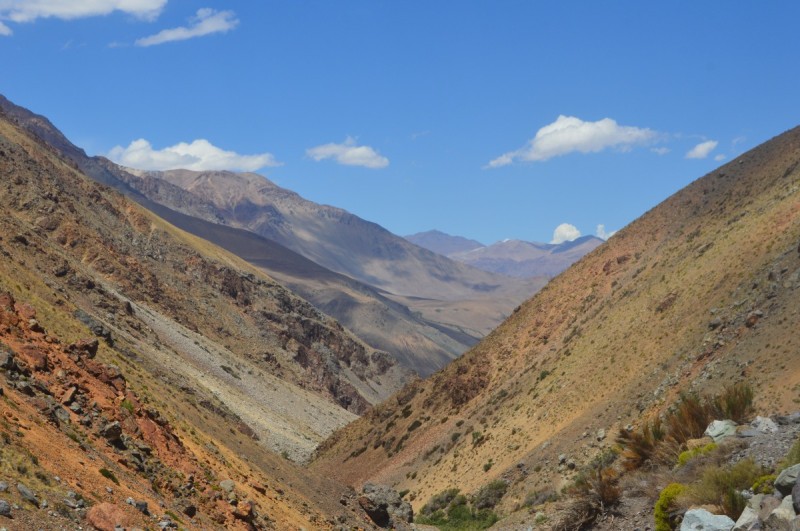
Above photo: Rocín River basin, Chile. Arón Cádiz-Véliz.
Vancouver-based Los Andes Copper retaliates against local official and scientist challenging its proposed Vizcachitas project.
Vancouver-based Los Andes Copper, developer of the proposed Vizcachitas copper-molybdenum mine in Chile’s Valparaíso region, has launched an aggressive campaign targeting the municipality of Putaendo’s mayor, Mauricio Quiroz, and local biologist Arón Cádiz-Véliz. The company is pressing legal and media challenges against them for opposing the mine and leading scientific efforts to protect the area.
The conflict centres on a report and technical study commissioned by the municipality, aimed at designating the Rocín River Valley—a high-altitude ecosystem with glaciers, wetlands, and endemic species—as a protected area. Los Andes Copper has sought to discredit both the study and the officials behind it, framing opposition as a challenge to its commercial activities and environmental credentials.
Cádiz-Véliz, a PhD student at the University of Concepción, says the research is purely scientific. “All we are doing is conducting a scientific investigation,” he said. “The more we study the Putaendo mountain range, the more evident the need to protect it becomes: we are discovering and describing new species for science, which could disappear if the Vizcachitas mining project were to go ahead.
“It seems that doing science can become an obstacle to these projects, because the more we learn about the territories in which the company intends to intervene, the more information becomes available against their initiatives.”
Los Andes Copper’s flagship Vizcachitas project has been marketed as “Chile’s next major copper mine” and framed as contributing to the “green transition” and the fight against climate change. The mine is projected to have an initial 26-year lifespan, producing hundreds of thousands of tonnes of copper annually along with significant quantities of molybdenum and silver. Company statements describe Vizcachitas as a “Tier 1” asset in Chile’s central copper belt, capable of becoming one of the country’s largest and most profitable copper mines.
There are more than 40 Canadian mining companies currently operating in Chile, overseeing more than 100 mines and projects across the country. Canadian firms have been active there since the early 1990s, investing heavily in copper, lithium, and other strategic minerals as part of a broader global rush for resources tied to the energy transition.
Copper and other critical minerals are in growing demand for renewable energy technologies such as wind turbines, solar panels, and electric vehicles. Chile, the world’s largest copper producer and second-largest lithium producer, has become a central node in this resource scramble, attracting foreign investment and putting local communities on the frontlines of extractive conflicts.
Communities impacted by this dash for critical minerals, however, remain staunchly opposed to the project as they fight to ensure the survival of a unique Andean ecosystem.
In May 2024 the company launched a complaint against the municipality of Putaendo, where Mr. Quiroz serves as mayor, before Chile’s Court of Public Procurement, alleging irregular use of municipal resources and irregular awarding of contracts. While the complaint was rejected in July, Los Andes Copper has indicated it intends to appeal the decision.
The Push To Protect The Rocin River Valley
Local environmental organizations, biologists, and the municipality of Putaendo are concerned that the Vizcachitas project will put the region’s biodiversity, high mountain ecosystems, and wetlands at serious risk. The ecologically sensitive area in the Andes mountains, which lies within the Rocín River Valley in the Aconcagua basin, is home to many endemic flora and fauna species that are in danger of extinction, including the Andean cat. The valley is also a region of historical and cultural significance due to the presence of ancestral routes used by the Inca in pre-colonial times.
Alongside its ecological and cultural value, there is serious local concern about the increased pressure of mining activities on an already stressed watershed. The rock glaciers and the Rocín River basin are Putaendo’s only sources of drinking water. The region has been suffering a prolonged and serious drought and has been designated a zone of water scarcity since 2004.
The valley of Putaendo has a long history of local resistance to large-scale mining. Residents, alongside local activist groups such as Putaendo Resiste, have challenged drilling and development permits for the Vizcachitas project, citing threats to water security, biodiversity, and the valley’s fragile ecosystems. Community members have also raised concerns about inadequate public consultation and environmental review processes, filing appeals with Chile’s Environmental Assessment Service to halt or modify project approvals.
Over the years, the communities of Putaendo have mobilized to put forward community-led alternatives to large-scale mining, including the creation of an Andean park in the Putaendo Valley and the official declaration of the Rocín River basin as a protected area.
Four years ago, the municipal government of Putaendo began exploring how best to protect the Rocín River basin from increasing threats from mining interests. They determined that the creation of a nature reserve in the Putaendo mountain range could protect both its ecosystems and strategic water reserves, and sustain traditional ancestral and local economic activities such as small-scale agriculture and sustainable tourism.
In 2024, the municipality submitted a technical study to the Chilean ministry of the environment to have the Rocín River basin declared a nature sanctuary. The study was prepared by a group of biologists, conservationists, and engineers, including Cádiz-Véliz. The project was resubmitted this year, requesting that the Rocín River basin be declared a “protected area with multiple uses” under new Chilean legislation on biodiversity and protected areas, which passed into law a few days after the first study was submitted. According to the report, the integrity of this water system is crucial for ensuring the water security of future generations in Putaendo.
Since the municipality submitted its first version of the protected-area study last year, Cádiz-Véliz and Mayor Quiroz have faced what they describe as a pattern of lawfare by Los Andes Copper—repeated legal actions aimed at slowing or delegitimizing their efforts to protect the Rocín River basin. Their experience reflects a broader trend across Latin America, where communities and land defenders opposing Canadian critical minerals projects report being subjected to aggressive legal and administrative pressure.
Smear Campaign By Los Andes Copper
Shortly after Putaendo commissioned Cádiz-Véliz to prepare the technical study for the protected-area request, Vizcachitas Holding, a subsidiary of Los Andes Copper, filed a legal challenge against both the mayor and the biologist, alleging irregular use of municipal resources and irregular awarding of contracts. According to community members and local partners, this was not the first attempt: the company has repeatedly challenged efforts to secure protected status for the area—whether as a nature sanctuary or, more recently, a protected area with multiple uses. In each instance, their complaints have been rejected by the relevant authorities, though Los Andes Copper has signalled it intends to keep pursuing appeals.
“[The company] has tried to discredit this report by accusing me and the municipality of using funds in a corrupt manner, which is not the case,” said Quiroz.
Cádiz-Véliz noted that both the comptroller’s office and the procurement tribunal ruled in favour of the municipality and the research team, confirming that the report and the contracts behind it were carried out in full accordance with the law. He says he has since been the target of defamation in local media due to his involvement in the study.
“One of the things [the company] mentions is that our technical report had been rejected by the ministry, but it was not because of a mistake on our part,” Cádiz-Véliz added. A new law came into force, abolishing the concept of a nature sanctuary and replacing it with new categories of protected areas, requiring the study to be resubmitted for approval.
“It is important to note that our application for declaration as a nature sanctuary was carried out under the law that was in force at the time,” he said. “But the ministry was unwilling to process it until the new law was approved, which delayed the process by more than a year.”
Although the public procurement tribunal declared the complaint against the municipality of Putaendo “inadmissible,” the executive director of Los Andes Copper, Santiago Montt, has stated that the company “will insist on a review by the tribunal to have the municipality’s illegal, arbitrary, and discriminatory actions overturned.”
According to Cádiz-Véliz, the ecological importance of the site cannot be understated. “We are talking about a site that has been completely unexplored by scientific research for a long time, which is now being investigated precisely because of this mining conflict. If the project goes ahead, many species may disappear without anyone even knowing they existed. This place has incredible biodiversity, which is little known and must be protected.
“It cannot be that a copper mining company that claims to be environmentally friendly and promotes sustainable mining not only opposes [an initiative to protect biodiversity], but also takes legal action against those who stand in its way.”
The mineral-intensive energy transition in Latin America is advancing in ways that fundamentally undermine human rights and nature. The rush for critical minerals is pushing deep into fragile ecosystems, overriding community consent, and placing human rights and environmental defenders at even greater risk.
As Mayor Quiroz put it, communities are not only resisting a mine—they are defending their future. “We have the right and the obligation to protect the environment, the mountains, the rivers, the glaciers, and, of course, the communities,” he said.
Viviana Herrera is the Latin America Program Coordinator at MiningWatch Canada.