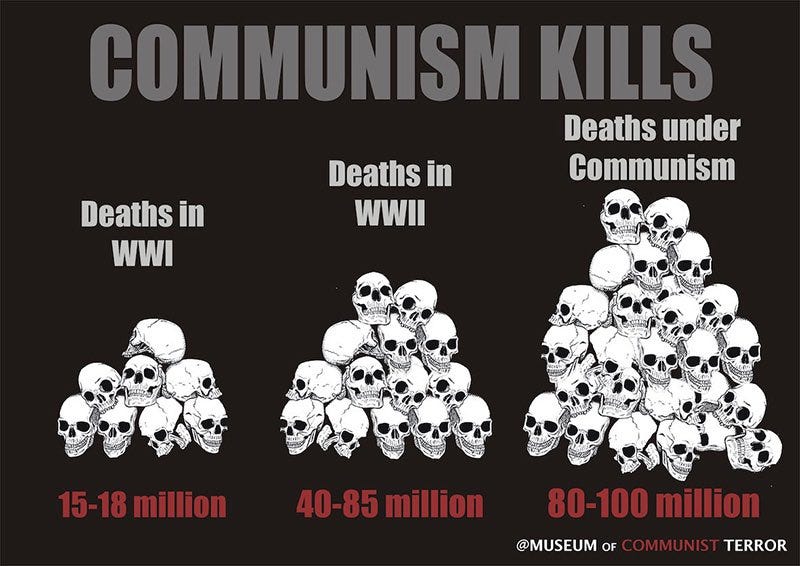
Above photo: An example meme from right-wing circles that shows the Alleged Victims of Communism.
We are debunking the arguments against Communism.
Their Talking Point:
“Communism killed 100 million people in the 20th century, making it the deadliest ideology in human history – worse than Nazism which only killed 25 million.”1
The Counter-Argument:
This tiresome and oft-repeated non sequitur of a soundbite has been recycled by many anti-communist organizations from Prager-U, TPUSA and most recently, a little over a month ago, Quillette Magazine published an article affirming this ludicrous number. To anti-communists, these inflated statistics are held up as definitive proof of the alleged “barbarism of communism.”
The fundamental flaw in the “100 million deaths” narrative: it treats political ideology as a kind of metaphysical cause of death. Policies are lifted out of context, conditions are ignored, and complex histories are reduced to an inflated scoreboard where people prosecuted for crimes that would be illegal anywhere are reframed as victims of communist persecution.
In that same 1997 edition of the Black Book of Communism, Courtois again asserts that “communist regimes committed crimes involving around one hundred million people, compared to around twenty-five million under Nazism.”(Original French Version available here). Despite this claim being edited out of other editions, the 1997 publication sold over a million copies, was translated into more than 27 languages, and became a primary source for the talking point now repeated by well-funded anti-communist organizations such as TPUSA, Victims of Communism Foundation etc.
Subsequent French and international editions quietly removed Courtois’s “100 million vs. 25 million Nazis” comparison after he was widely criticized—including by his own co-authors—for methodological manipulation and for minimizing Nazi crimes in order to inflate communist ones.
Several of the book’s own contributors immediately rejected Courtois’s claims. Nicolas Werth and Jean-Louis Margolin both tried to distance themselves from the “100 million” figure as soon as the book was released. They accused Courtois of being fixated on reaching that number, even if it meant manipulating the data to get there. Werth stated plainly that he had never cited twenty million deaths for the Soviet Union, and Margolin likewise insisted that he had never reported one million deaths for Vietnam. Both maintained that Courtois had effectively invented figures in order to hit the symbolic round number he wanted.
Werth and Margolin were not alone. Along with the historian Karel Bartošek, they publicly denounced Courtois’s methodology and the political agenda behind it. Werth, who authored nearly a third of the entire volume in his chapter on the USSR, and Margolin, who wrote the extensive section on Asia, both rejected the way their work was being used. Together with Bartošek, they resigned from Courtois’s editorial board at the journal Communisme in protest, making clear that they did not stand behind the inflated totals or the moral and historical equivalence Courtois attempted to construct.
Stéphane Courtois is a French historian, a director of research at the French National Centre for Scientific Research (CNRS), and the editor of The Black Book of Communism. He co-founded and directs the journal Communisme. He is known for his transition from being a Maoist activist in his youth to becoming a prominent anti-communist scholar.
Courtois intended the “100 million” figure to serve a central historical and moral argument: to forcefully establish that Communism was ethically equivalent to Nazism and, by a sheer numerical measure of victims, was the “deadliest” political system of the 20th century. The single, round figure functioned as a rhetorical device designed to shock and to create a moral equivalence between the two totalitarian systems—a move that the co-authors, including Werth, vehemently rejected.
But when we examine the numbers with even minimal scrutiny, a striking pattern emerges: many of the deaths folded into this figure were not innocents at all, but rather individuals who had actively participated in fascist collaboration, wartime atrocities, or violent counterrevolutionary activity. In fact, the historical record often shows that communist governments were far more restrained in their responses than their adversaries would ever acknowledge.
First of all, Courtois’s own arithmetic is flawed. He claims:
USSR: 20 million
China: 65 million
Vietnam: 1 million
North Korea: 2 million
Cambodia: 2 million
Eastern Europe: 1 million
Latin America: 150,000
Africa: 1.7 million
Afghanistan: 1.5 million
“International communist movement”: 10,000
When added properly, these numbers total 94.36 million, not 100 million. Their own arithmetic fails. But the fraudulent math is only the first problem.
The Black Book’s fundamental flaw: it treats political ideology as a metaphysical cause of death. Policies are lifted out of context, conditions are ignored, and complex histories are reduced to an inflated scoreboard where people prosecuted for crimes that would be illegal anywhere are reframed as victims of communist persecution.
This methodology produces a shocking result: To understand the full scope of the deception, we must examine who the Black Book counts as “victims of communism.” Nazis and Nazi collaborators comprise the largest category.
The book dedicates significant space to the USSR, and early on makes clear who they’re counting. “However, other crimes on a much larger scale are habitually overlooked, including the murder or death in the gulag of tens of thousands of German soldiers taken prisoner from 1943 to 1945.”2 In other words: Nazis and their collaborators, semantically bleached and redefined to capture the sympathy of the unsuspecting reader.
Later in the book, the authors classify 37,000 captured UPA soldiers as “victims of communism.”3 This framing obscures who these men actually were. The UPA’s brutality was so depraved that even regular Wehrmacht officers lodged complaints with Himmler. One report came from Erwin Bingel, who described Ukrainian militias on horseback, armed with pistols and cavalry swords, riding wildly through a town park. They drove terrified civilians—men, women, and children—before their horses and unleashed a hail of bullets into the human mass. Those not killed outright were cut down with swords. Bingel wrote of this “horde of Ukrainians, let loose and commanded by SS officers,” trampling savagely over human bodies and ruthlessly killing children, mothers, and the elderly—people whose only “crime” was escaping the earlier mass murder, only to be hunted down and slaughtered “like wild animals.”
Page after page, as the book continues its geographic sweep of various nations, who they count as victims are super-obvious. “Political commissars and counterintelligence units in this army, under SMERSH and the NKVD, were deeply involved in such operations. The repression was especially severe in the countries that had sent troops to fight against the Soviet Union—Hungary, Romania, and Slovakia—where the NKVD deported hundreds of thousands to the Soviet gulags.” In other words, countries that invaded the USSR alongside Nazi Germany faced harsh treatment when they lost. The book presents prosecuting enemy combatants who committed untold atrocities alongside the Nazis, as an atrocity.
The Black Book decries ‘systematic persecution’ of the Catholic Church across Eastern Europe (page 410), while omitting that the Church had actively collaborated with fascist regimes. In Slovakia, Catholic priest Jozef Tiso led the Nazi puppet state and oversaw the deportation of 75,000 Jews to death camps. In Croatia, Franciscan priests ran Ustaše concentration camps, whose brutality even shocked Wehrmacht officials. When communist governments prosecuted complicit clergy and reduced the Church’s institutional power, this wasn’t religious persecution – it was accountability for committing the Holocaust.
While the USSR and Eastern European sections at least provide documentation of who was prosecuted—revealing most “victims” were Nazi collaborators, invading soldiers, and Holocaust-complicit clergy—the China section abandons even this pretense of evidence. On page 464, the authors claim 20-43 million people died during the Great Leap Forward. A margin of error of 23 million people—more than the entire population of Australia—reveals a methodology so fundamentally flawed that no serious analysis should proceed from these numbers. Since the China section accounts for 65% of the alleged “Victims of Communism”, we must continue to dismantle it.
Unable to provide documentation for their claim of 20-43 million deaths, the authors resort to pages of cultural philosophy word salad—discussing Confucianism, Taoism, Buddhism, quoting Chinese philosophers from 500 BC, and noting that the Tang dynasty (960-1127 AD) had harsh punishments. None of this constitutes evidence for deaths during the Great Leap Forward. This is intellectual fraud disguised as scholarship: make enormous claims, provide zero documentation, fill pages with irrelevant cultural commentary, and hope no one notices the complete absence of actual evidence.
Later on in the chapter, the author admits that they do not have actual data. On Page 479, they clearly state, “There is no precise tally of the number of victims.” The authors make their own great leap forward in methodology – from ‘no precise tally’ to ‘necessarily at least one per village’ to 2-5 million dead, all without citing a single named source or explaining how they determined what was ‘necessary.’
Incredibly, the Black Book cites China’s population decline of 60 million between 1850-1873—under the Qing Dynasty, decades before the Communist Party even existed—as context for understanding communist revolution. They admit these deaths resulted from ‘immense rebellions, repeated attacks by Western imperialists, and the growing despair of a population living in abject poverty.’ In other words, capitalist imperialism and the old feudal system killed 60 million people, creating the conditions that led to communist revolution. Yet the Black Book blames communism for attempting to industrialize a country devastated by centuries of imperialist exploitation and regular famine.
As we continue the Asia chapter in the book, both their claims and their orientalism get more outrageous, escalating to the atrocity propaganda that we are familiar with in the build-up to any war. On page 492, they claimed that “children were killed and even boiled and used as fertilizer”, which has a very shady citation by another anti-communist Becker, which ultimately shows that it is a rumor that an anonymous witness heard his parents discuss. As the book moves further, it increases its racism and the atrocity propaganda gets more outrageous. It claims that because of the famine, many people were cannibalized. Again, the source for this one anonymous person, who cannot be verified.
The claims gets more hysterical and the book actually debunks itself to anyone who bothers to read the rest of the Asia sections. The golden admission in the last sentence of the DPRK section, admits to what the critiques already say: “Even if we content ourselves with a figure of 500,000 victims of the primary or even secondary effects of malnutrition (including the usual, unverifiable rumors of cannibalism), we end up with an overall figure of more than 3 million victims in a country of 23 million inhabitants that has lived under Communism for fifty years.”4
Of course, the biggest debunker for the 100 millions of victims of communism is the fact that apparently the government of Canada has not been able to name even 550 of these 100 million of them without running into Nazis and Nazi collaborators. As a recent government study showed that at least 60% of the so-called victims in their memorial wall were Nazis and Nazi collaborators – leading the government to build an accidental communist propaganda monument. They built a wall dedicated to the victims of communism, but in lieu of the uncomfortable truth coming out, they scrapped listing names of these so-called victims. Therefore, in Ottawa, now sits a large wall dedicated with the total number of victims of communism: zero.