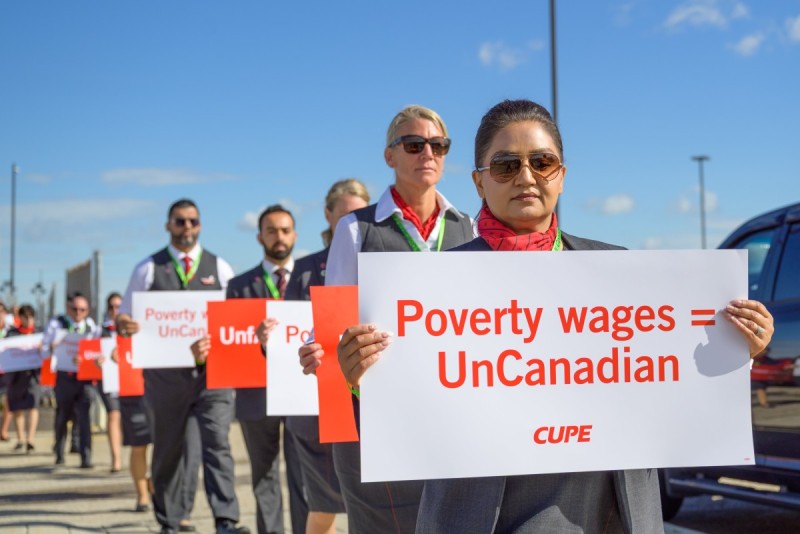
Above photo: Air Canada flight attendants during a demonstration at Toronto Pearson International Airport. CUPE.
We need a national carrier that gets us where we need to be without ripping off workers.
On August 16, 10,000 Air Canada flight attendants walked off the job. Three days earlier, their union, the Canadian Union of Public Employees (CUPE), had issued a 72-hour strike notice. In response, the airline served its own lockout notice, warning that it would cancel flights worldwide. The showdown came after months of stalled negotiations following the expiry of the attendants’ decade-old collective agreement in March. The strike did not last even a single day before the Carney government referred the parties to binding arbitration.
A central issue in the negotiations is the flight attendants’ “ground pay.” Under the current system, they are only paid for time in the air, leaving the hours spent working before and after takeoff uncompensated. According to the union, this means newly hired attendants effectively earn less than $12 an hour, which is below Canada’s minimum wage.
Despite challenges from Canada’s trade war with the United States and a decline in cross-border tourism, Air Canada has performed well financially since 2022. Critics of the airline have also pointed out that CEO Michael Rousseau received $12.08 million in compensation in 2023-2024, including his base salary of $1.3 million plus stocks and options.
Flight cancellations resulting from the strike were to impact 130,000 passengers a day, with 25,000 Canadians being stranded abroad. Despite Air Canada’s announcement of a lockout, only 34 flights were cancelled by August 14, with that number climbing to 294 by noon on August 15. Most cancellations came just hours before the strike, and even after it began, some passengers said their flights were never “officially” cancelled, preventing them from rebooking through Air Canada’s website.
As news spread that Air Canada was winding down operations ahead of the strike, many passengers tried to secure refunds or rebook their flights. But by August 14, the airline’s automated phone system simply disconnected callers, citing high call volumes. Some reached Air Canada through social media, only to be told refunds or rebookings would not be issued until their flights were officially cancelled, even when it was obvious the plane would never depart.
This policy produced Kafkaesque scenes: a company spokesperson went on television announcing that all flights would be cancelled as of August 16, while customer service agents continued to insist flights were operating as scheduled. Passengers were also told negotiations were ongoing and a strike might be averted, even though the union reported Air Canada had not met with them to negotiate since August 12.
By waiting until the last possible moment to cancel its flights, and refusing to rebook passengers or issue refunds until flights were cancelled, Air Canada made life more difficult for its customers. Prices for tickets on other airlines skyrocketed while Air Canada passengers sat and waited, unable to obtain a refund. Fortunately, Canada’s rules protecting air passengers require Air Canada to offer a refund or rebook passengers on another flight departing in the next 48 hours, regardless of carrier. Yet in order to meet the minimum legal requirement, Air Canada has often offered to rebook its customers on flights that are significantly longer or less convenient than their original itinerary.
Naturally, the airline attempted to cast these disruptions as the fault of the union for going on strike. The Canadian public and those passengers most affected by the cancellations, however, do not generally agree. When reached for comment by news agencies, stranded passengers have expressed support for the striking workers. A recent Angus Reid poll also shows widespread support for the workers and anger at Air Canada: 84 percent describe the working conditions of flight attendants as unfair.
Despite the airline’s efforts to blame the pain and disruption experienced by Air Canada passengers on striking flight attendants, the public is not buying it. Nor should they. It was the company that decided to make it impossible to contact customer support, to cancel flights at the last minute, and to offer inferior rebooking options. One could be forgiven for thinking that Air Canada deliberately made things worse for passengers in a bid to push the Canadian government to force a resolution.
Air Canada’s strategy of stalling and begging the Canadian government to intervene on their behalf is informed by the recent history of federal and provincial governments legislating strikers back to work. In 2012, when Air Canada flight attendants last threatened to strike, federal Labour Minister Lisa Raitt referred the dispute to the Canada Industrial Relations Board (CIRB), making the strike illegal until the board ruled otherwise. Later that same year, when pilots and maintenance workers were negotiating new collective agreements, Raitt again referred the matter to the CIRB to prevent a strike and then introduced Bill 33, which pre-emptively legislated airline workers back to work.
Although the Air Canada dispute is the first major labour action of the Carney government’s tenure, the predecessor Trudeau government would not hesitate to legislate striking workers back to work. In the past decade, provincial governments have also been willing to abrogate workers’ collective bargaining rights. The result is a political environment where large corporations understand that if they can drag out negotiations long enough, the government will refer them to binding arbitration, or legislate their employees back to work. The thousands of travellers that Air Canada has stranded were leverage which the company used to argue to the government that it was in the public interest to intervene. Ultimately, this worked, and the Carney government did as the company had hoped.
How might this kind of situation be avoided? By declining to interfere in the collective bargaining process, Canadian governments can passively discourage companies from negotiating in bad faith. If they know that they will not have recourse to the government legislating workers back to work, they will have to negotiate fairly. When it comes to Air Canada, the government could seek greater control over the airline. Air Canada frequently requires infusions of public funds to stay flying. If these funds were offered through stock purchases instead of bailouts, the federal government could reassert some control over the company. Presently, the government holds no stock in Air Canada.
Consider Singapore Airlines (SIA). Despite SIA being a privately run company, a controlling share of its stock (53 percent) is held by the Singaporean government through a holding company, Temasek Holdings. Although SIA has the autonomy to make its own business decisions, the government of Singapore, as the majority shareholder, has the power to intervene where necessary to promote the interests of Singapore and its citizens. If the Canadian government held a controlling share in Air Canada, they could do something other than either impotently asking that the company return to the bargaining table, or running roughshod over Canadian workers’ collective bargaining rights.
This strike is an opportunity for Canadians to reflect on both the state of collective bargaining rights in Canada, and the nation’s relationship with its foremost airline. Abetted by various governments, the erosion of collective bargaining rights has emboldened companies to act badly and to negotiate in bad faith. Air Canada has become a national joke and an international embarrassment; we should want a national carrier that gets us where we need to be without short-changing its workers.
Eric Wilkinson is a postdoctoral fellow in the Department of Philosophy at the University of British Columbia.