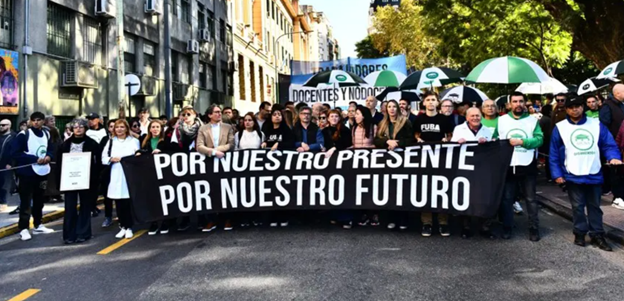
Above photo: Demonstrations across Argentina call for increased funding for public universities. @tiempoarg.
More than 50 public universities in Argentina held a 24-hour strike on Monday, combining walkouts with open classes and public forums to demand increased state funding and wage adjustments. The mobilization will continue Tuesday with activities across faculties, institutes, and university hospitals.
Organized under the slogan “No more wages below the poverty line,” the action brought together faculty, non-teaching staff, and students. The University of Buenos Aires Teachers’ Association (Aduba), the University of Buenos Aires Staff Association (Apuba), the Federation of University of Buenos Aires Teachers (Feduba), and the University Education Workers’ Union–CTERA coordinated the protest, pressing for salary increases, expanded budget allocations, and the approval of the University Financing Law.
The bill, passed by the Chamber of Deputies and awaiting Senate review, would raise the national budget for public universities and adjust salaries for both teaching and non-teaching staff. A report by the Ibero-American Center for Research in Science, Technology and Innovation (Ciicti) and the Federation of University Teachers (Fedun) found that real investment in national universities fell 22.1% in 2024, with a further decline of 8.6% projected for 2025.
Más de cincuenta universidades públicas argentinas protagonizan una nueva jornada de protesta para exigir mayor financiamiento, con una huelga de 24 horas, clases públicas y charlas abiertas.https://t.co/8REy3CId9C
— EFE Noticias (@EFEnoticias) August 11, 2025
Government austerity measures under President Javier Milei have reduced university funding to 0.5% of GDP—the lowest since 2005. Protests began earlier this year after the administration implemented its “shock” economic plan, affecting education and other public sectors. In 2024, Congress approved a law to boost university funding, but Milei vetoed it, citing the need to maintain a fiscal surplus.
Public higher education in Argentina has been free since 1949, enabling broad access for students nationwide. Nearly two million students are enrolled in state-funded universities, compared with about 500,000 in private institutions. According to official data from late 2024, 44.9% of Argentines aged 15 to 29 live in poverty, underscoring the role of free education in widening access to higher learning.