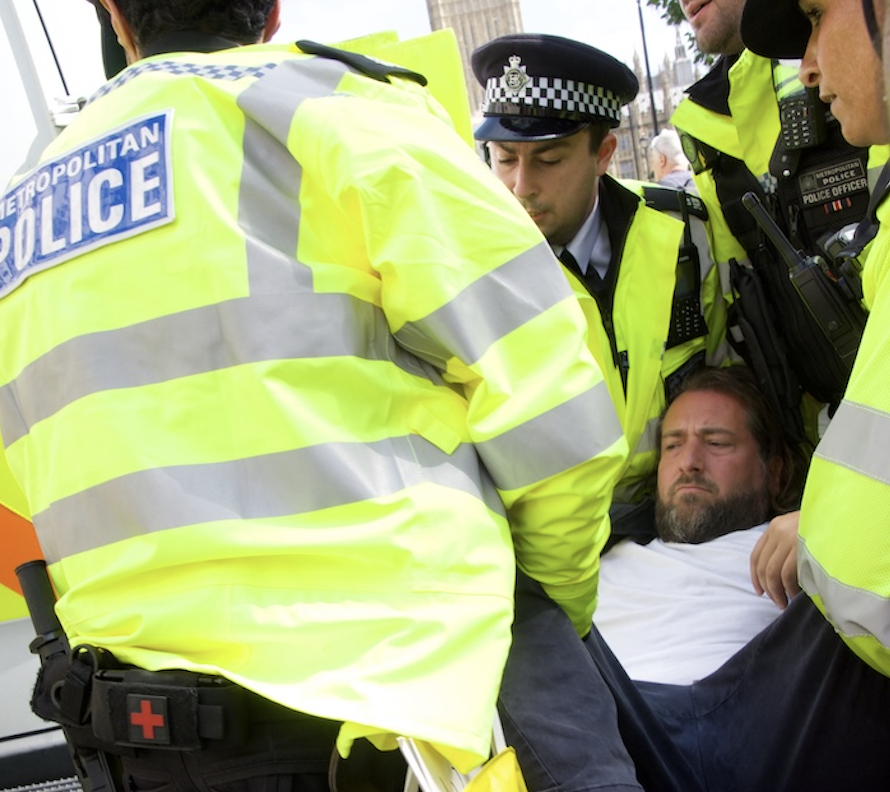
Above photo: Police on Sept. 6 arresting a demonstrator in London who was protesting against the proscription of Palestine Action as a terrorist organization. indigonolan /Flickr.
The justification, precedence, thinking and tactical logic behind a longstanding means of confronting unjust systems and laws.
Australian psychiatrist and author Dr. Niall McLaren believes civil disobedience presents a means of stopping domination hierarchies in a society spiraling towards outright fascism.
McLaren believes humans have a natural disposition towards forms of domination and if left unchecked, a political system of “narcisso-fascism” arises. McLaren told In Context:
We see this playing out in the world every day, but none clearer than in the U.S., where their president is obsessed to the point of mania with forcing everybody to do as he tells them: ‘Do as we say or we’ll slap tariffs and sanctions on you, we’ll deport you or blow you up.’ He doesn’t care how much he damages people or even his own country, as long as he can order people around, he’s happy. As is typical, he constantly tests the limits.
Similarly, in order to block criticism of the Israeli genocide, the U.K. government has proscribed a non-violent organisation, Palestine Action, as terrorist. Citizens are outraged and are deliberately flouting this unjust law to get arrested. However, instead of admitting they made a mistake, the government has intensified its efforts to suppress opposition.
Civil disobedience is based in the ancient idea known as lex iniusta non est lex — an unjust law is not a law. Any individual law must be consistent with the over-arching principle of universal justice.
“Civil disobedience is the last, inalienable right and duty of citizens to prevent the growth of tyranny.”
Zombie Societies Marching Towards Doomsday
Championing civil disobedience as a means of arresting civilisational collapse and barbarism has a long history.
In the 1950s, psychoanalytic theorist and author Erich Fromm argued civil disobedience was a necessary virtue and that our capacity to criticise and disobey may be all that stands between human progress and the end of civilization.
His concept of “bureaucratic Man” describes an alienated conformist who has lost the capacity for critical thought and genuine feeling or conviction, whose behaviours are managed and manipulated by powerful forces of the state propaganda and market advertising.
Fromm argues in part that conscientious acts of civil disobedience challenge the deadening and dehumanising effects of a bureaucratic, consumerist society, having the potential to jolt citizens out of their collective slumber to build a more democratic and humanistic society.
He warned that blind obedience to authority, on the other hand, could lead to humanity’s annihilation, with nuclear war posing a particular danger.
That danger is increasing today. NATO is pushing Western nations to militarise their societies, as it plans to confront “strategic adversaries” across what it calls a “multi-domain” environment.
In other words, it is making the social, economic, political, informational and educational realms of society arenas of war, as the Western power bloc attempts to challenge new “multipolar” centres of power now taking shape, which are challenging the U.S.-led imperial “rules-based” system.
For anyone who wants to appreciate the unhinged and dangerous nature of this strategic vision, watch informational videos released by NATO itself.
Such a totalising vision of war is beginning to have devastating effects on Western societies, as propaganda, censorship, state surveillance and criminalisation of protests and dissent erodes basic civil liberties.
Annual threat assessment reports from across the Five Eyes partner nations of Canada, the U.S., the U.K., Australia and New Zealand make clear domestic-spy-agency concerns of increasing social unrest among their own populations, as domestic political systems fail to implement policies in their interests of ordinary people.
Massive increases in military spending at the expense of social programs will likely increase such tensions. In the case of countries like the U.K. and Germany, this militarism poses a threat to the very existence of their welfare states.
Wide-ranging propaganda campaigns are now underway to convince Western publics of the necessity of military spending hikes amounting to 5 percent of GDP of NATO members, grossly inflating threats posed by Russia and China.
Western think-tank papers that have informed U.S. geopolitical policy over decades advocate strategies of containment of rising powers like China and Russia, as their economies grow alongside a corresponding ability to defy the diktats of Western institutions imposing policies of neo-colonial extraction and under-development.
These strategies have led to an escalating proxy war with Russia, genocide in defence of Israel’s apartheid settler colony in West Asia, encirclement of China by NATO-aligned frontline states, and regime-change operations against sovereign nations like Venezuela and Iran.
With the collapse of any semblance of a functioning U.N. multilateralism and instruments of international law, as well as severe democratic deficits within Western states, acts of civil disobedience by citizens are increasing.
From the student encampments that started across U.S. universities protesting the Israel-U.S. genocide of Palestinians, to damage to arms manufacturer sites in the U.K. by the terror-designated group Palestine Action, ordinary people are making their voices heard.
This trend is evident in New Zealand.
Civil Disobedience and the Courts
Young people like Joseph Bray have been engaged in protests that have included occupying defense contractor sites and damaging property (see Part I of this article).
In a written affidavit to the court used by Bray’s defence team, Jeremy Moses, a professor of international studies and political science at the University of Canterbury, said violence in Gaza had “unsurprisingly prompted large-scale global protest that has taken many forms” and that Western states’ failure to intervene had increased a sense of injustice and need for citizens themselves to act.
The statement added:
It is to be expected that many young people will engage in these actions in defence of basic principles of human rights and anti-genocide sentiment. While there will be limited cases where those actions cross the bounds of legality, I believe that larger values of human rights and human conscience should be at the centre of decision-making and that leniency toward these protestors will, in the long-term, be viewed as serving justice.
Moses isn’t the only scholar who believes leniency is appropriate in such cases.
U.S. legal scholar and theologian Professor Gary Chartier told Mick Hall In Context that civil disobedience against what people take to be unjust laws or policies seemed “understandable, often defensible, and in some cases laudable.”
The distinguished professor of law and business ethics and associate dean of the Zapara School of Business at La Sierra University said:
Sometimes, this kind of activity will involve no injury to persons or to non-state property and in this case, I would absolutely encourage judges to be as accommodating as possible.
In particular, I hope judges would take seriously the ways in which symbolic violations might be primarily expressive in nature and thus merit protection as communicative acts — say, for instance, when someone symbolically ‘trespasses’ onto the grounds of a missile base to protest war.
The challenge obviously arises in connection with the occurrence either of violence or of civil unrest with the serious potential to give rise to violence. Judges certainly need to be sensitive to the need to restrain the violent and those who might recklessly foster violence.
Michael Dorf, professor of law at Cornell Law School, said prosecutors and judges in the U.S. typically had considerable discretion concerning, respectively, charges and sentencing.
A similar discretion is evident in other Western countries, including New Zealand. In 2010, those involved in the Waihopai spy base attack case were found by a jury not guilty of intentional damage and entering a property with intent to commit a crime. Adrian Leason, Fr Peter Murnane, and Sam Land had argued they had acted to save lives.
On the other hand, Auckland District Court denied barrister Hannah Swedlund a discharge without conviction in September after she was charged with intentional damage to several government officials’ electorate offices in 2023, including that of Prime Minister Christopher Luxon.
Swedlund had been arrested in February 2024 with two others after several actions protesting New Zealand complicity in genocide.
“One sees a spectrum of attitudes,” Dorf says, adding:
Some prosecutors and judges show leniency to those engaging in civil disobedience, recognizing that those who engage in it do not pose a general threat to public safety and are acting out of public-regarding motives. At the other end, some prosecutors and judges use the full force of the law to punish and, they hope, deter future acts of civil disobedience, which they regard as at best a nuisance.
Less commonly, one sees an intermediate attitude rooted in the tradition of civil disobedience itself, as exemplified by Henry David Thoreau, Mahatma Gandhi, and Martin Luther King, Jr. In that tradition, a person engaging in civil disobedience willingly accepts punishment as part of the civil disobedience itself. Judges who sentence persons for acts of civil disobedience in this tradition typically impose light but non-trivial sentences.
Suffering and Conversion
Charles DiSalvo, professor of law at West Virginia University, points out it may be more beneficial for the causes of those engaged in civil disobedience to be treated harshly by the justice system.
From a strategic point of view, the leveraging of suffering endured as a consequence of civil disobedience and direct action may ultimately drive a new mass political and moral consciousness in society.
DiSalvo distinguishes between direct and indirect civil disobedience, one aiming at the laws that are being broken and the other aimed at targets which typically have nothing to do with the laws being broken.
“In the United States, think of the Freedom Rides and the lunch counter sit-ins in the 1960s,” he told In Context:
The laws blacks broke — prohibiting them from using buses and restaurants open to all other members of the public — were the very evils they were attacking. In these instances, courts had to make decisions as to whether the laws the blacks were prosecuted for breaking were valid. As you know, the courts, in the end, found the laws unconstitutional and invalidated the convictions the blacks sustained in the lower courts.
With indirect disobedience, disobedients need to understand that their disobedience will have little if any effect without suffering. It actually would be counter-productive on their part to seek leniency.
A case in point is the U.S. women’s suffrage movement, he says.
The women were arrested and shown no leniency. They were made to suffer in prison. The result of that suffering? The public sympathised. That put pressure on the politicians. The politicians converted and enacted a curative institutional measure — in this instance an amendment to the U.S. Constitution giving women the right to vote.
There’s one formula for successful indirect civil disobedience: suffering, sympathy, conversion, curative institutional change.
If the judges adjudicating the charges against the women had acted with leniency, rather than applying the law, the women would not have suffered. No suffering, no sympathy. No sympathy, no pressure on politicians to convert. No conversion, no change.
Mick Hall is an independent journalist based in New Zealand. He is a former digital journalist at Radio New Zealand (RNZ) and former Australian Associated Press (AAP) staffer, having also written investigative stories for various newspapers, including theNew Zealand Herald.