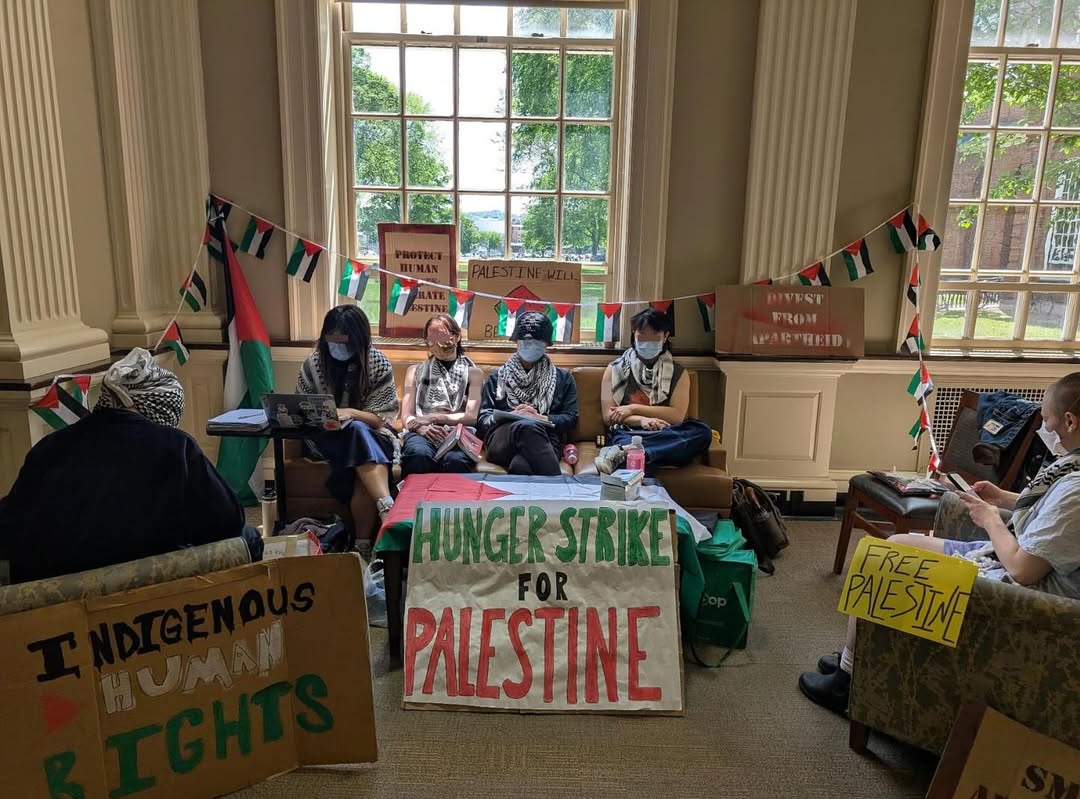
Above photo: Dartmouth hunger strikers. The Palestine Solidarity Coalition at Dartmouth Instagram.
Students at Dartmouth College have launched a hunger strike to demand that the school divest from Israel.
And lift the suspension of a student activist.
Last week, six Dartmouth College students began a hunger strike in support of Gaza.
The activists are demanding that Dartmouth’s Board of Trustees approve the Dartmouth Divest for Palestine divestment proposal, which was recently rejected by the college. They’re also calling for the school to lift its suspension of student Roan Wade, who was targeted over their involvement in campus protests.
Mondoweiss U.S. correspondent Michael Arria spoke with Wade, and fellow hunger striker Greyson Xiao about the hunger strike. Both students are members of the Palestine Solidarity Coalition.
Mondoweiss: Can you talk about the demands of the strike and what led you to this action?
Xiao: The indefinite hunger strike started at noon on Tuesday, June 3. It was announced at a rally for divestment, and our key demands for this action are that the Dartmouth Board of Trustees vote to pass the divestment proposal and that the administration overturn Roan Wade’s suspension.
This action is coming out of recent escalations in Palestine. Netanyahu announced a total blockade of aid to Gaza on March 2 and later walked it back to allow “minimal aid” only as plausible deniability to then airstrike those aid sites. For Palestinians, it’s all the same. They either starve to death or get lured to food sites just to get bombed. The UN has reported that 100% of Gazans are on the brink of famine. Students took these escalated actions in solidarity with Gazans. A sit-in was staged last week at the college administrative building, Parkhurst Hall, and that action led to Roan’s suspension without due process.
The divestment proposal we submitted was also recently rejected on all criteria. Thus, the college has shown us it will not bargain with us in good faith or dialogue.
Wade: The divestment movement existed before October 7 here. There has been an active Palestine Solidarity Coalition chapter for years now. We launched an encampment in October of 2023. We again engaged in a hunger strike that winter to push the college towards divestment.
We went on a hunger strike for two weeks and got minor concessions from the college that they didn’t follow through on. In May 2024, we launched our second encampment, at which almost 90 people were arrested.
Since then, we’ve continued to mobilize and protest for Palestine and divestment. In February, we submitted a divestment proposal tailored to align with the institutional mechanisms to achieve divestment.
This proposal was explicitly made to align with the college’s procedures. However, they rejected it on all criteria, making it abundantly apparent that working within institutional systems is not a mechanism to achieve divestment.
So, we decided to engage in more disruptive protests. Students launched another encampment on May 1 this year, followed by a sit-in last week. After that sit-in, I was placed on immediate suspension without due process and without evidence being provided because the college believed the action to be violent, even though it was entirely peaceful.
The only violence came from the campus cops, who violently threw a Jewish student protester to the ground. There’s a pattern at Dartmouth with these false characterizations of any solidarity with Palestine as being violent.
This mischaracterization perpetuates further violence against the Palestinian community in Vermont and New Hampshire by depicting solidarity with Palestine as violent.
I was suspended immediately over my continued protest for divestment since October 2023. I was given no time to get my belongings. I was banned from Dartmouth-owned properties and prohibited from all Dartmouth-affiliated properties, which, in rural New Hampshire, unfortunately, Dartmouth seems to own everything. I lost the employment that I had been working at for three years. I’ve lost my access to food. They did this knowing that I’m a low-income student who relies on the financial aid I received from the college to meet my basic needs.
This is a pattern of continued repression against the student movement for Palestine on campus. The college thinks that if they suppresses us enough, it will stop us from advocating for divestment, which is not true.
Can you talk about what about what you’re hearing from the administration, insofar as they’ve responded to this activism?
Wade: The college claims to have institutional channels through which we can achieve divestment. Unfortunately, it’s become abundantly clear that these institutional channels are a facade.
We had submitted this proposal. A coalition of faculty, staff, community members, and alums wrote this 55-page document and adhered to their criteria for divestment, outlining a divestment plan for six weapons manufacturers.
This effort went unanswered for months, despite our continued mobilization. It wasn’t until we erected an encampment on May 1 of this year that we could win some material concessions from the college.
Firstly, they agreed to respond to our proposal by May 20. They did respond by then, and as we said, they rejected it.
The second win was that the college agreed not to allow ICE on campus unless provided with a warrant signed by a district court judge. They also agreed to establish a $5,000 legal support fund for international and non-citizen students. This was a significant win for us, as these students have been highly involved in the movement.
The increase in crackdowns on international and non-citizen students from the Trump administration makes solidarity between the movement for Palestine and the movement against deportations and against ICE deeply intertwined.
We view these things as deeply connected, and there needs to be deep solidarity between these movements.
Ultimately, our institutions are invested in and profit from the ongoing genocide, so working within these institutional systems fails every single time. So we need to look towards what has worked throughout history, and that is disrupting business as usual, regardless of whether or not the college sanctioned it.
That was the motivation behind the actions at the sit-in: Students successfully disrupted business as usual for the Dartmouth administration for at least one day. The goal of a hunger strike is to continue to force the administration to confront its complicity and, hopefully, disrupt business as usual.
Xiao: The institution is panicking.
We saw that in the response to the sit-in. They immediately sent out this, likely, premeditated campus-wide email to students, parents, and alums, characterizing the action as violent, alleging that there was property damage and physical violence against administrators. When we see, time and time again, that Dartmouth is the violent party, not just toward students but toward Palestinians and victims of the global war crimes they fund.
The sit-in started this new string of repressive events, including Roan’s suspension. An alum group, the Black Alumni of Dartmouth Association, had just sent out a letter displaying the students’ statement from the sit-in alongside Dartmouth’s statement. They weren’t even taking a position, but the college immediately cracked down on them and suspended the group. Alumni Relations hacked the group’s email and sent a letter restating the college’s account of the action. The administration admits they lie because a neutral presentation of the facts threatens them.
We’ve rallied many more people recently because of the college’s repressive actions. Everything they’re doing inadvertently strengthens the movement and the resistance against the administration.
The hunger strike also comes at a time when attention on the college is high. Commencement and reunions are coming up at the college, and we’re hoping to apply pressure leading up to and at those events to push for divestment.
What’s the state of Palestine activism on campus? Is it a large movement? Are there many pro-Israel groups organizing as well?
Wade: The movement for Palestine on campus is very active and strong. We’ve invested a lot of time and energy into building strong coalition networks and worked closely with the community off campus. We often isolate ourselves from the broader community, especially at Ivy League and private universities, so we’ve put a lot of energy on that front.
I would not say that there is a strong movement for Israel on this campus because the administration is very much in alignment with Israel, so there’s not much for the pro-Israel group on campus to win.
Has activism on campus shifted in response to the Trump administration’s targeting of students? Have you needed to recalibrate your strategies?
Wade: Over the last 19 months, many people have realized that working within institutional systems is not viable. Many people have become increasingly disillusioned with our universities and the idea that they align materially with the values they claim to have.
Materially, this has meant emphasizing deep organizing rather than shallow organizing. There’s this idea that we must organize and build an inch wide, a mile deep, rather than just at the surface level.
The people who organize our college campuses are very, very dedicated. We probably put 10+ hours into organizing every week and take security culture very seriously. We understand the need to build deep networks of trust within our organizing apparatus because we know that we are, in a sense, operating in enemy territory, that the university is cracking down on us materially and violently. Hence, we need to prioritize keeping each other safe as activists.
That said, we’ve looked deeply into the history of social movements on our campus and what has worked. We look a lot towards the movement for divestment from South African apartheid here at Dartmouth in terms of informing our tactics. We’ve exercised almost every tactic, from signing petitions to going to office hours, talking directly to the board of trustees, and going on a hunger strike. This is our second hunger strike. We’ve had three encampments, sit-ins, and we’ve tried everything.
I think the plan is to continue to try everything until Dartmouth capitulates and meets our demands of divesting from weapons manufacturers that are fueling the mass slaughter of our peers in Gaza.
Xiao: The college has definitely been changing its tactics to repress the student movement. Instead of arresting protesters, as it has in the past, it is shifting towards more disciplinary action.
Strategically, this is where this hunger strike came out of. It’s a respectable and palatable action that does not explicitly violate any of the college’s rules but still forces the administration to contend with the human toll of their actions and investments.
However, this does not mean limiting ourselves to respectable and palatable actions. If anything, as Dartmouth has gotten more militant in their repression, we have also gotten more militant in our resistance and more explicitly pro-resistance in our rhetoric about Palestine. Over the past 20 months, we have learned that holding ourselves to peaceful protest and the college’s definition of acceptable dissent is futile, as the administration will characterize us however they please. It is also unprincipled to reject militancy if we are to truly stand in solidarity with Palestinians on the front lines of an ongoing global counter-war against empire.
By experimenting with diverse tactics, we also garner knowledge about how the college reacts in different circumstances, so we can continue building a movement. University organizing can be challenging because it’s transient, with people shifting in and out every four years. Dartmouth thinks it can exploit this transience and suspend students to stamp out our movement. So we are building on strategies deployed in the history of organizing at Dartmouth and continuing to build up that archive for those that will come after, because the struggle will always persist.
We believe that repression breeds resistance.
Can you talk about the significance of a hunger strike in responding to the current situation in Gaza?
Wade: Many students across the country are engaging in hunger strikes because of the continued starvation of people in Gaza. We need to highlight that the actions of the college are helping to starve people in Gaza. They’re complicit in the blockade of food and vital resources.
So, for us, it’s important to force them to see the material impact of their actions. Seeing us starving every day is a mechanism to highlight and bring that issue into conversation on our campuses.
Fundamentally, even though we are hunger striking, we are in a much better position than our peers in Gaza. We still have roofs over our heads.