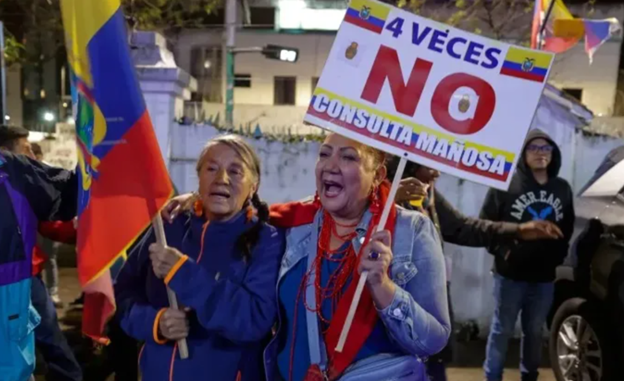
Above photo: Election day, which brought out more than 13.9 million Ecuadorians, passed peacefully. EFE.
The “No” vote won in the referendum across the country.
What did Ecuadorians reject?
The results of the popular consultation and referendum in Ecuador, held this Sunday, gave a clear advantage to the “No” option on the four key questions promoted by the government of US backed President Daniel Noboa, in a day characterized by high citizen participation. The initiatives promoted by President Noboa, supposedly focused on “protecting national sovereignty”.
According to data from the National Electoral Council (CNE), with more than 90% of the votes counted, the “No” vote exceeds 52% of the votes. This rejection is concentrated on the proposals to allow the installation of foreign military bases, eliminate state funding for political parties, reduce the number of assembly members, and convene a Constituent Assembly.
Given the trend in the results, former presidential candidate for the Citizen Revolution, Andrés Arauz, stated that the “No” vote is winning everywhere. Through his social media accounts, Arauz called on public servants to prevent what he denounced as “Operation Tello,” a maneuver to manipulate the election results.
Election day, which drew more than 13.9 million Ecuadorians to the polls, passed peacefully. Photo: EFE
More than 60% of the electorate voted “No” on the first question, regarding the possibility of eliminating the constitutional ban on foreign military installations and the transfer of Ecuadorian bases to international forces.
The response of the citizenry in defense of national sovereignty was emphatic and represents a major setback for the Ecuadorian president, who in early November had already visited, together with U.S. Secretary of Homeland Security Kristi Noem, two sites considered strategic for the potential installation of bases, in the towns of Manta and Salinas.
In this regard, former presidential candidate Luisa González stated that “the people are saying ‘no’ to a government that wants to turn Ecuador into the Noboa corporation.” González argued that the result is a massive defense of national sovereignty and the rights enshrined in the Montecristi Constitution approved in 2008 during the administration of Rafael Correa.
The political leader emphasized that the proposal to convene a Constituent Assembly sought to “appropriate Ecuador’s strategic natural resources” and “make employment precarious.” She also asserted that the verdict at the polls is “a resounding rejection of Daniel Noboa,” demonstrating that the public does not trust the right-wing president’s administration.
Election day, which drew more than 13.9 million Ecuadorians to the polls, passed peacefully. The president of the CNE noted that voter turnout exceeded 80%. The preliminary result represents a significant political setback for the Noboa administration, which sought to validate its full alignment with Washington’s policies through popular support.
This referendum took place amid an unprecedented surge in violence, which authorities attribute to the strengthening of drug trafficking and criminal gangs. Despite the declaration of “internal armed conflict” and the classification of these groups as terrorists, homicides continue to rise. According to official data, the current year 2025 has already become the most violent in Ecuador’s history.
The ABCs of the referendum and popular consultation.
There were four questions on the ballots received by the more than 10 million citizens who went to the polls on November 16. With more than 96 percent of the votes counted, the “No” vote won on all four issues raised by President Noboa, which included the re installation of foreign military bases and other political issues.
The four referendum questions on the ballot were:
Box A – Do you agree with lifting the ban on establishing foreign military bases or foreign facilities for military purposes, and with ceding national military bases to foreign armed or security forces, partially reforming the Constitution in accordance with the Annex to the question?
Box B – Do you agree with eliminating the State’s obligation to allocate resources from the General State Budget to political organizations, partially reforming the Constitution in accordance with the Annex to the question?
Box C – Do you agree with reducing the number of assembly members and electing them according to the following criteria: 10 national assembly members; 1 assembly member elected by each province; and 1 additional provincial assembly member for every 400,000 inhabitants according to the latest national census?
Box D – Do you agree that a Constituent Assembly should be convened and installed, whose representatives are elected by the Ecuadorian people, in accordance with the electoral rules set forth in the attached Constituent Statute, to draft a new Constitution of the Republic, which will only come into force if it is subsequently approved by the Ecuadorian people in a referendum?