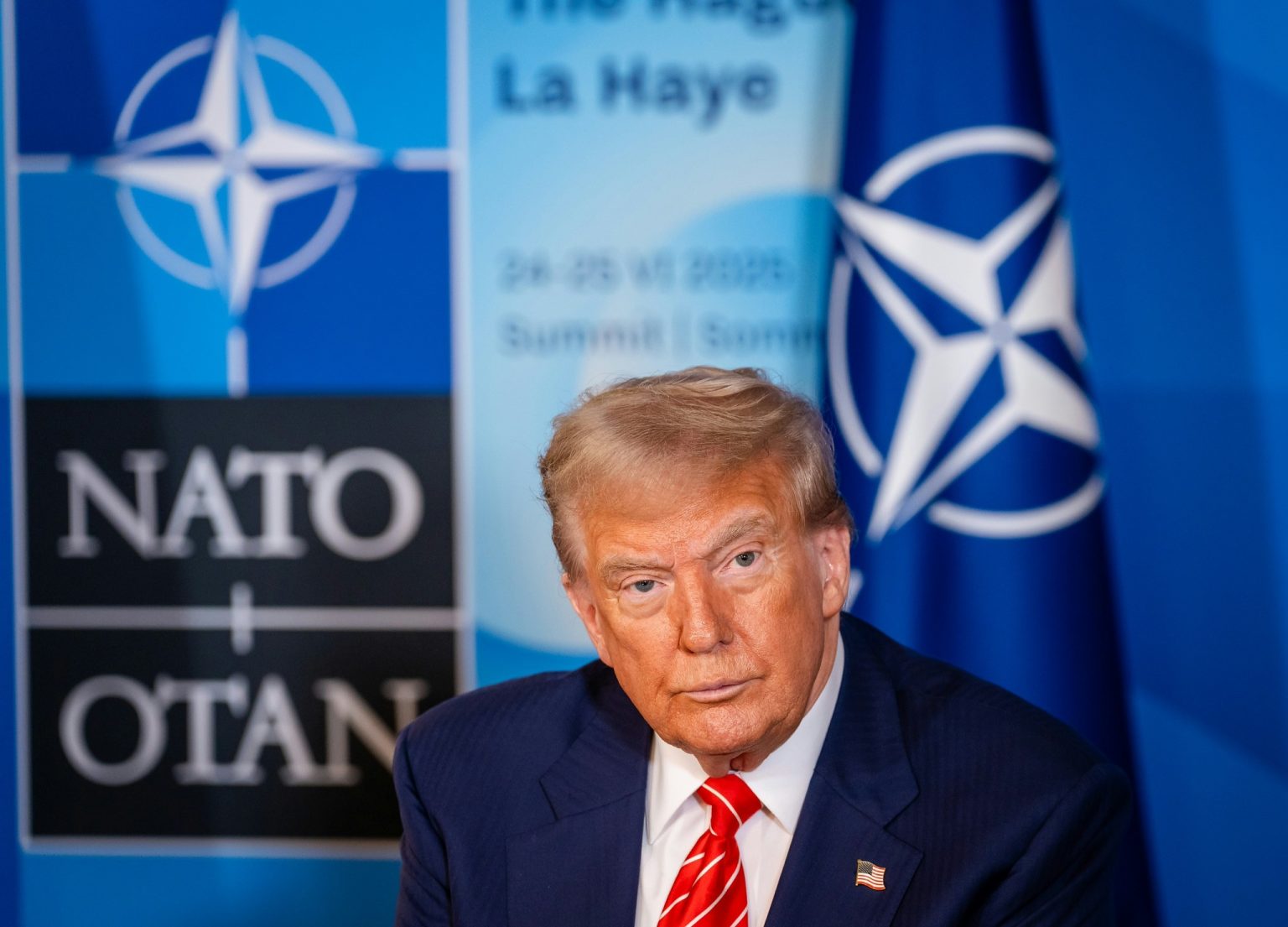
Above photo: U.S. President Donald during a meeting with NATO Secretary General Mark Rutte in The Hague in June. Martijn Beekman / NATO / Flickr.
Alastair Crooke on the Trump administration’s most recent National Security Strategy.
Which critiques U.S. pursuit of global primacy as a failure.
A National Security Strategy (NSS) is produced periodically by U.S. administrations (President Donald Trump authored one during his first term). Mostly these documents lay out an idealised version of an administration’s foreign and security policy, and do not have great practical import — because of what is left out — i.e. entrenched U.S. political and economic interests; the deep foreign policy consensus overseen by the curator class of the deep security state; and the policies espoused by the mega donor collective.
Nonetheless, this recently-released NSS reads rather differently by putting a distinctive “America First” gloss to U.S. foreign policy, eschewing global hegemony, “domination” and ideological crusades, in favour of pragmatic, transactional realism focused on protecting core national interests — homeland security, economic prosperity, and regional dominance in the Western Hemisphere.
The U.S. thus will “no longer prop up the entire world order like ‘Atlas’ and expects Europe to shoulder more of its own defence burdens,” the NSS says.
It critiques the U.S.’ earlier pursuit of global primacy as “a failure” that ended up weakening America — and situates Trump’s policy as a “necessary correction” to the earlier stance. It therefore accepts the tilt towards a multipolar world.
Two key foreign policy aims are nuanced rather than radically recast:
First, China is downgraded from “primary threat” and “pacing threat” to economic competitor (Taiwan is treated as an instrument of deterrence).
In respect to Russia, it says:
“It is a core interest of the United States to negotiate an expeditious cessation of hostilities in Ukraine, in order to stabilize European economies, prevent unintended escalation or expansion of the war, and reestablish strategic stability with Russia, as well as to enable the post-hostilities reconstruction of Ukraine to enable its survival as a viable state”.
The document does not mention “strategic peace” with Russia, but only a “cessation of hostilities,” i.e. a ceasefire. The careful choice of language used may signal that Trump does not intend a full settlement with Russia on its security concerns, but only a truce, a “cessation of hostilities.”
It terms European relations with Russia as “deeply attenuated”:
“The Trump Administration finds itself at odds with European officials who hold unrealistic expectations for the war perched in unstable minority governments, many of which trample on basic principles of democracy to suppress opposition. A large European majority wants peace, yet that desire is not translated into policy, in large measure because of those governments’ subversion of democratic processes. This is strategically important to the United States precisely because European states cannot reform themselves if they are trapped in political crisis.”
Essentially, Ukraine is pushed on the Europeans as their responsibility from now on. More generally, Allies are expected to foot the bills — as the U.S. builds at home.
One of the biggest NSS shifts is that America is defined now as a fortified hemisphere power in place of a global hegemon:
“We want a Hemisphere that remains free of hostile foreign incursion or ownership of key assets, and that supports critical supply chains; and we want to ensure our continued access to key strategic locations. In other words, we will assert and enforce a ‘Trump Corollary’ to the Monroe Doctrine.”
In terms of military presence, the Strategy states that this entails “a readjustment of our global military presence to address urgent threats in our Hemisphere.”
Perhaps the most meaningful aspect — in terms of practical impact — is the reference to “ending NATO as an ever-expanding alliance,” and to Europe, which is critiqued in the most astringent terms.
The NSS is highly critical of Europe’s economic stagnation, its demographic decline, the loss of sovereignty to EU institutions and its “civilizational erasure”:
“We want Europe to remain European, to regain its civilizational self-confidence, and to abandon its failed focus on regulatory suffocation,” it says.
The document declares the liberal/technocratic elites of the EU and many member states to be a threat to Europe’s future, regional stability — and to American interests. It makes it clear that supporting the Patriotic Right in Europe, and “cultivating resistance” to Europe’s current trajectory are in the American interest.
It calls out population replacement (immigration) as the gravest long-term threat to Europe and American interests, openly questioning whether some European nations will remain reliable allies given their current trajectory.
The transatlantic relationship therefore remains in place but is no longer the centrepiece of U.S. foreign policy.
The European Elite’s Panic
European leaders, including former Swedish PM Carl Bildt, said the NSS reference to Europe was “to the Right of the extreme Right.” In the U.S., Democrats, such as Rep. Jason Crow, deemed it “catastrophic” for alliances, i.e. for NATO.
To understand fully the panicked outcry issuing forth from Europe, a little context is required.
Liberal-woke identity politics allowed no “otherness,” no difference of opinion.
Washington Post columnist and MSNBC contributor Jennifer Rubin (long cited by the Washington Post as their “Republican columnist” for “balance”), writing in September 2022, rejected the very notion of an argument having “sides” since any contrary argument imputed a rationality to conservatives:
“We have to collectively, in essence, burn down the Republican Party. We have to level them — because if there are survivors, if there are people who weather this storm, they will do it again … The Kabuki dance in which Trump, his defenders and his supporters are treated as rational (clever even!) comes from a media establishment that refuses to discard … this false equivalence.”
And then-President Joe Biden, in a speech that same month, said pretty much the same as Rubin.
In a set-up bathed eerily in red and black light, at the historic Independence Hall, Biden unequivocally extended the threats from abroad to warn against the threat of a different terror, closer to home — from “Donald Trump and the MAGA Republicans,” who he said, “represent an extremism that threatens the very foundations of our republic.”
The core precept to this apocalyptic message duly crept across the Atlantic to capture and convert the Brussels’ leadership class. This should not be surprising: The EU’s regulation-based internal market was precisely intended to replace all political “contention” with Tech-Managerialism. The Euro-élites were in desperate need of a Values System to fill the EU identity lacuna.
The solution, however, was at hand [as Biden spoke in Warsaw on the first anniversary of the war in Ukraine on Feb. 21, 2023]:
“Appetites of the autocrat cannot be appeased. They must be opposed. Autocrats only understand one word: ‘No.’ ‘No.’ ‘No.’ (Applause.). ‘No, you will not take my country.’ ‘No, you will not take my freedom.’ ‘No, you will not take my future … A dictator bent on rebuilding an empire will never be able to ease [erase] the people’s love of liberty. Brutality will never grind down the will of the free. And Ukraine — Ukraine will never be a victory for Russia. Never. (Applause)
Stand with us. We will stand with you. Let us move forward … with an abiding commitment to be allies not of darkness, but of light. Not of oppression, but of liberation. Not of captivity, but, yes, of freedom.”
Biden’s later speech in Warsaw — complete with lighting effects and a dramatic backdrop reminiscent of his Liberty Hall speech — sought to portray the domestic MAGA opposition as a grave security threat to America and leant on radical Manichaeism to depict — this time — Russia (Russia being the external counterpoint to the related U.S. MAGA threat). This was his framing to the epic battle between the forces of light and of darkness that needed to be fought endlessly and won crushingly.
Once again, Biden was trying to cement America’s deep-seated missionary ethos as the “City on the Hill” a beacon to the world — to a “forever” cosmic war against Russian “evil.” He hoped to tie the American ruling class to the metaphysical struggle for the “light.”
David Brooks, author of Bobos in Paradise and a New York Times columnist, admits that initially he was taken by this liberal ideology, but later admitted this was a big mistake:
“Whatever you want to call them [the liberals] have coalesced into an insular, intermarrying Brahmin élite that dominates culture, media, education and tech.”
He acknowledges:
“I didn’t anticipate how aggressively … we would seek to impose élite values through speech and thought codes. I underestimated the way the creative class would successfully raise barriers around itself to protect its economic privilege … And I underestimated our intolerance of ideological diversity.”
Put plainly, this thought-code precisely gave the Euro-élites their shiny new cult of absolute purity and stainless virtue — filling for the EU its all too evident identity-gap lacuna. It resulted in the summoning of a vanguard whose proselytizing fury is to be focused on “the Other.”
Ursula von der Leyen, president of the European Commission, in her “State of the Union” address to the European Parliament in 2022, echoed Biden almost exactly:
“We should not lose sight of the way foreign autocrats are targeting our own countries. Foreign entities are funding institutes that undermine our values. Their disinformation is spreading from the internet to the halls of our universities … These lies are toxic for our democracies. Think about this: We introduced legislation to screen foreign direct investment for security concerns. If we do that for our economy, shouldn’t we do the same for ‘our values’? We need to better shield ourselves from malign interference … We will not allow any autocracy’s Trojan horses to attack ‘our democracies’ from within’.”
Despite the cleaving together of the American “Bobos” with the EU liberal warriors, many around the world nonetheless were astonished at the sheer alacrity by which the leadership in Brussels embraced the Biden line advocating for a long war against Russia — a compliance that appeared so clearly to run contrary to European economic interests and social stability.
Simply put, it was a war of choice that seemed to be rooted ultimately in radical Manicheanism.
NATO ‘Transmitting Democracy’
The initial formation of NATO in 1949 was generally opposed by the European Left due to its explicit anti-communist stance. However, with NATO’s bombing of Belgrade in 1999, the military alliance metamorphosed for some on the broader Left (including social democrats and liberals) as an instrument for liberal transmission and consolidation of “our democracy” (this was Biden’s language at the time).
The fusion of the EU leadership to NATO and with the Biden project was complete. Germany’s foreign minister at the time, Annalena Baerbock — every bit as intent on “ruining Russia”as Biden — in an address in New York in August 2022, sketched out a vision of a world dominated by the U.S. and Germany.
In 1989, President George Bush famously offered Germany a “partnership in leadership,” Baerbock claimed. But at the time, Germany had been too busy with reunification to accept the offer. Today, she said, things had changed fundamentally: “Now the moment has come when we have to create it: A joint partnership in leadership.”
Harking on the “leadership partnership” being understood in military terms, she said:
“In Germany, we have abandoned the long-held German belief in ‘change through trade’ … our goal is to further strengthen the European pillar of NATO … and the EU must become a Union capable of dealing with the United States on an equal footing: in a leadership partnership.”
Thus, the European élite’s outcry at the NSS’ devastating critique of Europe is not just that of America very obviously turning its back on an European ruling class who had dropped all to fawn on America. The NSS castigates their subversion of democracy — and even questions whether they will be suitable as allies for the future.
NATO is now declared to be not forever.
The European ruling strata now stand isolated, widely unpopular and bereft.
Alastair Crooke is director and founder of Conflicts Forum, based in Beirut. He was formerly advisor on Middle East issues to Javier Solana, the EU foreign policy chief.