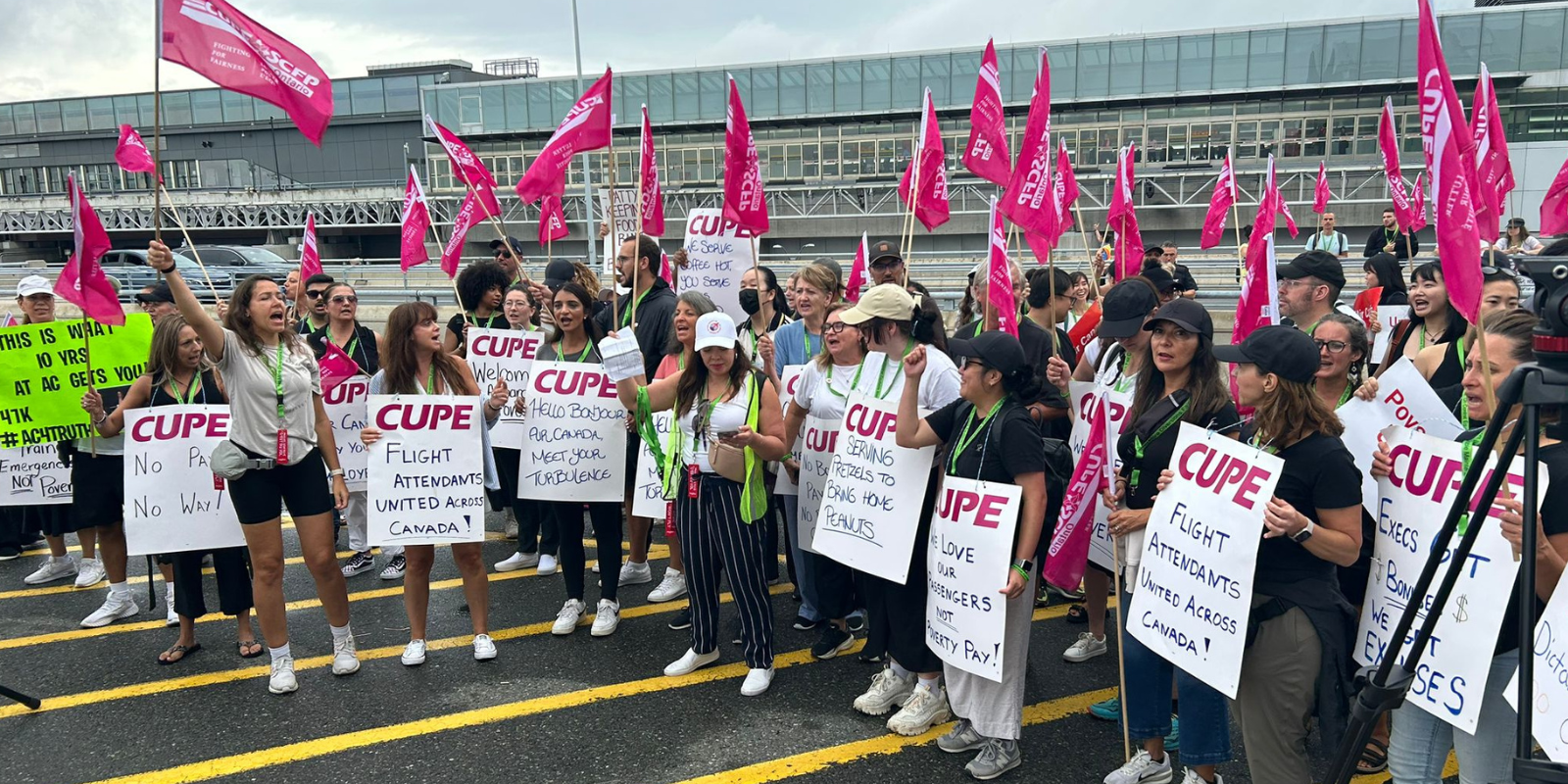
Above photo: Flight attendants rally outside of Pearson International Airport in Toronto on Sunday, August 17. Bea Bruske / X.
‘If our union is fined, so be it.’
Labour leaders say that the government is violating their Charter Rights to negotiate with their employer.
Labour leaders are condemning the federal government’s usage of Section 107 of the Canada Labour Code to end a strike by Air Canada flight attendants.
The flight attendants, who are represented by the Canadian Union of Public Employees (CUPE) are seeking higher wages and an end to unpaid labour. Flight attendants are only paid as long as a plane is in the air. They are not paid for as long as a plane is on the ground, but are still expected to help passengers board and deplane, as well as cleaning the aircraft and preparing food and drinks.
Both the union and Air Canada had been negotiating for months, but remained far apart in the lead up to the strike, which began on Friday, August 15.
The following day, federal minister for Jobs and Families, Patty Hadju, invoked Section 107.
This is just the latest example of the federal government using Section 107 to intervene in a labour dispute on behalf of an employer.
In recent years, the federal government has used Section 107 to end labour disputes at CN Rail, some of Canada’s major ports, as well as most recently, ending a strike by Canada Post employees in December.
In a statement to the media, Wesley Lesosky, president of the Air Canada component of CUPE, condemned the government’s violation of the Charter Rights of his members to negotiate with their employer.
“The Liberals have talked out of both sides of their mouths. They said the best place is at the bargaining table. They refused to correct this historic injustice through legislation,” Lesosky said. “Now, when we are at the bargaining table with an obstinate employer, the Liberals are violating our Charter Rights to take job action and give Air Canada what they want—hours and hours of unpaid labour from underpaid flight attendants, while the company pulls in sky high profits and extraordinary executive compensation.”
CUPE to defy back to work order
In a press conference on Monday, August 18, CUPE national president Mike Hancock said that his union will defy the government’s back to work order.
“We’re gonna stay strong. We’re gonna stay committed to making sure that those workers can do the job they love doing and can actually afford a roof over their heads. To afford caring for their families,” Hancock said. “And if it means folks like me going to jail, so be it. If it means our union being fined, then so be it. We are looking for a solution here. Our members want a solution here, but that solution has to be found at a bargaining table.”
Bea Bruske, president of the Canadian Labour Congress, Canada’s largest labour organization, said that the labour movement stands behind the flight attendants and CUPE.
In a statement Bruske called for the repeal of Section 107 of the Labour Code and said that unions across the country were ready to work with CUPE to ensure that the flight attendants will be supported if the government takes legal action against them for refusing the back to work order.
“Prime Minister Carney was elected to fight against Trump, not to undermine the rights of Canada’s workers. This government was elected to protect our jobs and our communities, not to support corporations like Air Canada that demand free work from their employees,” Bruske’s statement reads.
Lana Payne, president of Unifor, Canada’s largest private sector union, said that the government’s repeated use of Section 107 was giving employers an incentive to not bargain with workers.
“This move by the federal government sends a clear message to federally regulated employers: don’t bother bargaining fairly with workers because the government will step in to strip away your right to strike,” said Payne. “Our message is equally clear—Unifor will always defend workers’ right to strike and any government or company that tries to rip that away is in for one hell of a fight.”
Canada Industrial Relations Board and questions of bias
Once Section 107 of the Labour Code is invoked by the federal government, both the employer and the union are sent before the Canada Industrial Relations Board (CIRB) for binding arbitration.
The dispute between Air Canada and their flight attendants will be heard by Maryse Tremblay, a former legal counsel for Air Canada and current Chair of the CIRB.
“In an almost unthinkable display of conflict-of-interest, a former Air Canada legal counsel, Maryse Tremblay, will rule on whether to end job action by striking Air Canada flight attendants at the Canada Industrial Relations Board,” a statement from CUPE reads.
CUPE claims that they asked Tremblay to recuse herself from the case, but that she refused.
So far, the federal government has not announced any consequences for the flight attendants or CUPE for their refusal to comply with Section 107.