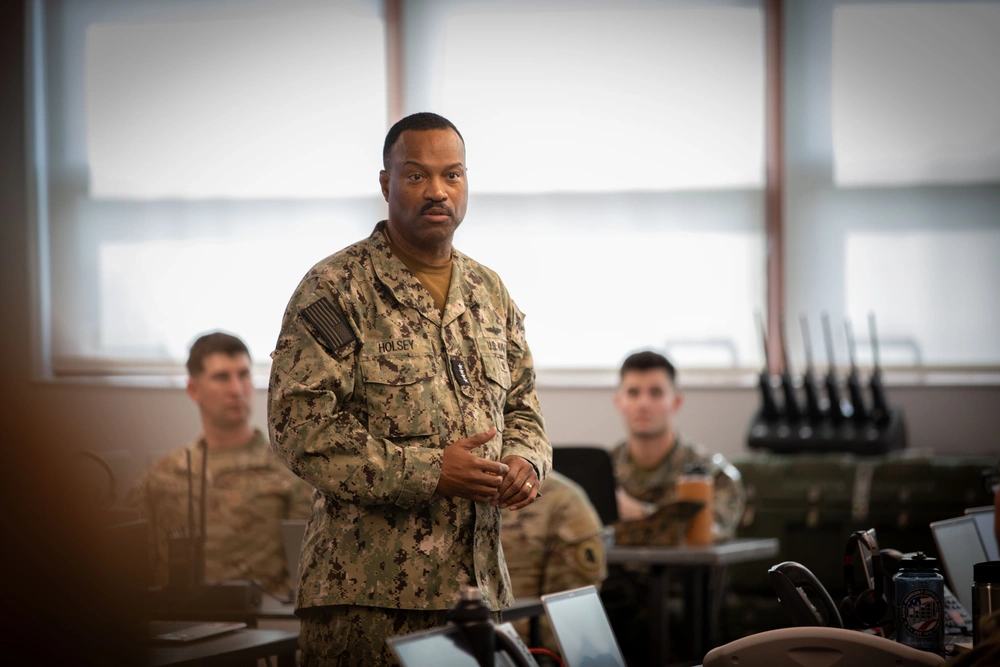
Above photo: US Navy Adm. Alvin Holsey visits the joint operations center for the illegal aliens holding operations at Naval Base Guantanamo Bay, Cuba, Feb. 5, 2025. US Army photo by Staff Sgt. ShaTyra Cox.
And Push Toward Venezuela Regime Change.
According to The New York Times, Adm. Alvin Hosley has raised concerns about bombing boats and the policy toward Venezuela.
The head of US Southern Command, the military commander overseeing US escalations in the Caribbean and the push toward an attempt at regime change in Venezuela, is stepping down, the Pentagon announced on Thursday.
According to a statement from SOUTHCOM Commander Adm. Alvin Holsey, who served in the position for less than a year, he will be retiring on December 12, 2025, ending a 37-year military career.
No reason was given for his resignation, but according to The New York Times, he had raised concerns about the US military mission in the Caribbean, which has involved a significant buildup of forces and the bombing of five boats that the Trump administration has claimed, without providing evidence, were carrying drugs.
Secretary of War Pete Hegseth issued a statement on Holsey’s retirement and praised the admiral, but the Times report said that officials at the Pentagon and on Capitol Hill said the praise “masked real policy tensions concerning Venezuela that the admiral and his civilian boss were seeking to paper over.”
Reuters also reported that a source said there had been tension between Holsey and Hegseth and questions about whether he would be fired in the days leading up to the announcement.
The Trump administration has come under significant criticism for its bombing campaign against alleged drug-running boats since the operations amount to extrajudicial executions. The Pentagon has also provided Congress with no hard evidence to back up its claims about the strikes.
US officials have also been clear that the real purpose of the military campaign is to oust Venezuelan President Nicolas Maduro. The administration has used drug trafficking as the pretext for the operations, pointing to the large number of overdose deaths in the US, but they are primarily caused by Fentanyl, which doesn’t come from Venezuela or travel through the country on its way to the US.
President Trump has recently authorized the CIA to conduct lethal covert operations inside Venezuela, as the US military is considering launching airstrikes directly against Venezuelan territory.
Report: US Bombs Another Boat in the Caribbean and There Are Survivors
The US launched another strike against a boat in the Caribbean on Thursday, and for the first time since the US began bombing vessels in the region, there are survivors, according to a report from Reuters.
The report cited an unnamed US official, who did not offer any more details about the strike. So far, there’s been no official confirmation from the Pentagon or President Trump, who has announced previous attacks on vessels in the region in posts on Truth Social.
The Thursday attack marks the sixth boat that the US has bombed since September 2. So far, the US has provided no evidence to back up its claims that the vessels were carrying drugs or that the 27 people extrajudicially executed were drug traffickers.
While most of the strikes have targeted boats that left Venezuela, at least one hit a vessel that left Colombia and killed Colombian nationals, according to a report from CNN. It also appears that a strike the US launched on Tuesday killed two citizens of Trinidad and Tobago, and the family of one of the men says he was a fisherman who was not involved in drug trafficking and was attempting to return home from a visit to Venezuela.
The Intercept has reported that while the US has been releasing videos of boats being hit by one missile strike, many of the attacks have required multiple strikes to sink the vessels and kill everyone onboard. In one of the attacks, a .50 caliber machine gun was used to sink the boat after it was hit by missiles.
US officials have been clear that the real goal of the US military campaign in the Caribbean is to oust Venezuelan President Nicolas Maduro, and combating drug trafficking is just a pretext. A Pentagon official told The Hill that the US has 10,000 troops in the region, with the majority in Puerto Rico, along with eight warships and a submarine. According to The Washington Times, US military planners believe the force is enough to potentially capture strategic ports and airfields inside Venezuela.
The US has been carrying out provocative flights near Venezuela’s coast, which have included sending B-52 bombers to the region and special operations helicopters. President Trump confirmed on Wednesday that he has authorized the CIA to take covert action inside Venezuela and that the US is considering attacks on Venezuelan territory.