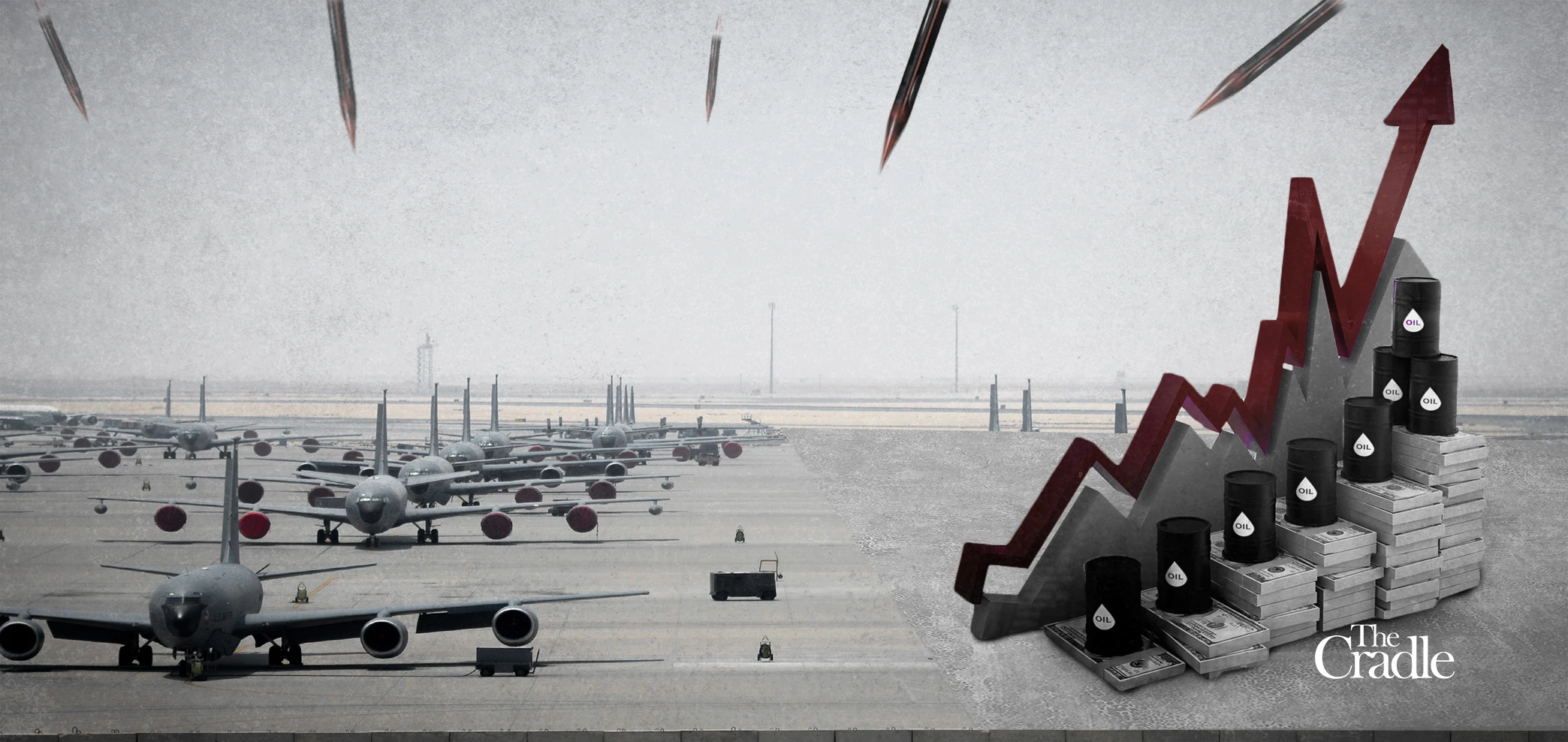
Above photo: The Cradle.
Iran and the occupation state entered direct confrontation.
Arab states of the Persian Gulf face unprecedented threats to their security, sovereignty, and energy lifelines.
NOTE: F. M. Shakil reports in The Cradle that Pakistan has already broken ranks with Washington and is assisting Iran: Though Pakistan continues to reject claims of missile transfers to Iran, its stance in recent days paints a different picture. On 16 June, members of the Iranian parliament chanted “Thank you, thank you Pakistan” following remarks by Pezeshkian, who praised Pakistan for standing by Iran. These developments fly in the face of Pakistan’s non-alignment rhetoric and indicate an ideological and strategic realignment by Islamabad. It was only early that Iran launched missile and drone strikes into Pakistan’s Balochistan region on 16 January, targeting extremist militant group Jaish al-Adl positions. Pakistan retaliated two days later on 18 January, conducting air and missile strikes into Iran’s Sistan and Baluchestan province in an operation dubbed Marg Bar Sarmachar. The tit-for-tat was remarkably friendly in the final analysis, and appears to have settled some critical border cooperation issues between the two states. The fact that these former adversaries – who had just engaged in direct military exchanges – have now adopted “resolute solidarity” is nothing short of breathtaking.
The rapidly escalating war between Iran and Israel has catapulted the Persian Gulf states into a vortex of geopolitical peril. Situated on strategic terrain and hosting a dense network of US military installations, these states are acutely aware that any US decision to join the warfront will obliterate their already-fragile neutrality. Their territories would then morph into frontline targets.
As the US-backed Israeli war on Iran escalates, the Persian Gulf monarchies are attempting a delicate balancing act – preserving security, safeguarding energy exports, and sidestepping an open-ended war that could raze vital sectors like aviation and desalination. Yet, they remain ensnared in a tightening web of regional alignments and strategic dependencies that leave little room for maneuver.
Diplomatic overtures amid firestorms
In the immediate aftermath of Tel Aviv’s 13 June strike on Iranian nuclear and military sites, Gulf capitals scrambled to project a posture of de-escalation. Saudi Arabia launched a flurry of diplomatic engagements with European and regional capitals – from Berlin and Brussels to Amman and Baghdad – urging restraint.
Qatar followed suit with calls to Ankara, Rome, and Ottawa, while the UAE coordinated with Paris, Islamabad, and Budapest. Even traditionally passive Kuwait and neutral Oman sought Turkiye’s assistance to cool regional temperatures.
A joint declaration from 20 Arab and Islamic states, including all six Gulf Cooperation Council (GCC) members, denounced any targeting of nuclear facilities and reiterated calls for a denuclearized region. Symbolic gestures followed: The UAE waived visa fines for Iranian residents, and Riyadh expedited the return of Iranian pilgrims.
Yet, the most forceful regional voice came from Qatar’s former prime minister, Hamad bin Jassim, who warned that Iran’s collapse would unleash uncontainable chaos. He urged Persian Gulf rulers to pressure Washington to “immediately halt the Israeli madness” and prevent the region from descending into full-scale war.
The ticking time bomb of US bases
The US military footprint across the Persian Gulf is both a deterrent and a provocation. Qatar, the only Gulf ally outside NATO, hosts the largest US outposts in the region at Al-Udeid and Al-Sailiya, which sit within 300 kilometers of Iran – well inside the range of even Iran’s older missile systems. Kuwait hosts four key US bases; the UAE, three; Saudi Arabia, Bahrain, and Oman each provide critical logistics and air-defense support.
While Gulf states retain legal rights to veto offensive operations from these bases, that sovereignty is largely theoretical if Washington chooses escalation. Iranian officials have already made clear that any platform used in aggression will be considered a legitimate retaliatory target. Should US airstrikes be launched from Gulf soil, none of these monarchies will escape the fallout.
Aviation paralysis and economic tremors
As tensions spiked, the region’s air corridors began to shut down. Flights over Iran, Iraq, Lebanon, and Syria were rerouted, suspended, or cancelled altogether. Emirates and Qatar Airways scrapped dozens of flights, while Dubai International Airport suffered cascading delays.
Rerouting costs surged. Fuel expenses soared. Passenger volumes fell. The financial hit was immediate: Air Arabia shares plummeted 10 percent – the sharpest drop since the 2008 financial crisis.
Energy chokepoints under threat
Iran holds the world’s second-largest natural gas and third-largest oil reserves. A single Israeli raid on a South Pars gas platform – connected to Qatar’s vital North Field – sent oil prices surging over 10 percent. If conflict continues, prices are projected to breach $100 per barrel.
That attack, despite sparing Qatari installations, jolted global energy markets and undermined confidence in the Gulf’s reliability as an exporter. The GCC faces a conundrum: While higher oil prices temporarily boost revenue, the specter of interrupted supply chains and targeted infrastructure poses an existential threat to their energy-based economies. Even brief closures of shipping lanes or disruptions at refineries could cause catastrophic economic blowback.
Straits on the brink
The Strait of Hormuz is the region’s jugular vein – 20 percent of the world’s liquefied natural gas passes through its narrow waters daily. Iran has repeatedly warned that it may close the strait if attacked. Such a move would cripple the exports of Kuwait, Qatar, and Bahrain, which lack meaningful alternative routes.
Even Saudi Arabia and the UAE, with backup pipelines to the Red Sea and Arabian Sea, cannot fully offset Hormuz’s strategic stranglehold. Further south, the Bab al-Mandab Strait – already disrupted by Yemeni military operations against Israeli shipping – saw daily oil transit fall from 8.7 million barrels in 2023 to four million in 2024.
Any simultaneous closure of both straits would spell catastrophe: The removal of over 60 percent of Gulf oil from global markets, pushing prices well beyond $200 per barrel.
A nuclear and cyber crossfire
Another silent peril looms: radioactive fallout. Iran’s nuclear facilities, located near Persian Gulf waters, pose a significant environmental risk. A leak triggered by Israeli strikes or sabotage could devastate marine ecosystems and render desalinated water undrinkable – an existential crisis for Qatar, Kuwait, and the UAE, which rely almost entirely on seawater for drinking.
Kuwait lies just 250 kilometers from the closest Iranian reactor, with Gulf currents flowing from Iranian shores. Yet, no comprehensive regional emergency plan exists. As Qatar’s foreign minister recently warned, even a minor contamination could deplete fresh water supplies within days.
Meanwhile, cyberwarfare has moved from the shadows to center stage. Disruptions in the Strait of Hormuz have already forced nearly 1,000 ships to revert to analog navigation amid suspected GPS jamming. The Gulf states now face the daunting challenge of defending not just borders and infrastructure, but digital sovereignty.
Strategic contradictions
The 7 October 2023 Operation Al-Aqsa Flood has reshaped the region’s political geometry. Arab states of the Persian Gulf, long tethered to US protection, are now hedging: normalizing with Tel Aviv, extending olive branches to Tehran, and pleading for strategic restraint from Washington.
But these contradictory moves – appeasing Israel, placating the Islamic Republic, and relying on the US – are colliding with a regional reality that no longer tolerates fence-sitting. What emerges is a West Asian policy built on three pillars: reconciliation with Iran, conditional normalization with the occupation state, and continued reliance on the US security umbrella.
Whether this fragile strategy can hold in the face of a widening war remains to be seen. But if the flames spread, the Gulf’s veneer of stability will be among the first to burn.