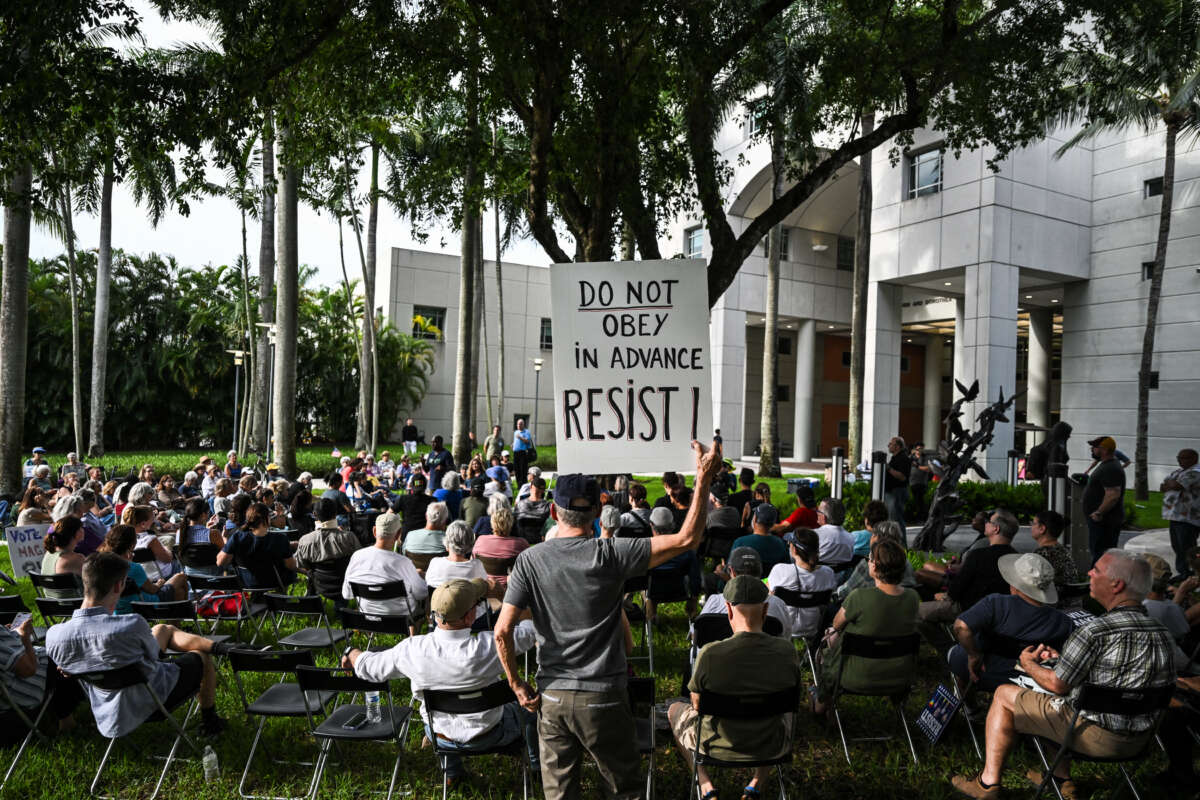
Above photo: A man holds up sign reading “Do Obey in Advance, Resist” during a protest as part of the ‘Good Trouble Lives On’ national day of action against the administration of U.S. President Donald Trump at Florida International University Green Library in Miami, Florida, on July 17, 2025. Chandan Khanna / AFP via Getty Images.
A Year Of Intensified Repression — And Expanding Resistance.
The right wants the teaching of history to no longer indict power or inspire resistance. But our side won’t submit.
On a humid June afternoon, I arrived at Florida International University expecting to give what I thought would be a standard talk on my new book, Teach Truth, about the escalating assault on antiracist education. But when historian and freedom fighter Dr. Marvin Dunn took me to the campus, he made clear this would be no ordinary event.
“This is Florida,” he said. “They banned saying ‘systemic racism’ in the classroom.”
I knew this was true in theory. But when he locked eyes with me and I saw the turmoil beneath his composure, it became profoundly real. Students — adult students — who had enrolled in university courses to study the Black freedom struggle and its challenge to systemic racism were now barred from doing so. The state had outlawed ideas. For a moment, his words stole the air from my lungs as reality sank in: Thoughtcrime from the book 1984 had slipped off the page and into the present.
To challenge this dystopian drift, Dr. Dunn built a different kind of classroom — one without walls, either around students’ bodies or their minds. As he explained to The Miami Times, “They won’t let us teach it inside the classrooms. We’ll teach it outside under this tree.”
He calls this liberation academy, “Under the Learning Tree.”
We set up under a sprawling tree whose branches formed a wide canopy. Dozens of community members — students, elders, teachers, parents, artists — gathered beneath it, some in camping chairs, others cross-legged in the grass. That afternoon, Dr. Dunn taught the history Florida tries hardest to censor — from the 1923 Rosewood massacre that burned an entire Black town to the ground; to attending Jim Crow schools and fighting desegregation battles; to the 1980 Miami rebellion that erupted after white police officers killed Arthur McDuffie; to the laws today that ban teaching how these events upheld systemic racism. I spoke about the spread of these truthcrime laws — legislation that criminalizes honest history and punishes educators for teaching historically accurate accounts of race, gender, and power — and about something spreading alongside them: resistance.
In 2025, communities across the country have found their own learning trees, collectively teaching the truths that the powerful have tried to erase.
A Year Of Intensified Repression — And Expanding Resistance
Public education has always been a battleground over national memory, but in 2025 the assault on honest teaching greatly intensified. The Trump administration launched a coordinated campaign to punish instruction that names systemic injustice, moving to abolish the Department of Education and roll back civil-rights protections that safeguard Title I and special-education funding. Executive orders threatening to defund schools that teach about racism, gender, or colonialism — and dismantling DEI programs across federal agencies — have sent a chilling message to districts nationwide.
The campaign extended well beyond classrooms, with Trump attacking the Smithsonian for teaching about slavery and ordering the removal of historical material — including images documenting the brutality of enslavement — from national parks, making the administration’s objective unmistakable: to transform public education and public memory into instruments of authoritarian control.
Yet even in a year defined by escalating repression, 2025 delivered something unexpected: cracks in the censorship machine.
At the ballot box, the public began pushing back. After far-right Moms for Liberty surged into school board seats in 2021 and 2022, voters delivered a sharp rebuke in 2025, when all 31 of the group’s contested candidates around the country lost, defeated by broad coalitions of parents, students, unions, and community organizations.
Many universities mounted an important resistance to the Trump administration’s attempt to coerce ideological compliance by conditioning access to federal funding on the adoption of so-called “patriotic education” frameworks that ban discussions of race and gender. These ideological loyalty tests were rejected by several prominent universities — including MIT, Brown University, the University of Pennsylvania, the University of Southern California, and the University of Virginia — demonstrating that even under political and financial pressure, institutions could refuse to trade academic freedom for federal favor.
The outcry over laws designed to intentionally deceive students about U.S. history has even begun to reverberate in some of the nation’s courts. In Florida, U.S. District Judge Carlos Mendoza struck down the law used to justify removing hundreds of books from school shelves, ruling in August that bans based on isolated excerpts were “overbroad and unconstitutional.” While the state has already indicated its intention to appeal the ruling, the Florida Freedom to Read Project responded, “Florida cannot be dubbed ‘the freest state’ if that freedom only applies to those who share a certain belief.”
Weeks after the Florida ruling, U.S. District Judge Patricia Giles issued an injunction halting the removal of nearly 600 books from Department of Defense Education Activity (DoDEA) schools serving military families worldwide. The purge — driven by Trump administration directives targeting material on race, gender, and democracy — was ruled a violation of students’ constitutional rights.
These decisions do not mean the book ban regime has been defeated. But they mark a turning point: After years of retreat, public outrage and targeted organizing have begun to force judicial limits on mass censorship.
Educators have often been the driving force behind the struggle for honest education.
In Chicago, educators answered Trump’s escalating assault on public education with collective bargaining — and won sweeping protections for truth-telling. Alongside raises and improved staffing, the agreement makes the curriculum Trump-proof by affirming educators’ right to “use their professional judgment and teach the truth,” as Chicago Teachers Union grievance director Zeidre Foster explained; and by explicitly protecting instruction in ethnic studies, Black history, LGBTQ+ contributions, climate science, reparations, and histories of state violence.
In the Portland area, teachers and activists formed a rapid-response coalition to defend educators targeted for teaching about Palestine. When coordinated pressure campaigns sought to force censorship, educators built a network committed to mobilizing within 48 hours to support colleagues under attack — ensuring that no honest educator is left isolated.
In Oklahoma, where the state has worked as hard as any to silence honest teaching, educators and communities have answered with some of the most powerful resistance to truthcrime laws in the country. In 2022, high school English teacher Summer Boismier publicly opposed House Bill 1775, which restricts honest education about race and gender, through a quiet but ingenious act of defiance. Educators were directed to either temporarily remove every book from their classrooms or cover them so they could not be seen until the censors could investigate all the books and determine which would be allowed to stay. Boismier complied just enough to expose the absurdity of the mandate: she covered her shelves with butcher paper labeled “Books the State Doesn’t Want You to Read” and posted a QR code linking students to the Brooklyn Public Library’s “Books Unbanned” collection, ensuring access to the very texts lawmakers sought to erase. The state responded by revoking her teaching license — a punishment Boismier has said was meant to turn her into an “object lesson” for other educators.
Instead, Boismier has become an object lesson in resistance. In 2025, she filed a federal lawsuit against the Oklahoma State Department of Education, arguing that both HB 1775 and the retaliation she faced violated her constitutional rights and were designed to intimidate teachers into silence. Her case unfolded alongside a broader lawsuit brought by educators, students, the ACLU, and civil rights organizations, which won a partial preliminary injunction blocking enforcement of key provisions of HB 1775. The court ruled that the law was so vague it failed to give educators clear guidance about what was prohibited, chilling constitutionally protected speech. As a result, the state is barred from enforcing the law’s restrictions in public universities and from applying its most confusing and sweeping provisions in K–12 classrooms while the case proceeds — a significant, if incomplete, victory for educators and students.
It’s important to emphasize that communities are not depending on courts to defend honest education. When Oklahoma lawmakers moved to effectively ban the teaching of Black history, Kristi Williams, whose aunt survived the 1921 Tulsa Massacre, refused to let that history disappear. She created Black History Saturday, a free, intergenerational program offering meals and monthly Black history education for children, teenagers, and elders. Together, these efforts show how educators and communities in Oklahoma are refusing erasure — transforming censorship into a catalyst for collective learning.
In South Carolina — the state with the highest number of book bans in the country — educator Alana Ward demonstrated to educators everywhere what they can do to resist truthcrime laws; she responded to the cancellation of her African American Literature course not by retreating, but by organizing.
Ward began her teaching career in the majority-Black public schools of Orangeburg. Many of her students told her she was the first Black teacher they had ever had — an experience she described as both grounding and clarifying. But under the wave of anti-history laws, she witnessed the slow, quiet erasure of the very curriculum that had once affirmed her students’ brilliance.
For years, Ward fought to keep African American Literature alive in her district. She hand-recruited students, walked them to guidance counselors, and kept meticulous enrollment records to prove the course was viable. “I’m signing up 32 kids for a class that really should only have about 25,” she told me. “Then I was told in April, well, your class ‘didn’t make.’” One counselor later admitted the schedule wasn’t even finalized until June — raising the question of how the course could have been canceled in April. Ward came to understand what she called the “sneaky, quiet disappearance” of Black history as no accident, but part of a broader strategy to suppress honest teaching.
“It’s masked as something to spare the feelings of others,” she said, “But the real intent is to keep power from a group of people who, if they knew their true greatness, might be able to harness that knowledge and change the world for the better.” She compared the current wave of censorship to earlier eras when Black people were forbidden to read or write. “Even then, we found a way,” she said. “And this is no different. We have to even more doggedly teach the truth.”
That conviction led Ward to launch South Carolina’s first Teaching for Black Lives study group. When she first opened sign-ups, six educators joined immediately. After she sent the invitation statewide, 38 teachers signed up — and more continued to write asking if there was room. “There is a need,” Ward told me. “And I saw that there was a need…so it’s good to even, just a little bit, be a part of the pushback among educators and citizens of South Carolina. So we just want to keep doing that, and keep magnifying our voices, and keep saying no to things that are unfair.”
These study groups have become a form of rebel professional development: educators meeting after hours, sharing banned books, studying freedom struggles, and building community — all in a state where the first anti-literacy law was passed in 1740.
Since 2020, the Zinn Education Project has helped support hundreds of Teaching for Black Lives groups like Ward’s, providing books, workshops, and a national network of social justice educators. In the shadow of truthcrime laws, teachers are creating the very thing that authoritarianism fears most: a collective practice of remembering.
Organized Remembering: A Radical Pedagogy Of Healing And Resistance
To understand what unfolded in 2025, we have to look beyond the daily headlines to the deeper political project at work. The right is not merely banning books or intimidating teachers; it is carrying out what scholar Henry Giroux calls the violence of organized forgetting — a systematic effort to erase histories that expose the foundations of capitalism, white supremacy, and empire. This erasure is not incidental; it is deliberate — a calculated effort to sever young people from the long history of resistance at the very moment they are being asked to survive ICE raids that tear families apart, armed forces that occupy their cities, climate catastrophe that makes survival itself uncertain, and an authoritarian order that can rule only if we forget the legacies of resistance.
Against this project of forgetting, educators across the country have responded with something far more powerful than compliance or retreat: organized remembering. In Teach Truth, I describe this as the Radical Healing of Organized Remembering. Organized remembering is not an exercise in nostalgia; it is an act of repair. It seeks to heal the damage done by organized forgetting — the wound left when young people are denied the truth about who they are, where they come from, and the struggles that made whatever freedoms they have possible. It is a refusal to normalize mandated lying to children about the past.
This tradition did not begin in 2025. It stretches back to the enslaved people who built pit schools in secret, risking their lives to learn to read because they understood literacy as a pathway to freedom. It lived in the freedpeople who, during Reconstruction, established the first public schools in the South — and rebuilt them again and again after the Ku Klux Klan burned over 600 of them to the ground. It reemerged in the Citizenship Schools, which taught literacy as a tool for voting rights, and in the Freedom Schools of the civil rights movement, where young people learned suppressed histories of struggle alongside the skills needed to transform society.
What we are witnessing today is the continuation of that same lineage of educators who know this truth: education has never been neutral — it either liberates or subjugates.
In classrooms and community spaces, educators are developing new strategies for truth-telling. Sometimes it looks like teaching the same material under different names. Sometimes it looks like shifting from textbooks to testimony, from worksheets to oral history, from scripted curricula to poetry and music — forms of knowledge that are harder for censors to police and impossible for them to fully contain. During the first week of February 2026, educators, students, and families have an opportunity to stand in this long tradition of resistance by supporting Black Lives Matter at School’s national Week of Action. The week is an affirmation of organized remembering and a declaration that Black lives, Black history, and Black futures belong in our schools.
Today’s truthcrime laws are, as Dr. Dunn warns, a dangerous “minimizing of the suffering, minimizing the violence.” They are designed to shrink history until it no longer indicts power or inspires resistance. But our side has never submitted. Dunn explains, “In slavery, after the working day was over, Black men gathered around a tree and talked. That is how our history was passed on — under a tree, informally, through stories.” That lineage endures wherever people gather collectively to remember.
And as Dunn put it plainly, with the authority of generations behind him: “You can’t erase us.”