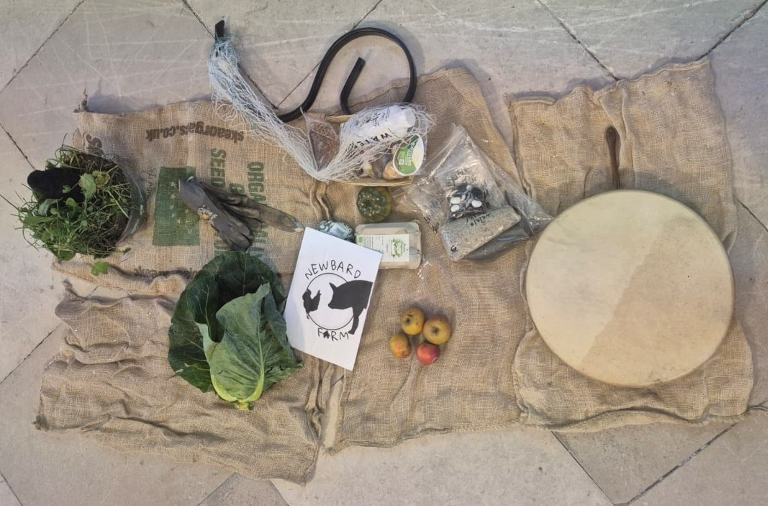
Above photo: Offerings from the land brought to Dublin as part of the mistica. Oliver Moore.
Every year the Feeding Ourselves movement joins more of the dots in the local food ecosystem.
This year especially it has broken new ground – digging into Ireland’s difficult colonial past and building bridges to a more resilient future by consolidating ties with unlikely partners and anchor institutions. To give us a taste of where the movement is at, Oliver Moore reports from Ireland.
In a nutshell – what is Feeding Ourselves?
Feeding Ourselves is a community of practice in Ireland (CoP) – an organised but informal network of food system animators from production to consumption and all the elements in between – which has been running for some years. Initially it was just a gathering, one that ARC has partnered with many times (e.g. last year’s here). Now, the CoP runs webinars, newsletters and organises events to build its knowledge and action base.
Its most recent event was a big step forward for the good food good farming movement in Ireland.
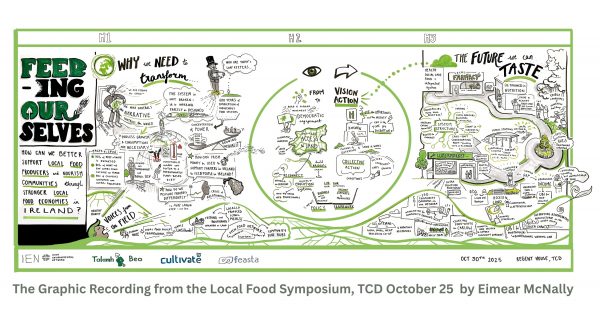
The Feeding Ourselves Local Food Symposium held on 30 October at Regent’s House, Trinity College Dublin, brought together 140+ people – activists, farmers, policy advocates, researchers, and progressive anchor institutions – for a day of dialogue, strategising and collaboration focused on strengthening local food systems in Ireland.
Taking a suitably participatory approach, it used mixed methods which brought varied voices forward. In particular, bringing in public health and institutional players into a food sovereignty network was a major step forward – from mapping local producers to building new impressive routes to market for agroecological farmers.
Introduction – what is the context for local food in Ireland?
In Ireland, the local food movement has been exceptionally weak for a variety of historical and structural reasons.
Ireland being a former colony was used for extractive commodity production. Its industrial development was stymied and sometimes even regressed, so local food processing and provisioning was never the priority.
Instead meat, milk, fish and cereals were exported, while local markets were ignored. Leading up to and after independence in 1921, despite some positive changes, these trade routes were largely kept intact: Britain was the main market for Irish produce until joining the then EEC – but even within the EU exports have been the focus for Irish ag.
So where is local food at now? Talamh Beo – the Irish branch of la via Campesina, and part of the Feeding Ourselves CoP – is compiling a list of local food producers at present. First indications are that it’s very low – considerably fewer than 1000.
State supports are basic and stagnant for local food while LEADER and other initiatives do great work under much pressure and cutbacks.
Some developments have shown some spark for local – organic is growing, having been stagnant for decades; home and allotment gardening similarly; even the existence of Talamh Beo in itself is something – it was formed at an earlier Feeding Ourselves in 2017.
In this context, developing a community of practice to grow local food provisioning is a positive collective action by relevant and interested parties. And Feeding Ourselves – the Dublin edition – was a real step forward for it.
A milestone for the movement
So what made this symposium such an important step for the Feeding Ourselves Community of Practice?
Partnerships beyond the bubble
When you think about the good food movement, you don’t necessarily think of hospital food and football fans. Well, we live in frenetic times and, turns out, that’s changing.
Big institutions have spending power, engage a lot of people, and can be crucial hubs in supply chains for change. Here in Dublin, the work by universities like Trinity College Dublin, and its collaboration with St James’ Hospital, as well as the work by Bohemian football club – show what’s possible when the big players come into the game.
This Community Wealth Building approach has finally come to Ireland. Pioneered in places like Preston (England), Cleveland and Jackson (US), and, earlier in the Basque country with Mondragon, this sees anchor institutions being utilised as powerful hubs for positive change – social, economic, ecological and more.
Bohemian FC (Bohs) has become something of a global brand, with social justice luminaries like Greta Thunberg donning their 3rd away strip while on a flotilla to break the illegal and immoral blockade of Gaza.
Back home, Bohs help map local retrofit needs for their football fans to save costs on renewable energy, run a community supported agriculture initiative, a repair workshop and a lot more, especially in the diversity and inclusion sphere.
So when Feeding Ourselves came to Dublin, Sean McCabe of Bohs presented on their iteration of community wealth building, and their exciting plans to scale up and out what they are doing. From insurance mutuals to bigger cooperative food provisioning plans, Bohs has shown that football and positive collective action can work together.
St. James’ hospital too, in its plans to turn the kitchen of Dublin’s new children’s hospital into an ingredient-led good food place – shows serious leadership and creativity. The wider plans unveiled include bringing farms into trust and using them for training growers agroecologically and generating the core ingredients of a good food kitchen in a children’s hospital. What’s not to love about that?
Soil in the city
This symposium broke new ground for Dublin by kicking off with what La Via Campesina call a mistica – an inspirational, evocative way to ground events and people in place.
Farmers, following a bodhrán deftly drummed by Talamh Beo’s Fergal Anderson, brought themselves and their produce from their farms, telling a little of their stories of who they are, what they do, and how they do it. They stood front and centre, and it centred us too. Seeds and soil, eggs and cabbages, and all manner of apples have a way of doing that. As do the people, the producers, themselves.
From history to health
The spectrum of Feeding Ourselves now covers new ground too – from deepening our understanding of the enduring impact of colonisation, and how to address this, all the way over to the solid work of developing healthy communities including schools.
The rest – the more standard stuff in between, agroecology, food sovereignty, inclusive rural development and so on – are now anchored in more thorough understandings and more practical changes.
Sometimes we need the arts to go deeper in, to uproot things, to turn the compost over. An evening screening of the film Farming is Medicine proved to be a powerful, moving way to finish off the symposium.
Seeing beyond the very white regenerative ag movement into a land back and land care movement, operating on a multi-generational level, from crying soils to the soaring skies of rooftop gardens – gets you. It moves you.
An evocative, emotive and immersive conversation followed, where this author and Rupa Marya traversed so much of the terrain of land, farming and food, from Gaelic Ireland and the land wars to indigenous land back movements and rapid fire colonisation and annihilation in Palestine. And especially, how we can heal ourselves, together.
The closing reflections of the daytime session, especially from Professor Colin Doherty, of both Trinity School of Medicine and St. James’ hospital, underscored the opportunity of the moment. Donning his robes, he acknowledged the troubled past of the institutions of the Protestant Ascendancy (Ireland’s landed anglophone elite), while composting this into a better future for all – and especially for those entering and leaving the children’s hospital.
Trinity College Dublin, St James’s hospital and other anchor institutions now more than ever recognise their role and indeed responsibility in transforming Ireland’s food future.
Conclusion
What started as an event is now more coherent and connected. Feeding Ourselves actually started with a big bang – its 2011 first event had 200 people and a lot of energy. Following this, it settled into a groove and has now grown, 2025 however, was a mighty step forward for the Community of Practice. Here’s to more in 2026.