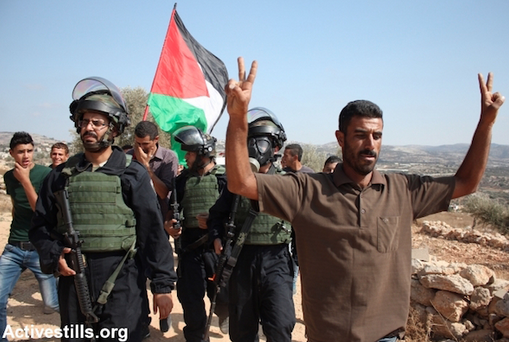
Palestinians, international and Israeli activists demonstrate against the separation barrier and the occupation in the West Bank village of Bil’in, October 17, 2014. (Photo by Ahmad Al-Bazz/Activestills.org)
There’s nothing new under the sun in Bil’in.
If you take a look at the Wikipedia page on Bil’in, you’ll see that the last updates about the village’s struggle against the separation wall refer to 2012. B’Tselem’s page on Bil’in was last updated almost two years ago. One could easily be led to believe that the struggle is over. But Bil’in continues to demonstrate.
Perhaps updating Wikipedia and B’Tselem’s website isn’t necessary. The situation in Bil’in remains as it was. Veteran protesters even experience flashbacks to 2008, when the demonstrations took place near the old route of the wall. This is the same route that stole nearly half of the village’s agricultural land, and which the High Court later ordered be dismantled and moved west. This was before the new route was built and introduced in 2011 — the same one that steals only one third of the village’s land.

Over the last several weeks, however, Israeli soldiers have been waiting for the protesters on the old route, near the monument for the late Bassem Abu Rahmah, who was shot and killed at close range by a high-velocity tear gas grenade. As far as I can tell from the videos and testimonies, Abu-Rahme was likely murdered intentionally. (The IDF closed its investigation into the killing without indictment.) From high positions the soldiers fire barrages at the protesters who try to make their way along the “Freedom Road.” Afterward, the soldiers descend toward the built-up areas of the village and fill people’s homes with tear gas.
Soldiers recently set on fire a building that stands between the old route and the new one. The army issued a demolition order for a playground that was built there. During the last protest a man who said he was a village resident told me that 20 of his olive trees, which are located on the other side of the wall, were set ablaze. Arresting protesters and assaulting them while in custody, practices that have become rarer in recent years in Bil’in, are once again becoming common practice.