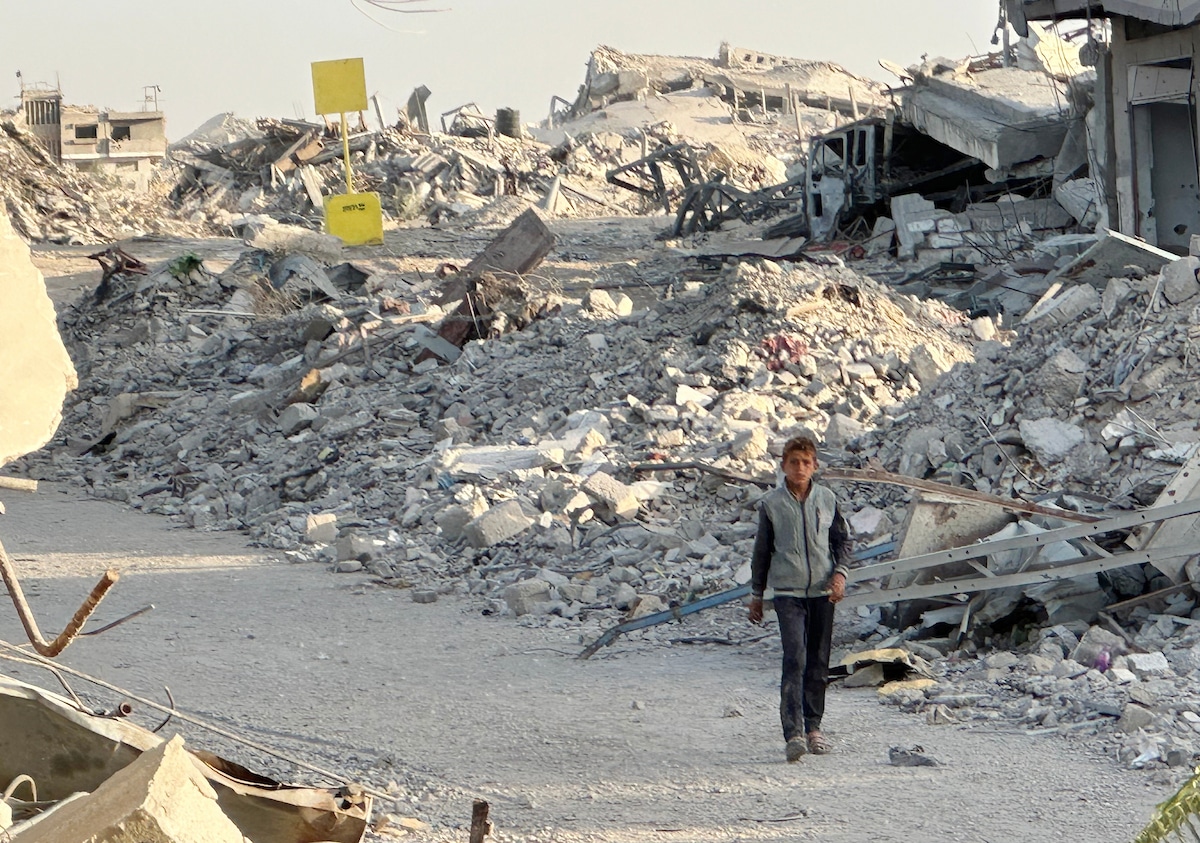
Above photo: Israeli bulldozers and military vehicles have placed yellow-painted concrete blocks along what is known as the “yellow line” inside the Gaza Strip, marking a field boundary in areas from which Israeli forces withdrew on October 10 under the current ceasefire agreement, in Khan Younis on October 22, 2025. Tamer Ibrahim / APA Images.
As part of the ceasefire, Gaza has been split in half by the so-called ‘yellow line,’ where Israel’s military controls just over 50% of the Strip.
Palestinians are being killed for trying to cross or even get close to the line.
There is an invisible line dividing Gaza, and any Palestinian who attempts to cross it, or even get close to it, is killed.
That is what happened to Ibrahim and Mazen al-Najjar, two men from the same family, on November 5th. Displaced in the al-Mawasi area of Khan Younis, they attempted to go to their home in the eastern part of Khan Younis, to attempt to retrieve some belongings. It was a simple enough task. The only problem was, their home lies behind the ‘yellow line’, which is the area of Gaza under full Israeli military control since the ceasefire on October 10. Ibrahim and Mazen never made it to their home, and returned to their displacement camp in body bags. They were shot and killed by Israeli soldiers while attempting to cross the line.
The al-Najjars are only a few of some 250 Palestinians who have been killed by Israel since the ceasefire began.
Many of those Palestinians have been killed in similar circumstances, while trying to return home. While the ceasefire agreement stipulates a full Israeli withdrawal from Gaza in the second phase, that has not yet begun. The ‘yellow line’ marks the area that Israel now controls in Gaza during this initial ceasefire period.
This line divides the inner neighborhoods of the Strip into two halves: one where residents are allowed to be present, and another that is forbidden to them. According to Palestinians, anyone who approaches those areas is dealt with by intense force.
The yellow line is a new reality, as it divides the Gaza Strip into two parts, with the eastern part under Israeli army control. According to estimates, there are around 37 Israeli military points and positions within these areas, starting from Rafah to Beit Hanoun. The yellow line passes through the middle of large, densely populated neighborhoods such as Shuja’iyya in eastern Gaza City, Jabalia in the north, and Khan Younis and Rafah in the south, covering about 50% of the total area of the Strip.
Inside the areas behind the yellow line – the eastern half of Gaza, bordering Israel – the military demolition, destruction, and shelling of Palestinian infrastructure has not stopped. Residents living on the western side of the yellow line, the side where Palestinians are allowed to be, constantly hear explosions and artillery fire coming from the other side of the invisible line.
For residents who had long waited for the war to end so they could return home, the yellow line came as a painful surprise.
For many, it separates them from their houses by just a few meters. They stand and look at their homes — or the rubble of their homes in some cases — unable to return. In many places, there is a lack of clear markings showing the boundary of the line. In some areas, the Israeli army has placed yellow-colored concrete blocks to demarcate the yellow line. Some families and individuals, due to the lack of clear markings indicating the boundaries of the yellow line — especially in the early weeks of the ceasefire when the ‘yellow line’ was merely a phrase repeated by politicians and not physically visible — entered those areas unknowingly. The Abu Shaaban family massacre, which took place on October 18 and claimed the lives of 11 Palestinians from the same family who were attempting to return to their home in the Zeitoun neighborhood located within the yellow zone, occurred without their knowledge of being in a forbidden area. After that, more killings occurred involving Palestinians crossing into or near the yellow line.
In recent days, more than four people were killed, the most recent being the two young men from the al-Najjar family. They were killed immediately upon approaching the area around the yellow line, and their bodies remained for five days before rescue teams could reach them, according to testimonies obtained by Mondoweiss. Field correspondents in Khan Younis also confirmed the killing of a woman and her child on November 4th while attempting to cross into the yellow line.
According to the Civil Defense in the Gaza Strip, between 30 and 40 people have been killed while crossing the yellow line—and they were shot dead immediately without warning.
Mahmoud Basal, the spokesperson for the Civil Defense, says that the impact of the yellow line in the Gaza Strip is extremely serious and dangerous. “There is no clearly visible line that would indicate to a resident that they have reached the forbidden zone. After repeated killings, the occupation placed concrete blocks painted yellow along the line, but the distance between each block was so large that a person could easily pass between them without realizing they had entered the yellow zone—and be shot dead instantly.”
“Any attempt by residents to reach or cross the line is met with force and direct killing by the Israeli army. Nothing else but death,” Basal said. He notes that Israel could deal differently with those who cross the line, especially since most do so out of ignorance, “but it insists on using excessive and intense force as the only response toward Palestinians.”
‘I Can See My House, But If I Get Close I’ll Be Shot’
Mo’men Sami, 26, a resident of the Shuja’iyya neighborhood, has repeatedly tried to visit his home, which lies only a few dozen meters inside the yellow line. He managed to go once, a very risky move. When he arrived, he found some of his neighbors hiding under the rubble, afraid of being spotted by drones. He said he managed to leave unharmed but had to run for his life.
“I went to check on my house, which is now rubble, but beneath it are still remnants of our childhood—our belongings and things we could keep,” he said. “People are longing to return to their homes after waiting so long, thinking the war had ended and displacement was over, but they are stopped only when they see Israeli soldiers or tanks in some areas, yet they keep walking toward their homes without hesitation.”
The yellow line divides the Shuja’iyya neighborhood into two parts: the western part, which is very small, and the eastern part, which is densely populated and where residents are still forbidden from returning. Those who try are killed. The same is true for other eastern areas across the Gaza Strip, where the yellow line passes through the middle of crowded residential neighborhoods in Jabalia. People there sit and look at their homes across the line, but the yellow barrier stands in between.
Zuhdi al-Shouli lives in a partially destroyed school in the Jabalia camp, only a few dozen meters from the yellow line. He waits anxiously for its removal so he can return to his home, which he says is all he has. “I have never seen anything more painful than this – to see my house there, just a few meters away, but if I get close, I’ll be shot,” he says. “I sit here at the closest point to my home. The soldiers see me, but I have nowhere else to go except my home, or its ruins.”
“I have never seen a line that splits the Jabalia camp in half in such a painful way. For us, the war is not over. We still hear shelling and destruction every night. We sleep in complete darkness, afraid of being bombed or killed. The war has not ended for us as long as we cannot return to our homes. We are still displaced in the open.”
Zuhdi explains that in the area where he is located, close to the yellow line, if something were to happen to his family and the few other families next to him in the same school, the rescue teams in Gaza would not even be able to cross their area and provide help to them. “When we call some organization to provide us with water, they say that we are near the yellow line and it’s a dangerous area, and they do not come,” he said.
Tareq S. Hajjaj is the Gaza Correspondent for Mondoweiss and a member of the Palestinian Writers Union. Follow him on Twitter/X at @Tareqshajjaj.