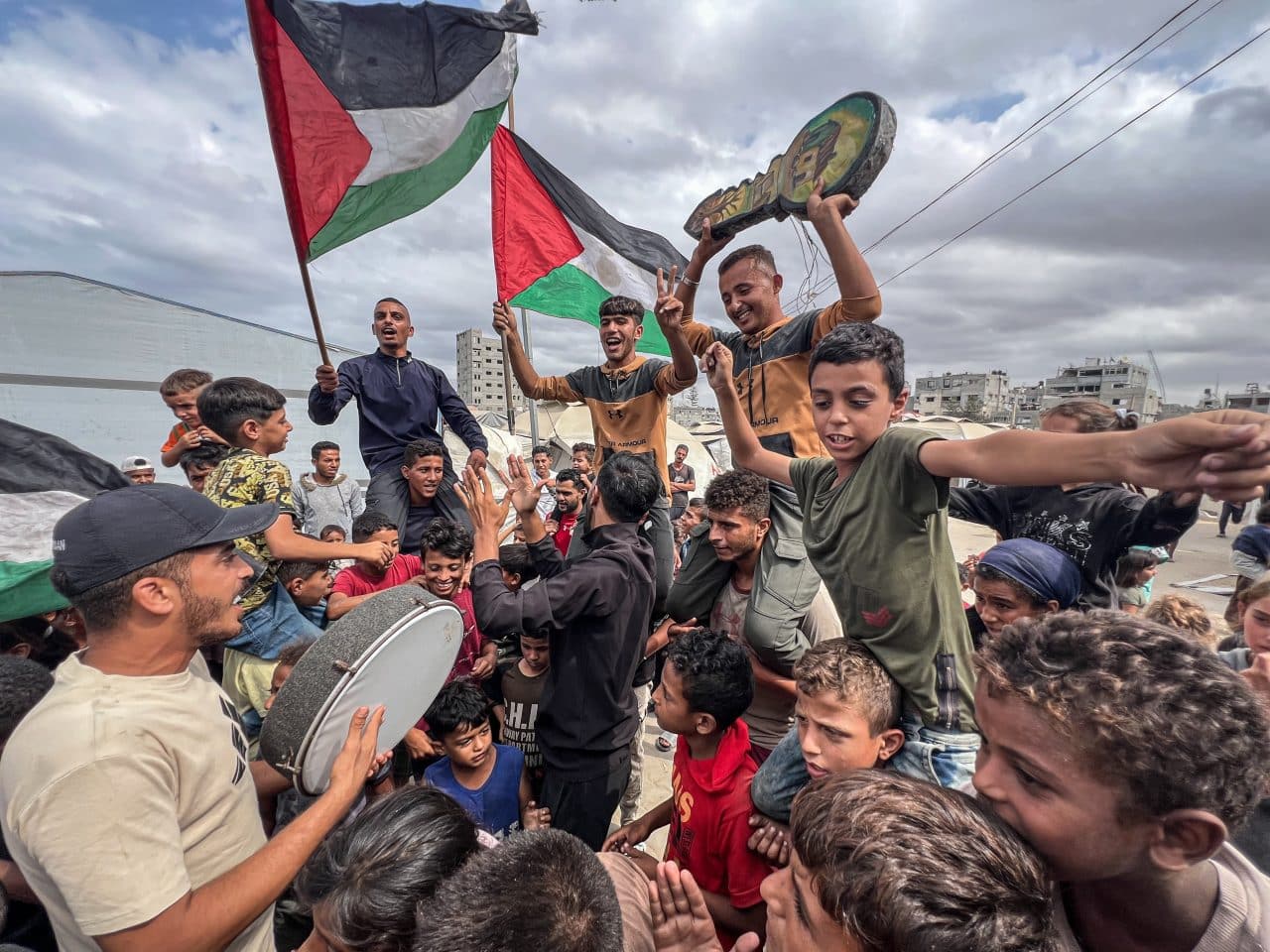
Above photo: Palestinians celebrate in Nuseirat refugee camp following news of agreement over a ceasefire between Israel and Hamas, October 9, 2025. Belal Abu Amer/APA Images.
‘Once The War Ends, We’ll Be Able To Weep.’
Gaza erupted in celebration as a ceasefire agreement between Israel and Hamas was reached on Thursday. But while there has been an outpouring of joy over the prospect of an end to the genocide, many are skeptical that it’s truly over.
Celebrations have erupted in Gaza. People sing in the streets, families hug each other, and children dance — all smiling and joyfully expressing their happiness that a deal for a ceasefire, and hopefully an end to the genocide, has finally been announced.
The agreement and the captives’ release were announced in the early morning hours in Palestine, and are only part of the first stage of U.S. President Trump’s plan. The agreement will see a ceasefire, the release of the remaining Israeli captives in Gaza, the release of a number of Palestinian prisoners, and the retreat of Israeli forces to an agreed-upon location. It is expected to be signed between Israel and Hamas on Thursday afternoon in Egypt and will immediately go into effect.
“After responsible and serious negotiations, the Hamas movement and the Palestinian factions engaged in discussions about Trump’s plan in Sharm al-Sheikh, Egypt, aimed at reaching an end to the genocide of our Palestinian people and the withdrawal of the Israeli occupation from the Gaza Strip. The movement announced the reach of a deal that states to end the war in Gaza and the withdrawal of the occupation and aid entry and prisoner swap,” Hamas said in a statement after the announcement that a deal had been reached.
After days of skepticism over whether Trump’s so-called “peace” plan would actually result in a ceasefire, people in Gaza have overwhelmingly embraced the announcement. It’s a moment they have been waiting two years for — to know that the war is going to end, and that people will be able to go back to their homes and resume their lives without the daily killing.
Muhammad Hadeidah, 43, stands in his displacement camp west of Khan Younis, unable to hide the joy on his face. He said that at midnight, he heard the news about an agreement to stop the war, and since then, he hasn’t been able to go back to sleep. His excitement led him to run through the camp and tell his neighbors that the war was going to end.
“When I heard the news last night, I asked some people to confirm, and they said that an agreement had been reached,” he told Mondoweiss. “All I think about is returning to my neighborhood east of Khan Younis. I want to start collecting my belongings and return home, even if the home isn’t there anymore.”
“We have had enough of the daily killings,” he continued. “We lost everyone. We lost everything. We have nothing now except our souls and what remains of our families. We want to hug them and tell each other that this stops now. The war is over and won’t start up again.”
Around Hadeidah in the camp, children gather in circles, raising their hands and cheering after hearing the news. “Look around you, we haven’t seen this scene in two years,” Hadeidah said. “Our children have only been scared, hearing the bombs and news of who’s been killed today, and who survived.”
“They deserve happiness, they deserve joy, and they deserve to be safe,” he added. “This is all we want — to be safe in our homeland, to be secure and have food, medications, and our basic needs met. I hope that this agreement will guarantee these rights to us.”
Gazans Wait To Grieve
Despite the overwhelming sense of joy and relief, many in Gaza remain skeptical that the agreement will actually lead to a lasting ceasefire, given Israel’s repeated violation of previous agreements. Many are also overwhelmed with the grief that the past two years have brought.
“We need a long time after this announcement to collect ourselves, to weep for what we’ve lost, to rediscover ourselves after the devastating past two years,” said Ahmad Barakat, a journalist in Gaza. “They were the worst two years in every person’s life in the Gaza Strip. We lost so much and lived through what no human can bear.”
“We are waiting for a new stage of this war,” he said. “The stage where we’re allowed to live with our sadness. Once the war ends, people will be able to weep.”
Before he can celebrate the current ceasefire, Barakat is concerned about the next stage of the agreement. “We are also waiting for the next stage. It’s not only about a ceasefire. We lived through two ceasefires before, and the war continued. We also need to know what’s next. Will they open the crossings? Will food enter Gaza without limits and restrictions? What about the lost people? What about the homes that were destroyed? Will there be any reconstruction process soon? Will people be able to travel from the south to the north of Gaza City, including those who evacuated recently? We also need to know all of this, and nothing is clear.”
But despite all these questions in Barakat’s mind, he is still excited and happy about the end of the war. “Despite all the challenges around this ceasefire, we are still happy. The relief sometimes pushes us to cry,” he said. “We are so grateful that the daily killing will stop. We are so thankful that our ongoing fear, displacement, and worries about our dear ones and families are all going to end.”
“We need a lot of time to believe the idea that the war has ended,” he added.
“And even though everyone in Gaza lost something, I’m grateful that this war is going to end, and I didn’t lose the most important thing in my life — my family. As a journalist, I seriously didn’t think for once that I would be alive for this moment, to live until the end of this war,” Barakat said.
As of Thursday, 12 p.m. local time in Palestine, the ceasefire went into effect. People reported seeing the sky clear of drones, offering a moment of respite after two years of near-constant bombardment. Some people had already packed their belongings, preparing themselves to return to their homes across Gaza.
But even after the ceasefire went into effect, some people tried to return to the north of Gaza via al-Rashid street, but Israeli tanks positioned nearby fired tank shells at them.
When he first heard news of the ceasefire, Muhammad Abu al-Qumsan could only think about returning to northern Gaza. He is displaced in Nuseirat in the central Gaza Strip. “The first thing I want to do now is go back to my home in north Gaza. I want to see if it is still there or not,” he said. “And if it was destroyed, I will still return, for good.”
“I experienced happiness before I graduated and when I got married, and it was the greatest happiness I had ever felt. But this is different. This means an end to the war. No warplanes will bomb us, no airstrikes, no shelling, no drones will fire on us in the streets, no more killings, no death. This war will stop, and this is what we were waiting for,” Abu al-Qumsan said.
“Now you can feel normal,” he added. “You can think that you can wake up if you go to sleep. You can stay out late with friends. You can walk on the streets in the dark. You can visit your friends and family. You can walk freely without overthinking whether you’re going to be killed at any moment.”
But according to Abu al-Qumsan, the happiness in Gaza is incomplete. “Although our joy is not full, we will keep reminding ourselves of the ones we lost — our loved ones and families — and the areas and places that were wiped out.”