Skip to content

Gerrymandering

Supreme Court Asks Why It Shouldn’t Gut The Voting Rights Act

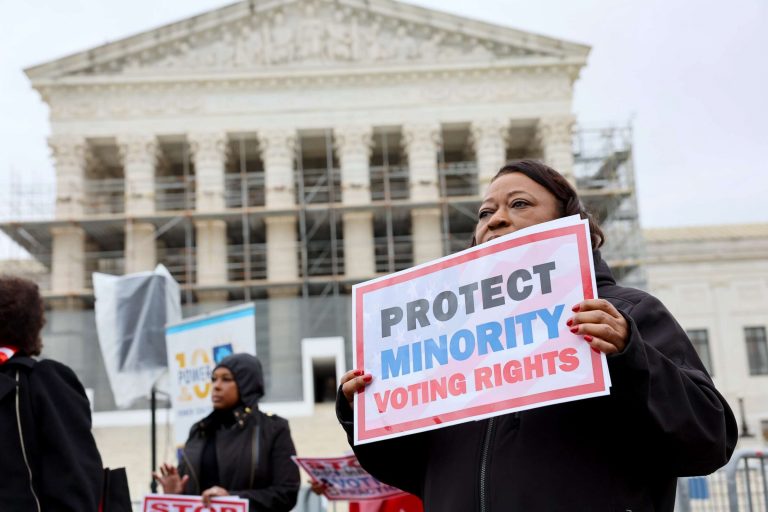
In what may prove to be the most consequential redistricting case to come before the Supreme Court, Louisiana is urging the court to gut the main provision of the Voting Rights Act of 1965 (VRA) and ban any consideration of race in redistricting. Louisiana filed its brief after the high court on August 1 asked the parties whether compliance with Section 2 of the (VRA) violates the Constitution’s 14th or 15th Amendments. By framing that question, the court may be signaling its intention to eviscerate the VRA. Louisiana v. Callais reached the Supreme Court after a coalition of civil rights organizations and Black voters sought to reinstate a map that the state legislature had adopted in 2024.

Right-Dominated Supreme Court Is Poised To Do Grave Harm

The 2023-2024 Supreme Court term will begin on Monday, October 2. Dominated by six right-wingers, the court has agreed to review cases in which voting rights, consumer protection, and the regulation of health and safety, workers’ rights and the environment are in jeopardy. The cases present the issues of gerrymandering and the power of administrative agencies. In light of its recent conservative rulings, we should be wary about how the court will rule on these critical matters. Besides the cases already on the Supreme Court’s docket, the court will add more cases by mid-January. Their decisions will be issued by the end of June or beginning of July 2024.

Here’s What ‘Moore V. Harper’ Means For Voting Rights Going Forward

Chief Justice John Roberts has historically not decided cases in a way that protects voting rights. In 2013, he authored Shelby v. Holder, which drove a stake through the heart of the Voting Rights Act. And in 2021, he voted to further weaken the Act in Brnovich v. DNC. But this past month, Roberts surprisingly authored two new Supreme Court opinions that support the right to vote. On June 8, the high court struck down a racist congressional district map in Allen v. Milligan, and on June 27, the court preserved judicial review of state legislative enactments in Moore v. Harper.

Mathematicians Want To Save Democracy

By Carrie Arnold for Nature. Leaning back in his chair, Jonathan Mattingly swings his legs up onto his desk, presses a key on his laptop and changes the results of the 2012 elections in North Carolina. On the screen, flickering lines and dots outline a map of the state’s 13 congressional districts, each of which chooses one person to send to the US House of Representatives. By tweaking the borders of those election districts, but not changing a single vote, Mattingly’s maps show candidates from the Democratic Party winning six, seven or even eight seats in the race. In reality, they won only four — despite earning a majority of votes overall. Mattingly’s election simulations can’t rewrite history, but he hopes they will help to support democracy in the future — in his state and the nation as a whole.
assetto corsa mods

Urgent End Of Year Fundraising Campaign

Online donations are back! Keep independent media alive. 

Due to the attacks on our fiscal sponsor, we were unable to raise funds online for nearly two years.  As the bills pile up, your help is needed now to cover the monthly costs of operating Popular Resistance.

Urgent End Of Year Fundraising Campaign

Online donations are back! 

Keep independent media alive. 

Due to the attacks on our fiscal sponsor, we were unable to raise funds online for nearly two years.  As the bills pile up, your help is needed now to cover the monthly costs of operating Popular Resistance.

Sign Up To Our Daily Digest

Independent media outlets are being suppressed and dropped by corporations like Google, Facebook and Twitter. Sign up for our daily email digest before it’s too late so you don’t miss the latest movement news.