Skip to content

Net Neutrality

FCC Net Neutrality Plan In Chaos

FCC Chairman Tom Wheeler, a former top cable and wireless industry lobbyist, appears to have misjudged both public opinion and his fellow Democratic commissioners regarding his "Open Internet" proposal Federal Communications Commission Chairman Tom Wheeler is scrambling to change his “Open Internet” proposal after a torrent of criticism from Internet giants, startups, venture capitalists, public interest groups, and consumers. Net neutrality advocates are mounting a campaign to convince Wheeler to reclassify Internet broadband service under Title II of the Communications Act, which would subject companies like Comcast, Verizon and AT&T to “common carrier” regulation. For decades, the FCC has regulated traditional phone service under common carrier provisions that require phone companies to connect all calls to people around the country. But in 2002, the FCC made the fateful decision to classify broadband as an “information service” not a “telecommunications service” — paving the way for internet fast lanes and setting the stage for a decade of legal wrangling.

Broadband Companies Nervous Over Latest Net Neutrality Push

Broadband companies are fighting back against a push to add teeth to the Federal Communications Commission's wavering defense of net neutrality. According to a Democratic House staffer, former New York representative-turned-National Cable and Telecommunications Association lobbyist Thomas Downey is looking for House members willing to sign on to a letter opposing any move to treat Internet service providers like public utilities. Federal courts have said that reclassifying Internet providers as utilities would hand the FCC a bulletproof tool to prevent broadband companies from charging companies like Netflix for faster access to customers. The letter argues that the "regulatory burdens and restrictions" resulting from reclassification could have a "potentially negative impact on job creation." Reclassifying Internet providers as "common carriers" under the Telecommunications Act would immediately give the FCC a clear legal framework for more closely regulating Internet providers. But for years, the agency has avoided this one step even as it sought ways to protect net neutrality.

Join Nationwide FCC #WaveOfAction To #SaveTheInternet May 15

The People’s Firewall #WaveOfAction at the FCC has made a significant impact on the fight to #SaveTheInternet. We need to keep momentum building and make a huge statement on Thursday, May 15th, when the FCC is planning to propose their new rules to kill net neutrality. We are calling on organizers and concerned citizens throughout the United States to show up at your local FCC office at noon on the 15th to show your support for Internet freedom. On Tuesday, May 13th, we are having a FCC #WaveOfAction organizing call via InterOccupy at 10am PDT / 1pm EDT. We will have updates from organizers — Fight For the Future, Popular Resistance and FreePress — with John Perry Barlow from EFF as our featured speaker. If you would like to take part in the call, please RSVP here.

FCC Net Neutrality Plan In Chaos

The Internet has become a new public utility, many net neutrality advocates argue, and should be treated as such. The nation’s largest cable and phone companies fiercely oppose that idea — fearing greater regulation — and are mobilizing their lobbyists and allies on Capitol Hill to push back. The FCC’s eighth floor executive office has been thrown into chaos amid a mounting backlash that shut down its phone lines as a growing number of Open Internet advocates camp out in front of their office. “Since Wheeler’s proposal was first reported in the media we’ve sent hundreds of calls to the FCC on a daily basis,” says Tim Karr, senior director of strategy at D.C.-based public interest group Free Press, a longtime net neutrality advocacy group. “Last week, we heard from callers that an overwhelmed FCC staff had begun asking people to submit comments by email instead.”

FCC Issue Sharpens As Proposed Rule Is Redrafted

The proposed rule on the open Internet is being modified by Chairman Tom Wheeler. He is moving in the right direction, raising questions about how to ensure that the US does not have a fee-based tiered system of Internet service as well as inviting comments on treating the Internet as a common carrier. But, reports indicate that the essence of his proposal remains the same because he does not confront the industry on the key issue: The Internet should be reclassified as a common carrier so it can be rescheduled in the public interest. This needs to be part of his proposal for consideration on Thursday. We are urging people to write: openinternet@fcc.gov and Tom.Wheeler@fcc.gov with a focus on treating the Internet as a common carrier. The Internet is a key forum for exercising our constitutional right to Freedom of Speech. There should be no fee based discrimination of this basic constitutional right. The FCC will only confront the industry if the people demand it. The issue has been focused, now we much ensure the right solutions are put in place. It is our opportunity to set the agenda and propose what the Internet should look like for the foreseeable future.

Surround The FCC! #SaveTheInternet

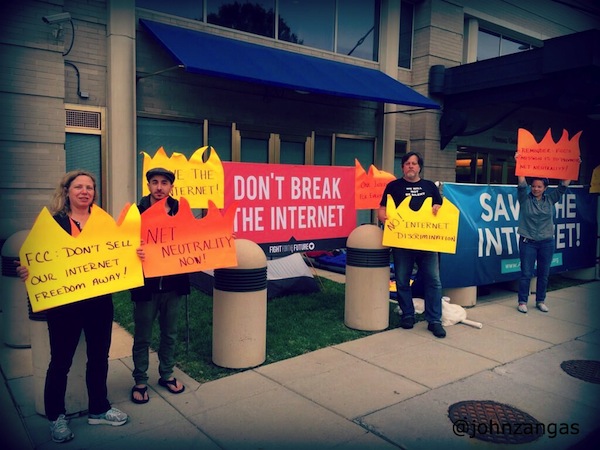
We're camping out day and night on the FCC's doorstep to defend net neutrality and keep the Internet free from discrimination and "slow lanes" Schedule at the FCC Camp This Week: Monday-Dinner Provided by Golden Frog (Let us know you’re coming so there is enough food, info@PopularResistance.org). Tuesday-Performance night, music and spoken word, bring your instruments. Wednesday-Art Build. Thursday-Rally at 9 AM, Open Commission Meeting at 10:30. Last week we wrote about the importance of taking action to save the Net. The Chairman of the FCC Tom Wheeler is proposing new rules that will be great for Comcast, AT&T, and Verizon, but terrible for the rest of us. The FCC has been surrounded by corporate lobbyists for too long. On Wednesday we decided that we had to follow our own advice and decided to take action. We have set up an encampment outside of the FCC and each day are taking action to push the people’s interest in a free, open and equal Internet. These next few days, up to the meeting of the FCC Commissioners on the 15th are a critical time for us to set the agenda and protect the public interest.

Talk of an Internet Fast Lane Is Already Hurting Some Startups

Some venture capitalists at the cutting edge of Internet innovation say they will shun startups requiring fast connections for video, audio, or other services, mindful that the U.S. Federal Communications Commission may let ISPs charge extra fees to major content providers. Proposed rules being drafted by the FCC’s chairman, Tom Wheeler, would allow ISPs to charge content providers like Netflix to ensure speedy service, so long as those charges are “commercially reasonable.” The rules are scheduled to be released for public comment May 15. In the absence of clear rules, some ISPs have already begun requesting—and receiving—access fees. Netflix recently agreed to pay big ISPs like Comcast interconnection fees to ensure a high quality of service, but Netflix CEO Reed Hastings then wrote in a blog post that the United States needs a strict form of net neutrality, with no such tolls, because users who are already paying high prices for fast service should be able to get what content they want.

Fifty Capital Investors Write FCC Opposing End Of Net Neutrality

Would it be possible to build the next YouTube or the next Netflix if big ISPs like Comcast and Verizon were allowed to charge companies for a "fast lane" that privileged their data? That has been a major concern for tech investors and entrepreneurs ever since the FCC lost its court battle with Verizon back in January. Today a group of leading venture capitalists published an open letter to the FCC calling on them to prevent what they say would be the end of net neutrality and a crippling blow to young startups. ""The internet will no longer be a level playing field."" "If established companies are able to pay for better access speeds or lower latency, the internet will no longer be a level playing field," they write. "Startups with applications that are advantaged by speed (such as games, video, or payment systems) will be unlikely to overcome that deficit no matter how innovative their service." The group includes investors from around the country, including Union Square Ventures, Andreessen Horowitz, First Round Capital, and many more. Collectively they have funded companies like Twitter, Facebook, Foursquare, Tumblr, and others. You can read their full letter here. They join a group of the world's biggest tech companies who filed a protest with the FCC yesterday.

Google, Facebook And Amazon Write FCC Demanding True Net Neutrality

More than 100 technology companies including Google, Facebook, Twitter and Amazon have written to US regulators to warn that proposed net neutrality rules pose a "grave threat to the internet". The intervention comes against a backdrop of protest at Federal Communications Commission plans that opponents say will create a two-tier internet where big corporations are able to transmit their content to recipients at much higher speed, disadvantaging smaller competitors and other users. The internet companies' letter to the FCC chairman, Tom Wheeler, and the agency's four commissioners comes amid calls for a delay in a vote on the plan that is scheduled for 15 May. The letter says FCC rules should not permit "individualised bargaining and discrimination," the companies said. "[The FCC must] take the necessary steps to ensure that the internet remains an open platform for speech and commerce," the letter says. One of the FCC commissioners, Jessica Rosenworcel, has called for a delay of "at least a month" on Wheeler's plan. "Rushing headlong into a rulemaking next week fails to respect the public response to his (Wheeler's) proposal," she said.

Public Outcry On Net Neutrality Rules Puts Pressure On FCC

Commissioners on an FCC panel which could determine the future of the Internet are feeling the heat this week as protest intensifies against a new set of Open Internet rules proposed by Chair Tom Wheeler. Advocates for Net Neutrality claim the rules would result in just the opposite of a free and open Internet, and their outrage has sparked a massive reaction. Apparently the din has reached the ears of commissioners, and they’re having an effect. FCC Commissioner Jennifer Rosenworcel is urging Wheeler to delay consideration of new rules for at least a month. “I believe that rushing headlong into a rulemaking next week fails to respect the public response to his proposal,” she said. On Thursday another commissioner came out against the plan. “I have grave concerns about the Chairman’s proposal on Internet regulation and do not believe that it should be considered at the Commission’s May meeting,” said Ajit Pai in a statement. A third commissioner has stated his commitment “to preserve an ever-free and open Internet.” “Over 100,000 Americans have spoken,” wrote Mygnon Clyburn on the FCC website, referring to tens of thousands of emails and hundreds of phone calls received by the FCC. “I am listening to your voices.”

Democratic FCC Commissioners Ask Wheeler To Slow Down Net Neutrality Proposal

Federal Communications Commission chairman Tom Wheeler may have just hit a snag in rushing his net neutrality proposal into the procedure pipeline at the May 15 meeting. On Wednesday, both Democratic commissioners Jessica Rosenworcel and Mignon Clyburn pushed back on Wheeler's net neutrality proposal. They represent critical votes that Wheeler needs in order to move the proposal forward. Both are being bombarded by consumers that are worried Wheeler's proposal doesn't go far enough in preserving an open Internet. In a blog post, Clyburn noted that "over 100,000 Americans have spoken" via email, calls and letters. Rosenworcel, citing the outcry, said she thought the commission should delay consideration of the rules by at least a month. "I have real concerns about the process," Rosenworcel said in a speech before the Chief Officers of State Libraries in Washington, D.C. "His [Wheeler's] proposal has unleashed a torrent of public response. Tens of thousands of e-mails, hundreds of calls, commentary all across the Internet. We need to respect that input, and we need time for that input. So while I recognize the urgency to move ahead and develop rules with dispatch, I think the greater urgency comes in giving the American public opportunity to speak right now, before we head down this road."

Technology Open Internet Backers Stage ‘Occupy FCC’

Internet libertarians calling for the equal treatment of all Internet data have camped out in front of the Federal Communications Commission (FCC) in Washington, D.C., saying they won’t quit their Occupy-style protest until the regulator stands up for Net neutrality. About 15 people stood outside the FCC’s headquarters on Wednesday afternoon in a protest organized by the two groups, Fight for the Future and Popular Resistance. Five of the demonstrators said they were determined to set up camp overnight and stick around until May 15, when the commission is set to unveil proposed new Net neutrality rules — or perhaps longer, if the new rules don’t meet their expectations. Margaret Flowers of Popular Resistance says members of the protest – officially called “Camp Out to Save Net Neutrality” or “People’s Firewall FCC Camp” and unofficially as “Occupy FCC” – are in it for the long haul, bringing sleeping bags, signs and chants, such as “Hey, hey FCC, the Internet must be free” and “FCC drop the barrier, make the Internet a common carrier.”

FCC Response To Our Emails: “Open” Internet Is Not An “Equal” Internet

The FCC began sending out responses to the thousands of people who sent an email to Chairman Tom Wheeler from Popular Resistance. Our emails focused on protecting net neutrality so there would not be discrimination on the Internet ...Wheeler's response missed the point and highlighted the conflict in our views. An Open Internet is not the same as an equal internet with net neutrality. I can get on an open highway and be relegated to the slow lanes, while wealthier people get on the same highway but are allowed to go to the fast lanes. That is an "Open Internet" but it is not the kind of information superhighway we want the Internet to become. Today, we are going to the FCC at 445 12th St., NW and begin ongoing protests at noon and 5 PM each day until May 15th when the FCC holds its Open Internet Meeting . We hope you will join us so we can save the Internet from becoming a class-based, tiered service. Net neutrality is the Free Speech issue of the 21st Century.

Five US Internet Providers Are Slowing Down Access Until They Get More Cash

So why hasn't interconnection been a bigger part of the network neutrality debate? Until recently, it was unheard of for a residential broadband provider like Comcast to demand payment to deliver traffic to its own customers. Traditionally, residential broadband companies would accept traffic from the largest global "backbone" networks such as Level 3 for free. So anyone could reach Comcast customers by routing their traffic through a third network. That limited Comcast's leverage. But recently, the negotiating position of backbone providers has weakened while the position of the largest residential ISPs — especially Comcast, Verizon, and AT&T — has gotten stronger. As a consequence, the network neutrality debate will be increasingly linked to the debate over interconnection. Refusing to upgrade a slow link to a company is functionally equivalent to configuring an Internet router to put the company's packets in a virtual slow lane. Regulations that try to protect net neutrality without regulating the terms of interconnection are going to be increasingly ineffective.

FCC’s New Net Neutrality Rules Could Disempower Communities of Color

Out of 1.2 trillion Google searches in 2012, Trayvon Martin was the ninth most searched event. But the unarmed black teen who was fatally shot in Florida may have never become a household name if it wasn’t for Twitter, Facebook and the blogs that kept his story in the news until it reached a national level. Now black and Latino net neutrality advocates say it will be much harder, and maybe even impossible, to catapult stories like Martin’s to a national level if new Federal Communications Commission (FCC) ‘fast lane’ rules are implemented. Martin was shot dead by George Zimmerman on February 26, 2012. It wasn’t until March 16 that national coverage of Martin’s death intensified. But in those three weeks, small local news sites, blogs and black news sites continued reporting on the story until it was one that national broadcast networks could no longer ignore. Internet neutrality advocates (or activists who believe that all Internet traffic should be treated equally) say a similar media experience like Trayvon Martin’s would be harder to replicate if the FCC’s new rules are implemented.
assetto corsa mods

Urgent End Of Year Fundraising Campaign

Online donations are back! Keep independent media alive. 

Due to the attacks on our fiscal sponsor, we were unable to raise funds online for nearly two years.  As the bills pile up, your help is needed now to cover the monthly costs of operating Popular Resistance.

Urgent End Of Year Fundraising Campaign

Online donations are back! 

Keep independent media alive. 

Due to the attacks on our fiscal sponsor, we were unable to raise funds online for nearly two years.  As the bills pile up, your help is needed now to cover the monthly costs of operating Popular Resistance.

Sign Up To Our Daily Digest

Independent media outlets are being suppressed and dropped by corporations like Google, Facebook and Twitter. Sign up for our daily email digest before it’s too late so you don’t miss the latest movement news.