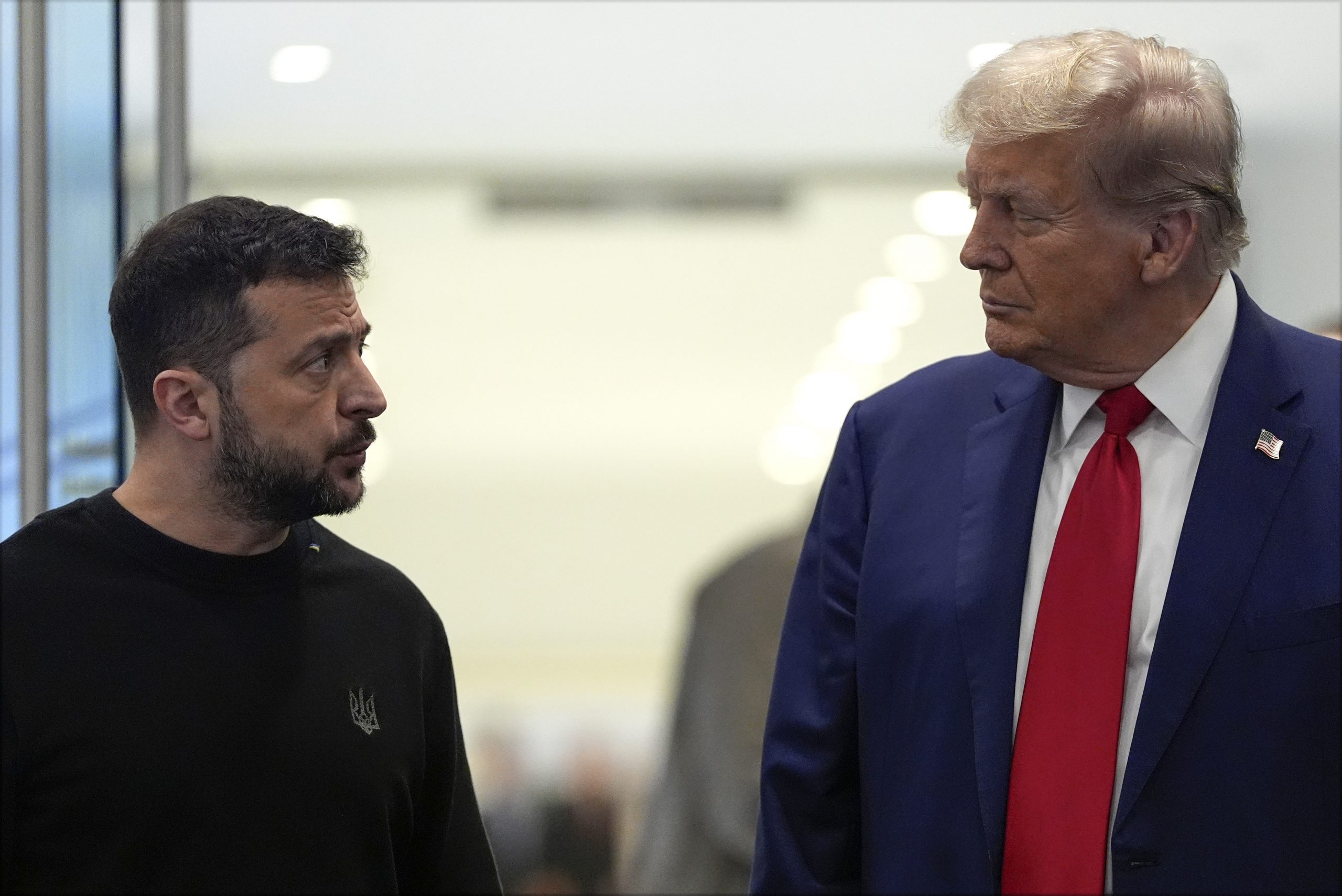
Above photo: Julia Demaree Nikhinson. AP.
It there any politician who is less reliable than U.S. President Donald Trump?
At the August summit in Anchorage with President Vladimir Putin of Russia Trump had aimed at a ceasefire along the frontline in Ukraine. But Putin made clear that the war required a long term solution of the underlying problem, NATO enlargement, and that a preliminary ceasefire would not be helpful in that regard. Russia also demanded full control of the Donbas and other regions.
Trump did agree to that and announced it as the brilliant result of the talks. This was his first turn on the issue.
But Ukraine’s (former) President Zelenski rejected any retreat from the regions Russia intends to acquire. European politicians, who fear losing the war against Russia, chimed in. Republican war hawks in Congress likewise put pressure on Trump.
A month after the talks in Alaska Trump again changed his position. This was his second turn. He criticized Putin and threatened Russia with new sanctions. Talk about sending Tomahawk cruise missiles to Ukraine crept up.
A day before Zelenski was supposed to visit the White House Putin preemptively intervened by holding a phone call with Donald Trump. There followed another, the third, change in mind. Trump announced that there would soon be another summit. The Kremlin was more cautious with that claim. It said that a summit would need extensive preparation.
The Europeans, Zelenski and Republican hawks immediately renewed their campaign against any agreement with Russia.
A phone call between the Secretary of State Marco Rubio and Foreign Minister Sergei Lavrov followed. After the call any further preparations for another summit were called off.
Trump turned again – the fourth time – and again demanded a ceasefire in Ukraine. The Russians said that this constitutes a breach of the agreements reached during the Anchorage talks.
While Trump nixed any talk of Tomahawks for Ukraine he lifted restriction on Ukraine’s use of long-range missiles (archived) to be fired into Russia:
The unannounced U.S. move to enable Kyiv to use the missile in Russia comes after authority for supporting such attacks was recently transferred from Defense Secretary Pete Hegseth at the Pentagon to the top U.S. general in Europe, Gen. Alexus Grynkewich, who also serves as NATO commander.
The U.S. also issued sanctions against two major Russian oil companies (archived) and their subsidiaries:
President Trump announced on Wednesday that he was imposing significant new sanctions on Russia for the first time in his second term, underscoring a new degree of frustration with President Vladimir V. Putin after a plan for the two leaders to meet in Budapest fell apart.
The new sanctions were announced just as the president sat down in the Oval Office with NATO’s secretary general, Mark Rutte, who had flown to Washington on behalf of a coalition of European leaders desperate to keep Mr. Trump on the side of Ukraine.
…
Mr. Trump’s irritation with the Russian leader was evident on Wednesday. “Every time I speak with Vladimir, I have good conversations, and then they don’t go anywhere,” he said. “They just don’t go anywhere.”He explained his decision to scupper the Budapest summit that had been planned for some time in the coming weeks. “It just it didn’t feel right to me,” Mr. Trump said. “It didn’t feel like we were going to get to the place we have to get. So I canceled it.”
As for the sanctions?
“I just felt it was the right time,” he said.
On the same day Russia’s President Putin felt it was the right time to test Russia’s nuclear tirade:
“Today, we are conducting a planned – I want to emphasize, planned – nuclear forces command and control exercise,” Putin said in a video conference with the top military brass.
…
Videos shared by the state-owned military TV channel Zvezda showed the launch of a Yars intercontinental ballistic missile from the Plesetsk Cosmodrome in Russia’s north and a Sineva ballistic missile fired from the Bryansk nuclear-powered submarine in the Barents Sea. Tu-95MS long-range bombers also fired air-launched cruise missiles, the defense ministry said.
The new sanctions will, like any before them, have little effect on Russia. Global oil prices will increase and Russia will find ways to market its oil at higher prices.
Sanctions don’t work. The U.S. Government Accountability Office recently found that the U.S. is flying blind and even lacks the means to measure the effect of sanctions it imposes:
U.S. agencies primarily responsible for implementing sanctions and export controls on Russia have not established clearly defined objectives linked to measurable outcomes with targets for their activities. As a result, agencies cannot fully assess progress towards achieving their objectives, thus limiting the U.S. government’s ability to determine the effectiveness of its broader sanctions and export controls efforts related to Russia. This information is crucial for improving current efforts and informing the future use of sanctions and export control.
China has already announced that it rejects any secondary sanctions the U.S. will try to impose as China continues to buy Russian oil. India, which pays for Russian oil in Yuan, will likely react in kind.
The EU just issued its 19th round of sanction against Russia. None of these rounds have influenced Russia while all of them have damaged economies in Europe. As a saying, misattributed to Albert Einstein, goes: “Insanity is doing the same thing over and over again and expecting different results.”
There is simply no way for the U.S. and/or its European vassals to prevent a Russian victory in Ukraine. To insist on a different outcome will not change the facts on the ground.
As Aaron Maté writes:
When it comes to intransigence, the Beltway’s is not in dispute. The prevailing outlook was captured earlier this year by longtime Republican Senate leader Mitch McConnell. “It seems to me pretty obvious that America’s reputation is on the line,” McConnell told Defense Secretary Pete Hegseth. “We don’t want a headline at the end of this conflict that says Russia wins and America loses. That’s extremely important if we’re going to continue to play the role in the world that the vast majority of members of Congress think we should still play.”
…
The alternative to McConnell’s refusal to “lose” is compromise. As Fiona Hill, a Russia expert who served in Trump’s first term, recently put it: the Russians are “always want something they can take to the bank, an agreement they can hold the U.S. to.” In other words, the Russians are interested in diplomacy – a concept foreign to veteran lawmakers and bureaucrats in Washington. If Trump is serious about ending the Ukraine proxy war, he will have to move beyond his ritual back and forth with Zelensky and defy a more powerful obstacle to peace in Washington.
Trump seems to know that he can only end the war with a compromise that will largely give Russia whatever it wants. But lacks the support, will and power to achieve it.