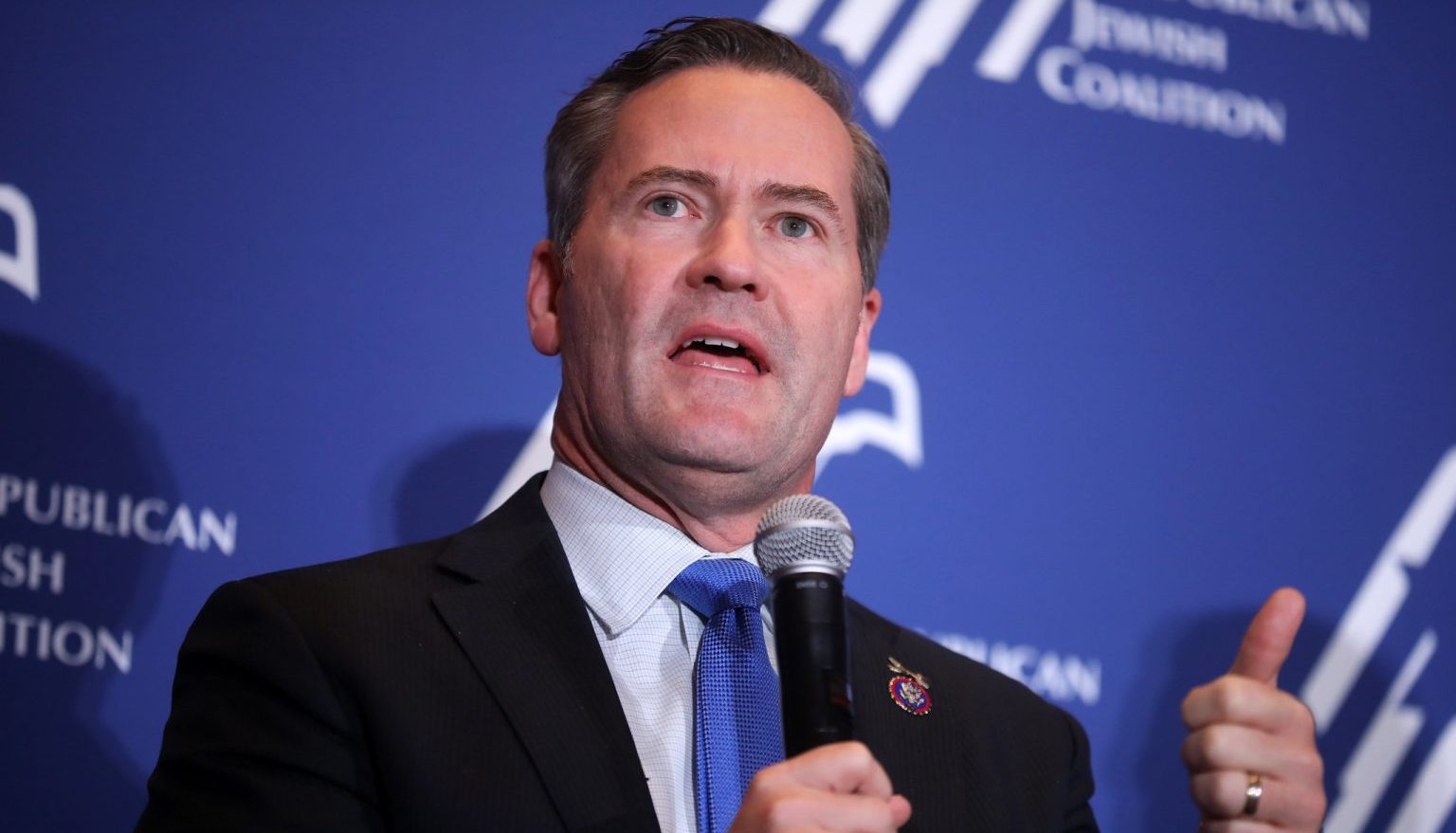
Above photo: Michael Waltz speaking with attendees at the Republican Jewish Coalition’s 2023 Annual Leadership Summit in Las Vegas, Nevada. Gage Skidmore.
U.S. negotiations with Iran over its nuclear program continue to show signs of success.
But Merav Ceren’s appointment to the National Security Council shows the institutional power pro-Israel forces will have to sink a deal.
On Saturday, the United States and Iran will hold another round of talks in Muscat, the capital of Oman. The aim is to continue to advance talks on Iran’s nuclear program.
Thus far, the talks have gone well, but, as I have explained on several occasions recently, there are serious difficulties to overcome. These include the fact that Iran, having not pursued a nuclear weapons program to any degree since 2003, starts from a grudging position where it, justifiably, wonders why it should compromise over a non-issue. Meanwhile, the United States, which, along with Israel, has created a terrifying image of a nuclear-armed Iran, is pressing hard for unprecedented intrusiveness in monitoring Iran’s nuclear work.
That just scratches the surface. At this point, the U.S. is holding to its position that Iran will have to sacrifice all of its own nuclear enrichment, including for public use. That will put even its civilian program at risk if the U.S. decides in the future to once again abandon the agreement as Trump did in 2018.
Yet positive signs are emerging even now. On Tuesday, a prominent voice from Iran’s hardline Islamic Revolutionary Guard Corps (IRGC) stated in an interview with an Iranian news outlet that the IRGC supports the nuclear talks. This was a clear reflection that the Supreme Leader is putting some weight behind the negotiations and is pressing his aides to fall in line. Other Iranian hardliners have also expressed support.
Meanwhile, Iranian Foreign Minister Abbas Araghchi, who is heading up the talks, made a tempting offer to Trump when he spoke of Iran’s long-term plan to build 19 civilian nuclear reactors, a project that would be wide open for foreign investment. Trump understands this language well, and he would like to reinvigorate the American nuclear sector.
Trump needs a win badly. He has been forced to back away from his beloved tariffs and the American economy hasn’t even begun to feel the worst effects of his economic ignorance. His early success in pressing Israel into a temporary and incomplete ceasefire is largely forgotten under the shadow of an Israeli blockade and onslaught that has brought the genocide in Gaza to a new level, and his promise to end the Russia-Ukraine war has been a dismal failure.
This is a win he can actually get. The path to a deal with Iran is there, but Trump needs to be willing to walk it.
That starts with the question of Iranian nuclear enrichment.
Iran appears open, but is hedging its bets
A handful of countries that do not possess nuclear weapons enrich their own uranium for civilian purposes. These include Argentina, Brazil, Germany, Japan, the Netherlands, and Iran. Robust inspections, such as those that were carried out under the JCPOA (the 2015 Iran nuclear deal) by the International Atomic Energy Agency (IAEA), can reliably ensure all but the most paranoid of Iran’s compliance with any new deal on enrichment. It’s not necessary to ban it all.
Iran insists on its own enrichment program because, as it exports even more of its oil and natural gas to rebuild its economy so badly damaged by sanctions, it will need to rely more on civilian nuclear power. It is certainly feasible, and might even be cheaper for Iran, to allow another country to enrich uranium for it. Russia has filled that role before, although the arrangement was not without its problems.
But given the lack of reliability of its foreign interlocutors, including both the United States and Russia, Iran is loath to rely on their goodwill to maintain the level of nuclear energy they will need for domestic consumption in the coming years.
These are concerns that the United States should be able to understand. Trump may have a harder time with that, but the prospect of American investment in the construction of nuclear reactors that Araghchi dangled should be a factor in overcoming any hesitancy.
It also seems likely that Iran is prepared to allow very robust and intrusive inspections and monitoring of its facilities. It did so under the JCPOA, and it would be unreasonable for them to enter into these talks if they were not prepared to do so again.
But they are not fools in Tehran. Iran has nearly completed a new security perimeter around the Natanz enrichment facility, and it is believed they are using the tunnel system inside that perimeter to store advanced centrifuges and enriched uranium.
This has raised alarms at the IAEA, which has not been permitted access to the tunnel system. But it is both a wise precaution in the event that talks break down and a useful bargaining chip to move toward sealing a deal with the U.S. If such a deal is reached, it would be easy enough for Iran to open the tunnels to IAEA inspection. It is certain that any deal would include access to Natanz and the tunnel network around it.
Another pro-Israel voice at the NSC
The Trump administration was divided from the outset in its approach to Iran. Both Vice President JD Vance and Trump himself have been publicly reluctant to involve the United States directly in large-scale warfare, although they are both more than happy to see other states fight the battles for them.
But other figures such as Secretary of Defense Pete Hegseth and National Security Adviser Mike Waltz are both known to support military action against Iran. Their positions have been somewhat weakened of late, but they have powerful backing from the right wing and pro-Israel policy ecospheres in Washington, and that has been sufficient to convince Trump to deploy a good deal of American military might near Iran in obvious preparation for a potential attack.
That influence was reflected last week in Merav Ceren’s appointment as Director for Israel and Iran at the National Security Council. Many observers were concerned when the appointment was revealed.
Ceren, who was born in Israel but raised in the United States, is a strong pro-Israel figure, dating back to her undergraduate days. She also worked as an intern in the Israeli Ministry of Defense, where, according to her bio at the Foundation for the Defense of Democracies, “she participated in negotiations in the West Bank between Israel’s Coordinator for Government Activities in the Territories and Palestinian Authority officials.”
Ceren’s appointment, in itself, is not cause for real concern. Though it’s not entirely clear if she holds dual Israeli and American citizenship, her experience working in the Israeli Defense Ministry and her obvious and passionate attachment to Israel don’t really differentiate from many right-wing Americans, Jewish and not, on this issue.
Ceren’s previous experience working for the far-right Senator Ted Cruz and as a congressional staffer, and her long-time activism in support of Israel, make her a fairly typical nominee.
Indeed, it is the fact that Ceren is unremarkable for her connections to Israel that is so concerning. This is reflective of the sort of NSC that Waltz runs and of Waltz’s own views on the Middle East.
When Israel recently pitched a plan for a joint attack on Iran, even Pete Hegseth joined Vance and Director of National Intelligence Tulsi Gabbard in opposing it. Waltz did as well, but only because American support wasn’t there and he assured Israel, correctly, that such an operation could not succeed with Israel going it alone.
Waltz and often Hegseth are generally supported by Secretary of State Marco Rubio. Rubio has been particularly vocal lately in putting forth the insistence on zero enrichment for Iran, which would be a deal-breaker. But even by the standards of Trump’s cabinet, Rubio is a mouthpiece for the President, who carries little weight on his own. It’s likely that Rubio’s statements are part of the administration’s attempts to mollify their pro-Israel and neoconservative critics, but in any case, by himself, Rubio’s views don’t go far in determining policy.
That all means that the key factor remains Trump’s need for a splashy political win. It’s apparent from the tone and what has been reported about the substance of the talks that Trump doesn’t really care much about a harsher deal than the one that Obama negotiated. What he wants is a Trump deal, not one made by Obama.
That desire, along with Trump’s reluctance to put American soldiers into direct combat on foreign shores, provide significant incentive to reach a deal. Israeli Prime Minister Benjamin Netanyahu and his many ideological fellow travelers and supporters in the United States know that, and they will surely pull out all the stops they can to steer Trump in a different direction.
Democrats will be tempted to see Trump fail. But this is a time to put such petty politics aside. Reinstating a nuclear deal with Iran and defusing the potential for a regional war in the Persian Gulf is an unusual circumstance: it’s one where that outcome is good for supporters of peace, for Republicans, for Democrats, for Iranians, for all the people and the leadership of Arab states in the region.
In this matter, it is imperative that Donald Trump be supported in staying the course of finding a reasonable agreement with Iran. He is going to be pushed hard in the opposite direction.