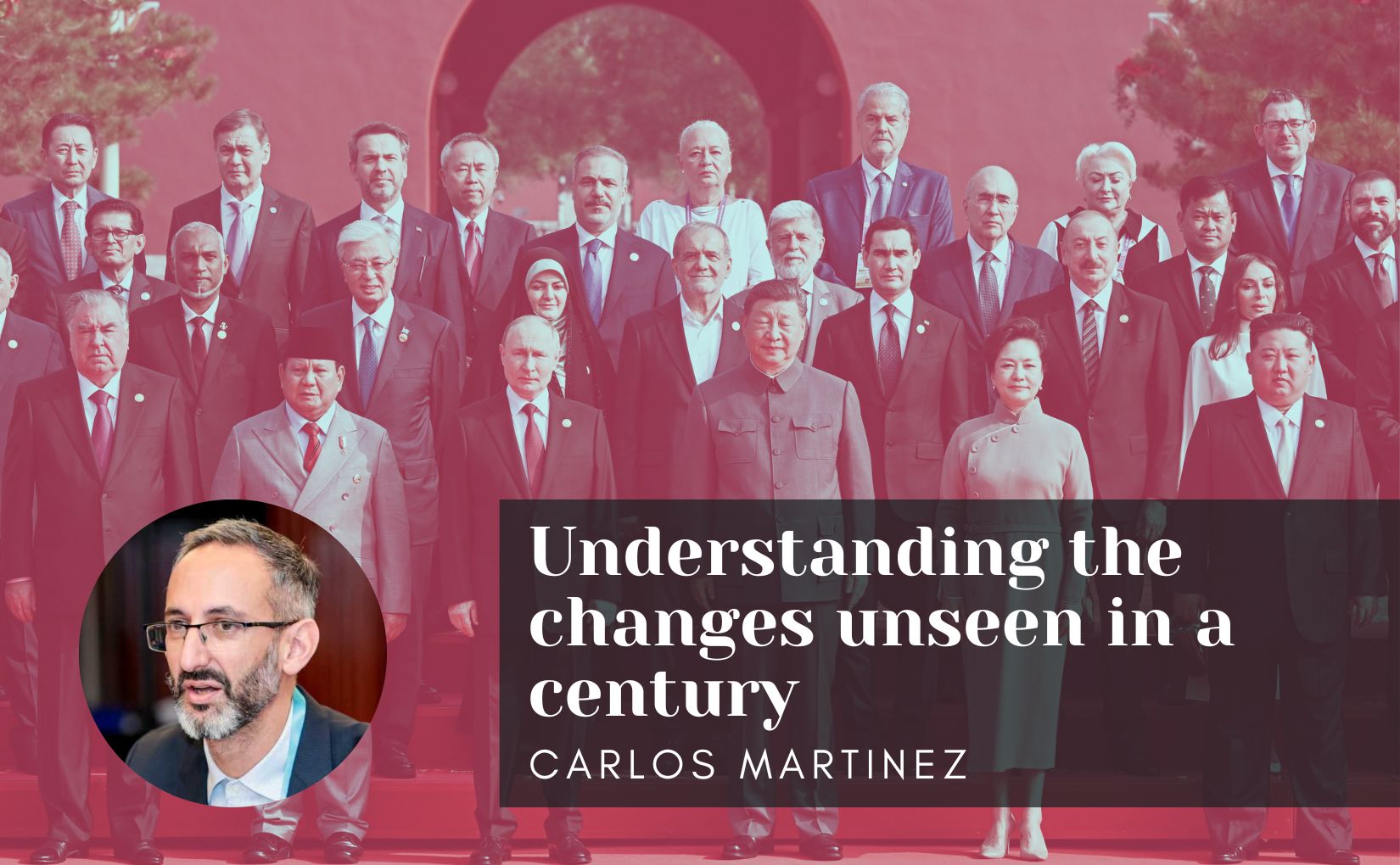
Note: The following text is based on a presentation given by Friends of Socialist China co-editor Carlos Martinez at the Thinkers Forum, held at Fudan University, Shanghai, on 16 October 2025, which event brought together thinkers and scholars from around the world to discuss “Global Changes and the Reshaping of the World Order.”
Carlos explores the meaning of Xi Jinping’s observation that “the world is undergoing profound changes unseen in a century”, arguing that these changes reflect a historic shift from Western-led unipolar dominance toward a multipolar, post-imperialist global order. The article traces these changes back to the October Revolution of 1917, which opened a new era of socialist development and anti-colonial liberation.
After the setbacks of the 1980s and 1990s — including the collapse of the Soviet Union and the rise of neoliberal globalisation — Western commentators like Francis Fukuyama declared “the end of history”. Yet, as Deng Xiaoping noted, history advances through contradictions and reversals. The 2008 financial crisis, widening inequality and environmental collapse have since exposed the limits of neoliberal capitalism.
Meanwhile, a multipolar world is emerging. China stands at the centre of this process, advancing initiatives such as the Belt and Road, the Global Development Initiative, and the Global Governance Initiative — all based on sovereignty, non-interference, and mutual benefit. Such efforts are helping countries of the Global South break from dependency and pursue sustainable, sovereign development.
The US and its allies, meanwhile, cling to hegemony through wars, sanctions, economic coercion and destabilisation. Humanity faces a stark choice: socialism or barbarism, cooperation or confrontation. Carlos concludes by calling for a global united front of socialist, anti-imperialist, and progressive forces to ensure that this century’s transformations lead to peace, justice, and sustainable development.
Carlos’s presentation was summarised in the popular Chinese news website Guancha.
General Secretary Xi Jinping has observed several times that “the world is undergoing profound changes unseen in a century”. What are these changes, and what are their implications for the current global situation?
Before addressing the changes the world is experiencing today, it is worthwhile reflecting on the major changes that occurred a century ago, since the dramatic shifts of that time laid the foundations for the transformations we are witnessing now.
The October Revolution of 1917 was a watershed moment marking the beginning of humanity’s transition from capitalism to socialism. The revolution in Russia led to the formation of the world’s first socialist state – the Soviet Union – which became a revolutionary base area for the working class and oppressed peoples of the world. The Soviet Union provided crucial support for the liberation of, and construction of socialism in, Eastern Europe, China, Cuba, Korea, Vietnam and elsewhere.
The Soviet Union and China played the decisive role in the defeat of fascism in World War II. This victory gave tremendous impetus to the anti-colonial movement and national liberation struggles around the world – in Africa, in Asia, in Latin America, in the Caribbean and the Pacific. The colonial system was no longer viable.
As such, the October Revolution constituted the first major breach in the imperialist world system, thereby marking the start of the current era of human development.
Of course, history does not move in a straight line. Since the 1980s, the global working class has suffered a series of reversals: the collapse of the Soviet Union and the people’s democracies of Eastern Europe; the rise of neoliberal globalisation; the rolling back of social democratic advances in the West; the reassertion of neocolonialism through structural adjustment programmes and unequal exchange; along with imperialist wars in Iraq, Afghanistan, Yugoslavia and Libya.
In 1992, the American political scientist Francis Fukuyama famously proclaimed “the end of history”, arguing that the dissolution of the Soviet Union and the end of the Cold War marked “the end-point of mankind’s ideological evolution and the universalisation of Western liberal democracy as the final form of human government.”
The End Of The End Of History
That same year, however, Chinese leader Deng Xiaoping put forward a more dialectical analysis:
Feudal society replaced slave society, capitalism supplanted feudalism, and, after a long time, socialism will necessarily supersede capitalism. This is an irreversible general trend of historical development, but the road has many twists and turns. Over the several centuries that it took for capitalism to replace feudalism, how many times were monarchies restored! So, in a sense, temporary restorations are usual and can hardly be avoided. Some countries have suffered major setbacks, and socialism appears to have been weakened. But the people have been tempered by the setbacks and have drawn lessons from them, and that will make socialism develop in a healthier direction. So don’t panic, don’t think that Marxism has disappeared, that it’s not useful any more and that it has been defeated. Nothing of the sort!
Indeed, the “end of history” did not last long. While neoliberal capitalism was able to postpone the inevitable crisis through financialisation and the massive transfer of surplus value from Global South to Global North – by virtue of technological changes enabling global supply chains, just-in-time production, and so on – the contradictions inherent in the system asserted themselves with a vengeance, starting with the financial crash of 2007-08.
Capitalism has been thrown into a prolonged crisis of profitability and productivity, underpinned by the fundamental contradiction between socialised production and private appropriation leading inexorably to overproduction and underconsumption, as patiently explained by Marx in Capital a century and a half ago.
The economic crisis in the West – manifested in stagnant wages, rising prices, rising inequality, austerity policies, and the replacement of stable employment by temporary, part-time, precarious labour in the “gig economy” – is compounded by an ever-more urgent environmental crisis, posing a genuine existential threat to humanity. Meanwhile, the popular revulsion at the West’s wars of aggression, in particular the support of the US and its allies for Israel’s genocidal onslaught on Gaza, has severely undermined the legitimacy of the imperialist world order. The “Project for a New American Century” is running aground.
A Multipolar World Order
In parallel with these developments, a new multipolar world order is emerging. The BRICS grouping (composed of Brazil, Russia, India, China, South Africa, Indonesia, Iran, the United Arab Emirates, Egypt and Ethiopia), along with the Shanghai Cooperation Organisation (SCO), the G77+China coalition of developing countries and various regional bodies, are challenging the unipolar dominance of the US and its Western allies. BRICS now surpasses the G7 in terms of GDP, population and landmass. The process of dedollarisation is accelerating, given momentum by the US’s reckless financial warfare against Russia and other countries.
China lies at the core of this multipolar transformation. As the largest trading partner of two-thirds of the world’s countries; as the initiator of the Belt and Road Initiative (BRI), the Global Development Initiative (GDI), the Global Security Initiative (GSI), the Global Civilisation Initiative (GCI) and most recently the Global Governance Initiative (GGI); as a central pillar of BRICS and the SCO; China is playing a central role in reshaping the global order and in uniting the Global South in opposition to imperialism.
China engages with the world on the basis of international law, respect for sovereignty, non-interference, peaceful coexistence and mutual benefit. It is spearheading the global transition to green energy, and is actively assisting the countries of Africa, Asia, Latin America, the Caribbean and the Pacific to break out of underdevelopment. As such, the model of international relations being advanced by China is highly attractive to the majority of the world’s countries.
Such are the “changes unseen in a century”: a rapid acceleration of the process of overcoming colonialism, overcoming imperialism, and building a new, more just and democratic world order; one which upholds sovereign equality and pursues peace, development and sustainability.
Furthermore, by breaking the stranglehold of the imperialist core (US, Europe, Japan) over the periphery, and allowing countries to determine their own development path, multipolarity “provides the framework for the possible and necessary overcoming of capitalism” (Samir Amin, Beyond US Hegemony? Assessing the Prospects for a Multipolar World, p149).
The Empire Strikes Back
Needless to say, the US and its allies are not going down without a fight. While the US is losing its supremacy in the economic and technological realms, it remains by far the world’s foremost military power, with a vast nuclear arsenal, a global network of military bases, extensive alliances, deployment of tens of thousands of troops and weapons around the world, and the ability to project power globally. US strategists appear to be reverting to a Cold War mentality of “better dead than red”, pursuing an increasingly reckless and confrontational policy of wars, regime change operations and economic coercion.
The US is the prime mover behind the proxy war against Russia in Ukraine; it is intensifying its encirclement of China through military buildup in the Pacific, provocations in the Taiwan Strait and the South China Sea, and the construction of the AUKUS nuclear pact; it is providing unconditional support for Israel as its “unsinkable aircraft carrier” in West Asia. Through its tariff war, its semiconductor export controls, its financial warfare and its vast regime of unilateral sanctions, the US is seeking to hobble the economic rise of its rivals and to punish any nation that dares to defy its diktat.
As such, the world finds itself in a very precarious situation. While we have a clear trajectory towards a brighter future, we also need to urgently address the existential crises facing humanity: climate breakdown, the dangers of unregulated and uncontrolled AI, and the ever-present danger of escalation into nuclear Armageddon.
Navigating this perilous situation will require great wisdom, prudence, patience and flexibility. China’s strategy appears correct in its basic contours: unite the Global South to the greatest degree possible through win-win cooperation based on respect for sovereignty and non-interference; neutralise the intermediate zone by strengthening trade relations with the countries of Europe and elsewhere; avoid falling into the various traps being laid by the US; continue to provide desperately-needed leadership on clean energy and environmental protection; and continue to pursue military modernisation – whilst maintaining a clear, consistent, defensive posture – in order to reduce the imperialists’ appetite for World War III.
The other major change a century ago was the rise of fascism as the last-ditch effort of a dying capitalist order to suppress the revolutionary aspirations of the working class and oppressed peoples. A fascist resurgence should by no means be precluded. The stakes could hardly be higher: it is either socialism or barbarism.
Everyone has a role to play in building a global united front – composed of the socialist countries, the national liberation movements, the anti-imperialist forces of the Global South, and the progressive forces in the advanced capitalist countries – against imperialism, militarism and fascism. Such a united front will be indispensable in ensuring that the changes unseen in a century lead to a new era of peace, development and sustainability for all humanity.