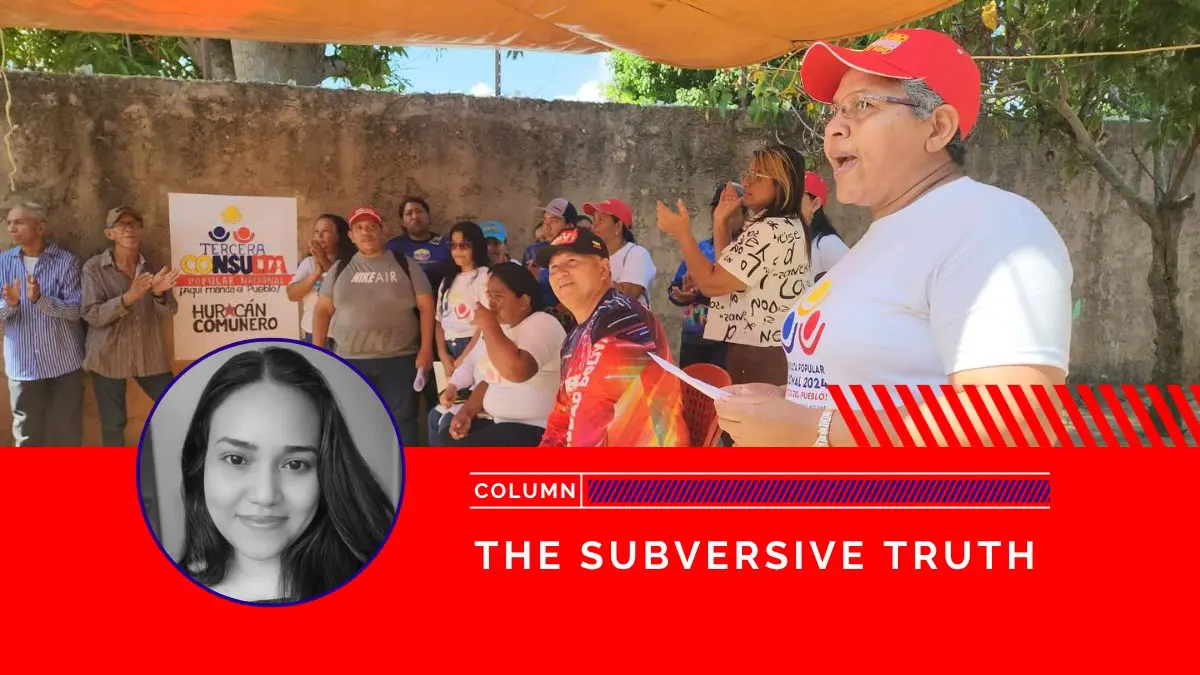
Above photo: In a new edition of “The Subversive Truth,” Chávez sheds light on Venezuela’s democratization.
Andreína Chávez examines Venezuela’s communes and grassroots democracy.
Just in time for Sunday’s “National Popular Consultation.”
The term “democracy” triggers different reactions when it comes to Venezuela. For local far-right forces, democracy has been nonexistent since 1998 and can only be restored by dismantling everything that evokes popular power, self-determination and social justice.
In the hawkish eyes of the United States, “democracy” is an excuse to punish sovereign nations with economic sanctions and blockades until regime change is achieved. Whether elections are fair and free is irrelevant for US “democratic” standards, as are human rights abuses, as long as a country complies with US interests. Ecuador under Daniel Noboa and El Salvador under Nayib Bukele are obvious examples. Anything that diverges from this stance is deemed undemocratic.
Then, there are the proponents of liberal democracy who insist that choosing representatives is the pinnacle of democratic governance. For them, a country’s claim to democracy hinges on its adherence to liberal principles and nothing else. This perspective often implies that true democracy requires the rotation of political ideologies. Even if one of those models is an enemy of sovereignty and the working class.
However, if you speak to a Venezuelan engaged in grassroots organizing, you’ll find that to them democracy is about much more than counting ballots or electing politicians, and they reject foreign meddling as a matter of principle. True democracy demands a deep commitment to democratizing a country’s political and economic system, ensuring that people have control over the structures and resources that shape their lives.
This principle is embodied in Venezuela’s participatory and protagonistic democracy, where people have a direct voice and a leading role in ruling their own destinies. This is best exemplified in Venezuelan communes—assembly-based grassroots organizations where people exercise sovereignty over their territories, community spaces, and in the most advanced cases, means of production.
A Venezuelan commune is typically formed by the coming together of several communal councils—each consisting of dozens of families from the same neighborhood—alongside social property enterprises and social movements. It requires legal registration to access state resources, funding and training programs.
The commune movement was integral to President Hugo Chávez’s socialist project, famously encapsulated in his 2012 speech, “Commune or Nothing!” Communes aim to decentralize power, promote collective ownership and grassroots democracy. Contrary to right-wing narratives, substantive democracy is crucial for building socialism.
According to the Ministry of Communes, Venezuela is home to 4,505 communes nationwide, encompassing around 49,000 communal councils as well as around 829 Communal Circuits, which are considered communes in the making.
However, the success of communes varies significantly based on local contexts, with most of them still in the process of fully developing their identity, governance structures, political objectives and socio-productive initiatives.
While not all communes are well-established, most showcase the potential for self-organization. For instance, El Panal Commune in Caracas, founded in 2006, is known for its political education programs and planned economy. Last year, Marxist thinker and legendary Palestinian fighter, Leila Khaled, visited El Panal and described Venezuelan communes as “the foundation upon which the socialist project stands,” linking them to the worldwide anti-imperialist struggle.
Although they operate with a degree of autonomy, communes collaborate with local and national-level authorities to secure resources for their initiatives. This partnership is not contradictory; rather, it highlights communes as vital components of Venezuela’s broader social and political landscape. The government relies on communes to further the socialist path by transferring state power to them. You could call it a mutualistic symbiotic relationship.
Regardless of their level of consolidation, every commune plays a vital role in organizing the grassroots voting initiatives launched last year to strengthen participatory and protagonistic democracy: the National Popular Consultations. Successfully held in April and August 2024, and in February 2025, these consultations saw citizens aged 15 and older vote on local projects that received government funding.
A fourth consultation is scheduled for April 27, with communes once again organizing both the vote, with support from the National Electoral Council (CNE), and the execution of the chosen projects, as well as rendering accounts to their own communities.
Prior to the vote, communal councils hold assemblies to identify pressing community needs, primarily focusing until now on social services. These proposals are then discussed in 5,334 commune and communal circuit assemblies to reach consensus on up to seven options for voting. Voting takes place across the country, with each circuit selecting one winning proposal.
The winning project receives USD $10,000 from the state, while the runner-up on some occasions receives funding as well. In previous consultations, projects predominantly addressed issues related to water and electricity supply, roads, healthcare, and environmental concerns.
For example, the communal circuit “En Revolución Todos” in the José Laurencio Silva municipality, in the country’s western Falcón state, recently acquired an ambulance and an electric generator for a local medical facility, while the “Comuna Socialista Simón Bolívar” in Caracas’ 23 de Enero neighborhood was able to rehabilitate streets and stairways, benefiting some 4,820 people.
Naturally, questions have been raised about the popular consultations. Do they truly deepen grassroots democracy? And do they relieve elected officials, such as mayors and governors, of their responsibilities?
To the first question, the answer is yes. Voting empowers people to recognize themselves as members of a community, to prioritize issues that affect everyone, and to implement projects, ensuring accountability and optimal results.
The second question, however, misses the point. If citizens gain the power to address community problems and secure funding for innovative social initiatives, politicians can no longer rely on empty election promises and cheap electoral rhetoric like “I will fix this road,” “rebuild schools,” or “guarantee clean streets.”
Popular consultations will compel representative politicians to demonstrate genuine commitment to their constituents rather than merely serving as party figureheads. For example, candidates for the May 25 regional and legislative elections have already pledged to collaborate with communes on policy decisions as equals, rather than acting as local rulers.
As communard Randy García from the “Comuna Socialista Simón Bolívar” stated, “It is we, the people, who prioritize our problems and choose where to start. We are consolidating the country’s communal government.”
Ángel Prado, Minister of Communes and former spokesperson from El Maizal Commune, aptly described these grassroots elections as the embodiment of Venezuela’s “popular socialist democracy.”
That is because communes and popular consultations showcase the country’s deep commitment to building community ties for the future socialist society, breaking away from the hyper-individualism and “survival of the fittest (or richest)” promoted by capitalism.
It’s often said that it takes a village to raise a child; similarly, it takes a whole community to foster social development.