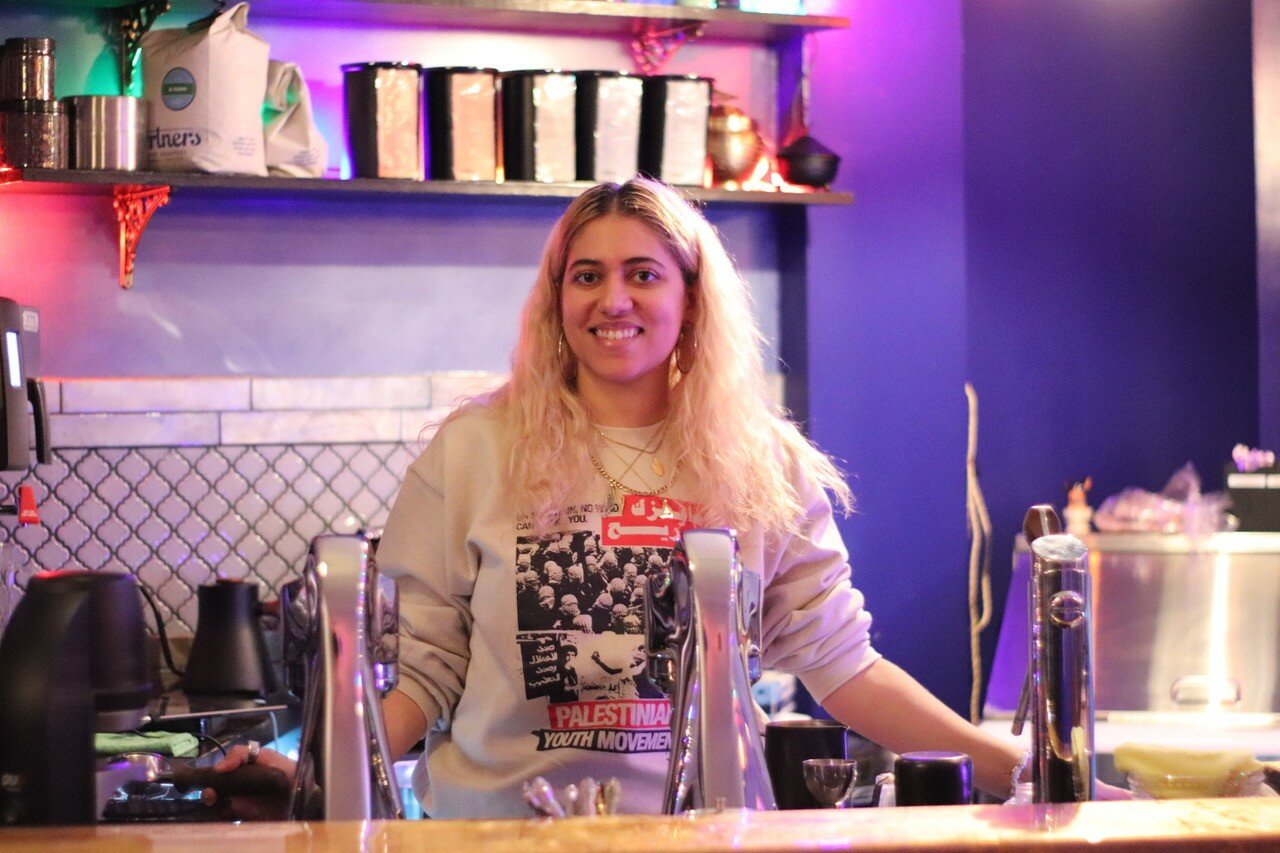
Above photo: Hena Mustafa, a worker-owner at Boyfriend Co-op, a lesbian cafe-bar located in Bushwick, Brooklyn. Camille Luong / The Chief.
Brooklyn’s Boyfriend Co-op shows power of shared ownership.
At most workplaces, there is a boss and an employee. The boss calls the shots — how much employees get paid, what drinks get put on the menu, what the exterior and interior design of the workplace will look like and more. If workers get burnt out, they either get fired or quit, with little say on how things get run or how they could change.
What if, instead, the binary between worker and owners was shattered, and workplaces were run collectively by worker-owners?
This was the question that Boyfriend Co-op, a lesbian cafe-bar in Bushwick, Brooklyn, sought to answer when they opened nine months ago, joining a movement of more than 85,000 worker-owner cooperatives around the world. Boyfriend Co-op currently consists of four worker-owners and two workers on the track to becoming worker-owners. Compared to a traditional workplace, Boyfriend Co-op worker-owners make decisions collectively.
“There’s a different chain of command and hierarchy,” said Hena Mustafa, one of the founders and worker-owners of Boyfriend Co-op. “Basically nobody is structurally above anybody else. It’s one person, one vote, and we all get equal pay, equal say.”
Mustafa described exploitative past work experiences as one of her key motivations in envisioning a more equitable workplace.
“My background before this was in film and television, and that’s a very hierarchical job industry,” she said. “I’ve definitely been under really intense chains of command where I felt overworked, undervalued, underpaid, and underappreciated. Making sure to not bring that into this space was really pivotal.”
At Boyfriend Co-op, the four worker-owners work together to curate the cafe and cocktail menu, design the space and plan events. Although there is a hierarchy of roles — one worker-owner with more expertise in event-planning may take on more of those responsibilities, for instance — there is no hierarchy of person.
To become a worker-owner, people can participate in a “labor buy-in,” working for the cafe-bar for six months and contributing 60 hours to co-op improvement like pitching events, adding menu items and more. Currently, two workers are on that path.
“As not only a worker but also an owner, I feel a lot of responsibility to the space, the community it serves, and the workers that are building it,” said Mustafa.
A larger movement for cooperatives
Following in the footsteps of Boyfriend Co-op and many other worker-owned cooperatives, Dave Dausch plans to turn their pop-up event collective “Dave’s Lesbian Bar” into a permanent, physical worker-owned cooperative.
“We want it to be as fair and as equitable as it can be, and worker co-ops are really the only business structure that we have seen that feels that way,” said Dausch. “It just made a lot of sense that all of our labor is what’s going to make this place, and all of our labor should be valued monetarily in this, since we have to have money.”
To prepare for the launch of their cooperative, Dausch participated in cooperative business management classes led by the Astoria Worker Project, a project by NYC-based nonprofit workforce development organization the Consortium for Worker Education. As they move forward in opening their physical space, Dave’s Lesbian Bar also actively works alongside The Working World, a co-op bank headquartered in New York that funds worker-owned cooperatives around the world.
Not all worker-owned cooperatives have been successful in the city. Lower East Side bookstore “Bluestockings” ran into financial troubles and difficulties maintaining equitable management — leading to their closure in September of this year. When reflecting on the difficulties of maintaining Boyfriend Co-op, Mustafa discussed how the current systems are not designed for cooperative management.
“Cooperative businesses are not a utopia,” said Mustafa. “There’s a big barrier to multiple ownership, especially legally. To bring people on, for instance, we have to add people to our LLC or our liquor license. The current system usually only allows for one person to be in charge of these things.”
But the worker-owners of current and future cooperatives remain optimistic. “I truly believe that there could be a transition to a different system, if people saw an option that really looked viable,” said Dausch.
“There’s an urgency to have autonomy over more spaces, and to build things that have workers in mind,” Dausch continued. “I’ve seen an uptick in worker-owned spaces.”
“So much of this point in history is reimagining different structures of governance — trying to figure out what systems can exist that counteract all the systems that we’re trying to break down right now,” said Mustafa. “I hope that Boyfriend can serve as a model of what kind of structures are possible.”