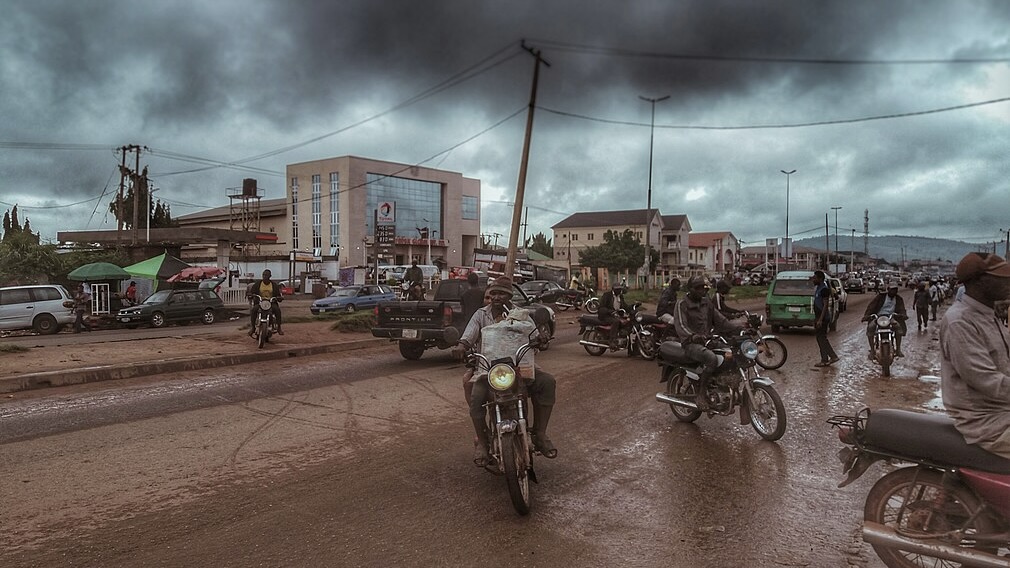
Above photo: Workers in Abuja, Nigeria. Wikimedia Commons.
But Doubles Down On The Reforms Causing It.
Acknowledging that the implementation of its reforms coincided with an increase in poverty, the World Bank nevertheless calls on Nigeria to stay the course.
The World Bank projects that 139 million Nigerians will be living in poverty by the end of this year, a nearly 60% increase from 87 million in 2023, when President Bola Tinubu started implementing the reforms it had prescribed on the first day of his term.
Promising to slash petrol prices during his election campaign, Tinubu declared in his presidential inaugural speech on May 29, 2023, “the fuel subsidy is gone,” overseeing a petrol price hike of nearly 488% in Africa’s largest producer by October 2024.
This also increased the price of electricity multifold because more than 58% of the Nigerian households, left out of the national grid, rely on petrol and diesel generators.
With storage capacity and cold-chain logistics limited, a lack of “reliable access to power also leads to high food losses. It is estimated that production losses amount to 76% for tomatoes, 25% for maize, and 34% for catfish,” the World Bank said in its biannual report on Nigeria, published on October 8, 2025.
The consequent rise in prices of all essentials, including food, was further aggravated by the loss of purchasing power of Nigerians after Tinubu free-floated the currency and unified the exchange rate in mid-June 2023.
At the time, about 465 Naira equaled one US dollar. Reduced to a fraction of its value, a dollar cost almost 1,465 Naira by November 2024, when the UN World Food Program (WFP) warned, “Never before have there been so many people in Nigeria without food.”
“Hunger Protests” had already broken out that August, lasting 10 days before being suppressed by security forces who killed at least 24 and arrested over a thousand, several of whom were tortured in custody.
As thousands thronged for the food parcels handed out in charity events that Christmas, at least 67 people, including 35 children and 22 women, were trampled to death in three stampedes.
The poorest households, 70% of whose total expenditure is on food, are the worst affected, the World Bank observed. Nevertheless, its acknowledgment that poverty and hunger have increased sharply alongside the implementation of the reforms it had prescribed does not lead the Bank to reconsider its policy prescriptions.
Instead, it doubles down on neoliberalism, opening the report’s executive summary with the words, “Nigeria has made substantial progress on macroeconomic stabilization. The government has implemented important reforms since mid-2023”, including the “reunification of the exchange rate” and “removal of the petrol subsidy”.
“Growth has increased; the overall fiscal situation has improved due to a surge in revenue; the foreign exchange (FX) market has been stable and is consolidating; the external position is strong with rising FX reserves and a large current account surplus powered by a surge in exports; and inflation has started to gradually decline.”
While acknowledging that in the meantime poverty has increased from 38.9% to 61%, the Bank evades making the causal connection in its report titled, ‘From Policy to the People: Bringing the reform gains home’.
The press release about the publication of this report is titled “Positive Economic Momentum in Nigeria, Now Time to Bring Home the Gains.” And in order to do so, it prescribes “sustained monetary discipline and structural reforms to tackle food prices”.
This tackling is not to be done by increasing public investment in agriculture and food processing in Nigeria. That would contradict its “urgent” prescription, “Improving the efficiency of public spending”, which is the Bank’s parlance for further squeezing public expenditure.
Instead, it prescribes “tackling food inflation by removing trade barriers such as import bans and excessive duties,” which can flood the domestic market with heavily subsidized produce from the US and other Global North countries, driving Nigeria’s agrarian classes into deeper distress.
As a band-aid, it offers what the press release described as “domestically financed cash transfers for the ultra-poor and a shock-responsive safety net system.”