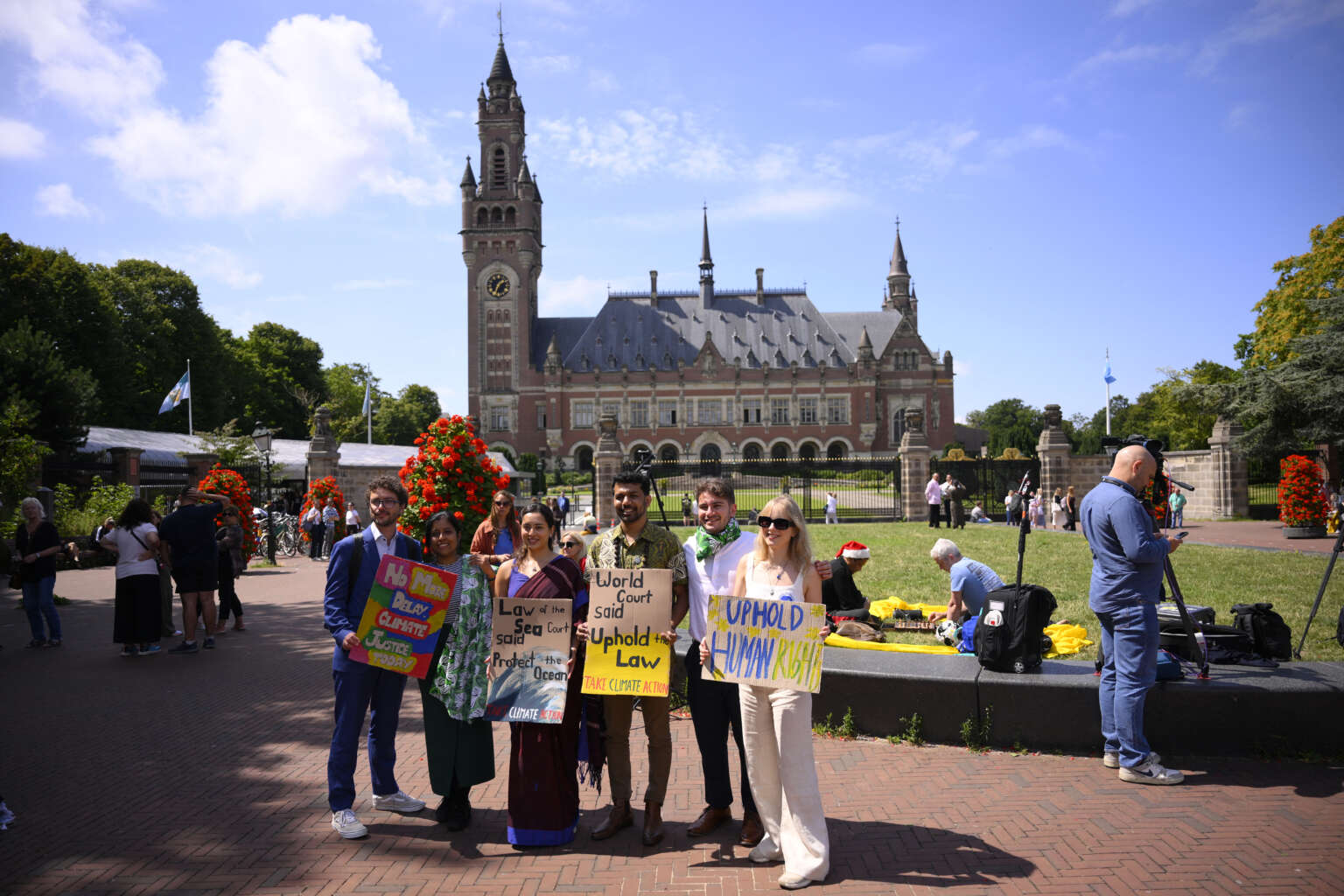
Above photo: Joie Chowdhury, attorney for the Center for International Environmental Law; Vishal Prasad, director of Pacific Islands Students Fighting Climate Change; and Jule Schnakenberg, CEO of World’s Youth for Climate Justice pose with signs ahead of the International Court of Justice session tasked with issuing the first Advisory Opinion on States’ legal obligations to address climate change, in The Hague, on July 23, 2025. John Thys / AFP via Getty Images.
The ICJ’s landmark ruling says there is an international human right to a clean, healthy, and sustainable environment.
A new ruling from the World Court provides climate activists new tools for demanding accountability.
On July 23, in a stunning 140 page advisory opinion, the International Court of Justice (ICJ, or World Court) held for the first time that there is a human right to a clean, healthy, and sustainable environment, and countries have a legal obligation to protect the climate from greenhouse gas emissions. The ICJ found that climate change poses “an existential problem of planetary proportions that imperils all forms of life and the very health of our planet.”
“In a historic breakthrough, the ICJ held unanimously that those who did the least to fuel the climate crisis deserve protection, reparations and a future,” Richard Harvey, legal counsel for Greenpeace International, told Truthout. “The court has blocked every loophole beloved of polluter states and corporations: States must phase out fossil fuel production and consumption. They must regulate the industry and cease to subsidize it.”
Harvey noted: “All 15 Judges held the right to a clean, healthy and sustainable environment is a binding norm of international law and a precondition for the enjoyment of other human rights.” They include the right to life; the right to health; the right to an adequate standard of living; the right to privacy, family and home; and the rights of women, children, and Indigenous peoples.
This was the ICJ’s fifth unanimous advisory opinion of the 29 it has issued in the past 80 years. It was the court’s first decision on climate change and its largest case ever. While not binding, the opinion will invariably be cited by litigants in national, regional, and international courts who seek to hold states legally accountable for failing to prevent significant harm to the environment by not exercising due diligence or all means at their disposal.
More than 100 states and organizations argued before the ICJ from December 2 to 13, 2024, in this landmark case initiated by Pacific Islander law students. The grassroots movement that the students launched had persuaded the UN General Assembly to request an advisory opinion from the ICJ.
On March 29, 2023, UN General Assembly Resolution 77/276 directed the ICJ to render an advisory opinion on the obligations of states under international law to protect the climate from human-caused emissions of greenhouse gases. The resolution also asked the court to weigh in on the legal consequences for states that failed to protect the climate and caused significant harm to present and future generations and other states.
Even States That Aren’t Parties to Climate Change Treaties Have Binding Legal Duties
The court cited the findings of the Intergovernmental Panel on Climate Change (IPCC) that about 3.3 to 3.6 billion people are highly vulnerable to climate change. The IPCC found that in all regions, increasing extreme heat events have caused human mortality and morbidity (ill health), and climate-related diseases are on the rise. Increasing weather and extreme climate events have exposed millions of people to reduced water security and acute food insecurity. Homes and infrastructure have been destroyed, and the climate crisis has caused a loss of income, property, and human health. In addition, the IPCC established that the least developed countries and small island states are responsible for much lower per capita emissions of greenhouse gases than the global average.
“While climate change is caused by cumulative [greenhouse gas] emissions, it is scientifically possible to determine each State’s total contribution to global emissions, taking into account both historical and current emissions,” the court found.
The ICJ ruled on the binding effects of provisions in the climate change treaties, including the United Nations Framework Convention on Climate Change (UNFCC), its Kyoto Protocol, and the Paris Agreement.
But the court also determined that even states that are not parties to those treaties are bound by the entire corpus of international law, including international human rights law and customary international law, as well as well-established principles of state responsibility. Customary international law arises from the consistent and general practice of states, which is accepted by states as legally binding.
Customary law includes a duty to prevent significant harm to the environment by acting with due diligence. In addition, states have a duty to cooperate with each other in good faith to prevent significant harm to the climate system and other parts of the environment.
According to the ICJ ruling, all states are responsible to regulate businesses within their jurisdiction for harm caused by their emissions regardless of where the harm occurs.
Interpretation of climate obligations must be guided by intergenerational equity, which means that “present generations are trustees of humanity tasked with preserving dignified living conditions and transmitting them to future generations,” the court said.
When climate change leads to life-endangering conditions, the people facing those conditions often flee to another country and are sometimes prevented from returning to their own. The court cited state obligations under the principle of non-refoulement which forbids states from sending climate refugees to a country where there are substantial grounds to believe they face a real risk of irreparable harm to the right to life.
“States are subject to the duty to prevent significant harm either where no harm has yet been caused but the risk of future significant harm exists, or where some harm has already been caused and there exists a risk of further significant harm,” the court concluded. “For a finding of State responsibility, what is required is an internationally wrongful act and its attribution to a State, whether the act causes harm or not.” It is necessary to prove causation in order to receive reparations.
The court set forth a two-part test to determine whether a breach of climate obligations caused damage to other states: (1) whether a specific climate impact can be attributed to climate change and (2) whether damage caused by climate change can be attributed to a particular state or group of states in a specific case.
Remedies for the breach of a legal duty might include orders to cease and not repeat the wrongdoing. Reparations that could be ordered are restitution, compensation and/or satisfaction (apologies or education of the society about climate change).
A state need not be injured in order to invoke the legal responsibility of another state if the obligation arises under customary international law. In that case, the obligation “is owed to the international community as a whole,” the court noted. But a non-injured state may not claim reparations for itself.
“Nowhere to run, nowhere to hide,” attorney Harvey said. “Every state, irrespective of whether they are a party to the Paris Agreement, must act ‘to respect and ensure the effective enjoyment of human rights by taking necessary measures to protect the climate system and other parts of the environment.’ States must use all means at their disposal to prevent activities carried out within their jurisdiction or control from causing significant harm to the climate system and other parts of the environment.”
Trump Withdrew U.S. From Paris Agreement But Still Must Obey International Law
The United States is the world’s largest historical emitter of greenhouse gases, and the second largest current emitter behind China. During his first term, Donald Trump withdrew the U.S. from the Paris Agreement, in which 196 countries set a temperature goal of limiting global warming to 1.5 degrees C above pre-industrial levels. Although Joe Biden rejoined the agreement in 2021, Trump once again removed the U.S. from the Paris Agreement on January 20, 2025.
Trump also issued executive orders revoking most of Biden’s executive orders on energy and climate change, encouraging the rapid development of fossil fuel resources and removing regulatory obstacles, and preventing wind farms from being built on federal lands and waters.
In May, 22 young people between the ages of 7 and 25 filed a lawsuit in U.S. district court in Montana, challenging three of Trump’s executive orders. The plaintiffs are alleging that the orders violate their Fifth Amendment rights to life and liberty, and that Trump exceeded his authority by trying to countermand the Clean Air Act. Nineteen Republican-led states filed a motion to intervene in order to defend Trump’s “drill, baby, drill” program. Eva Lighthiser, the 19-year-old lead plaintiff, said in a press release, “Trump’s fossil fuel orders are a death sentence for my generation.”
Earlier this month, the Inter-American Court of Human rights issued an advisory opinion which found that states have an obligation under international human rights law to prevent harms from climate change.
In May 2024, the International Tribunal for the Law of the Sea concluded that carbon dioxide released by burning fossil fuels constitutes marine pollution and ruled that states have legal obligations to mitigate the resulting harms.
ICJ Case “Will Reverberate From the Boardrooms to the Courtrooms”
As of June, nearly 3,000 climate cases have been filed in nearly 60 countries, according to the Grantham Research Institute on Climate Change and the Environment in London.
“It’s hard to overstate how momentous this ruling is,” Wesley Morgan, research associate with the Institute for Climate Risk and Response at the University of New South Wales, told ABC News in Australia. The holdings of the ICJ will invariably be cited in climate litigation around the world.
“This case, which started in a Pacific classroom, has taken the world by storm. Unlike a typhoon or hurricane which injures the poorest and weakest, this case will reverberate from the boardrooms to the courtrooms,” attorney Harvey told Truthout.
International law, the ICJ noted, “has an important but ultimately limited role in resolving this problem. A complete solution to this daunting, and self-inflicted, problem requires the contribution of all fields of human knowledge, whether law, science, economics or any other.” The court hopes its conclusions “will allow the law to inform and guide social and political action to address the ongoing climate crisis.”
But justice is a constant struggle. As recommended by Trump’s blueprint, Project 2025, the Environmental Protection Agency is urging the repeal of the EPA’s 2009 finding that greenhouse gas emissions constitute a threat to human health and the environment.