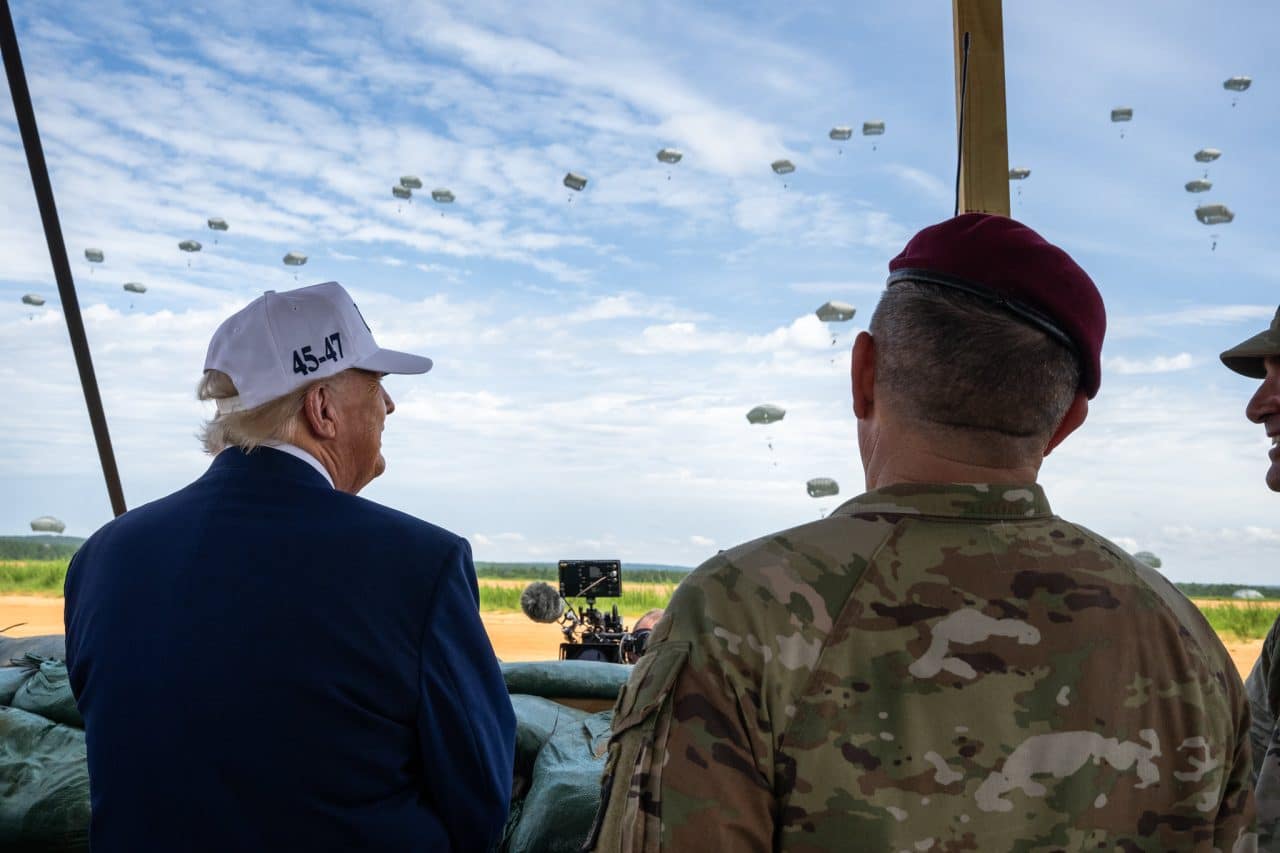
Above photo: President Donald Trump observes a military demonstration at Fort Bragg, North Carolina on Tuesday, June 10, 2025, during a visit to commemorate the 250th anniversary of the U.S. Army. Official White House Daniel Torok.
Donald Trump has set a two-week deadline to decide whether to enter Israel’s war on Iran.
He is facing strong pressure both for and against attacking. If he does, it will be the most catastrophic U.S. foreign policy decision since Iraq 20 years ago.
NOTE: Well, the answer to this question arrived quickly. Al Jazeera reported that at approximately 7 pm Eastern time on June 21 in the United States: “the president says in a social media post that the US has conducted ‘very successful’ strikes on Iranian nuclear facilities at Fordow, Natanz and Isfahan, and that all planes are now out of Iranian airspace.
The US Constitution gives lawmakers the power to declare war and authorise military activity. But Trump did not seek the approval of Congress before striking Iran.
In the Senate and House of Representatives, lawmakers from both major parties had put forward legislation to compel Trump to go to Congress before attacking Iran’s nuclear site. But Trump preempted the votes on the bills.
Lack of congressional authorisation will likely be a major talking point in US politics, especially if a broader war breaks out.
The US president suggested in his announcement of the strikes that Iran should stand down to end the hostilities after its nuclear sites were attacked.
But Iranian officials have been pledging a harsh retaliation against any US attack over the past few weeks.
Threats included strikes against US bases and interests in the region, and closing the Strait of Hormuz, through which 20 percent of the world’s oil flows.”
“I don’t care what she said.”
That’s what U.S. President Donald Trump said when a reporter confronted him with the one point that every reporter should be bringing up to him: “Tulsi Gabbard testified in March that the Intelligence Community said that Iran wasn’t building a nuclear weapon.”
The President of the United States, with no evidence, stated that he simply believes a very key, yet false, point to be true despite his own intelligence services telling him that it isn’t. And on that basis, he may bring the United States into yet another doomed war in the Middle East.
While Trump has given strong indications that he is going to join Israel’s attack on Iran, the decision has not been made yet, and, as he always does, Trump is sending out mixed signals.
A meeting on Tuesday of Trump’s senior staff, following Trump’s unexpected early departure from the G7 meeting in Canada, was widely expected to be the site from which Trump would announce his next steps regarding Iran. But he didn’t.
As Trump plays games about his intentions, he is likely hiding the very real indecision of a man in beyond his depth. The best we can do is examine what he has done and what he is doing to get some hint as to what he will do.
American Involvement In The Decision
As soon as Israel attacked, Secretary of State Marco Rubio sent out a statement denying any American involvement. But as it quickly became apparent that Israel’s initial attack was more successful than anticipated, Trump wanted part of the credit and contradicted Rubio.
Trump seemed to have genuinely sought a diplomatic resolution, on his terms. He wants to make one-sided deals that are the fruits of bullying tactics that force his interlocutors to cave in to his demands, and he doesn’t like to spend a lot of time getting the deal done.
He tried this tactic in his first term but more hesitantly, as he was less sure of his footing and had people in his administration who would push back against his excesses.
This time around, he assembled senior staff from a variety of backgrounds and political ideologies who all had one thing in common: they would genuflect to Trump completely regardless of whether they thought his decisions were foolhardy or dangerous.
Trump was not prepared to work through a diplomatic process or to reach a deal that satisfied the bottom lines of both the United States and Iran. He set a 60-day deadline, which was a sure step toward failure. Iran is a deliberative country, and it was not prepared to rush into a deal, especially one where sanctions relief was not clearly spelled out.
When Trump reversed his position in the talks on Iranian domestic enrichment of uranium, the possibility of a deal became even more remote. At the beginning, he held to the “zero enrichment” policy, but when his negotiators began their work, they realized quickly that this was a non-starter. Trump backed off, but then, as his self-imposed 60-day deadline for talks loomed closer, he again reversed himself, mixed messages flooded the ether, and negotiations, predictably, hit a wall.
Trump has beefed up the U.S. military presence in the area as another way of threatening Iran, hoping to bully the Islamic Republic into acquiescence. This only hardened Iran’s position on the enrichment issue, which they see as a matter of national pride and a right granted to them under the Nuclear Non-Proliferation Treaty (NPT). Trump grew ever more frustrated.
Meanwhile, even though American intelligence never wavered from its assessment, held since 2007 at least, that Iran was not pursuing a nuclear weapon, they also assessed that Israel was going to attack Iran with or without American support. Trump stalled Netanyahu for a while, but his efforts in this regard faltered quickly as his frustration with Iran’s refusal to capitulate to his threats built.
In the end, Trump was confronted with the reality that he would have to use his biggest card, threatening to cut off offensive weapons, to stop Israel, and he was not about to do that, especially since he was no longer sure he even wanted to.
The fact that Trump was so easily backed into this corner is a mark of his weakness. It’s hardly a secret that Israel has wanted to attack Iran for many years, and prior presidents, despite bowing to pro-Israel pressure on many points, were never so weak that Netanyahu thought he could force Washington’s hand on Iran. That didn’t happen until Trump was completely unleashed in his second term.
Israel, and especially Benjamin Netanyahu recognized that this was not only an opportunity to carry out the attack on Iran he had lusted after for decades, but a moment where Iran was historically weak because it could expect no help at all from any potentially impactful player in the region or around the world. Netanyahu was not about to let this opportunity simply pass by without launching an attack, and he knew that even if he did it in defiance of Trump, there was a strong possibility that the U.S. would enter the fray.
What Are The Pressures Pulling Trump To, And Pushing Against, His March To War?
Trump has given himself two weeks to announce whether he will enter the war of choice and aggression waged by Israel against Iran. He made that announcement just a day after it was revealed that he had approved a military plan but had not yet given the green light to it.
If he feels strongly drawn toward intervention or toward staying out, chances are he won’t just sit tight for two weeks but will make the call well before that deadline. This is not a patient man.
But more likely, Trump is unsure of himself and frightened about the prospect of actually being a wartime president who has to make truly monumental decisions, often choosing between a host of bad options. Trump is a weak man who dislikes long hours and hard work. He prefers his pageantry, his tweeting, and his weekends on the golf course. It’s a shame he didn’t think of that before he tore up the 2015 Iran nuclear deal for no reason other than it being Barack Obama’s signature foreign policy accomplishment.
Like it or not, Trump has to decide about this and he finds himself in the middle of a tug of war.
His MAGA base has split in an unprecedented way. A significant portion of it clings powerfully to isolationism. But the Christian Zionist and neoconservative pieces of the Republican party are passionately supportive of Israel’s war.
Democrats are similarly split, but Trump is not particularly concerned about the anti-war segment of the Democratic Party. But the centrists, led by Senate Minority Leader and blind supporter of Israel Chuck Schumer are not only pushing for the U.S. to fall in line with Israel’s wishes, they are laying in wait for Trump to back away to attack him from the right, which is their preferred tactic in most things.
Polling supports the MAGA isolationists and anti-war Democrats, however. In a recent poll, 65% of Democrats, 53% of Republicans, and 61% of Independents oppose any U.S. involvement in Israel’s war. This despite the fact that 75% of Americans say that Iran is an “enemy” or is “unfriendly.” It’s far from the only such poll.
Meanwhile, the Saudis, Qataris, and Omanis are pitching a negotiated settlement on Iran’s behalf, but their efforts have been decidedly low-key for countries that have a clear interest in containing this conflict. There is every reason to believe that they would face considerable blowback and material impact, including attacks from Iran and militias that support the Islamic Republic, if the United States gets directly and openly involved in bombing Iran.
As I explained elsewhere, this duality results from a certain ambivalence on the part of these states. They are very concerned about the conflict spreading to them, but despite recent efforts to find a regional accommodation with Tehran, they wouldn’t mind seeing Iran’s revolutionary government fall.
Europe and the U.S.’s other G7 allies implied a very similar sentiment. In their statement at the end of their gathering in Canada on Monday, they reaffirmed Israel’s “right” to defend itself, ignoring Israel’s unprovoked act of aggression in “response” to a “threat” that doesn’t exist. They also admonished Iran as “the principal source of regional instability and terror.”
Some of that wording is surely included to get the U.S. to sign on to the statement. But the result is a complete exoneration of Israeli crimes and absolute justification for Israel’s aggression. A more watered down, but still highly distorted statement was issued soon after by the E3 (the UK, France, and Germany) along with the EU.
Yet the Europeans have also scheduled talks for Friday in Geneva with Iran, talks that they say were “coordinated” with Washington. This is undoubtedly an attempt to circumvent Iran’s refusal to return to talks with the U.S. while under fire from Israel. It is also a clear indication that, their shameful denial of reality notwithstanding, the Europeans are not willing to openly back a war of regime change in Iran.
The Europeans have no love for the Islamic Republic and would not mind seeing it disappear. But they are very concerned, as are the Arab states and anyone with any bit of rational interest in the global economy, of the potential aftermath of ousting this regime.
There is some hope that Trump might lean toward at least containing this conflict, which would mean keeping the U.S. out of it. Despite all the threats and bellicosity, some of which have certainly been echoed by Iran, Trump’s lead negotiator, Steve Witkoff, has maintained phone contact with Iranian Foreign Minister Abbas Araghchi. Hopefully, that helps to pull him toward a diplomatic resolution and away from what would be a catastrophic decision to enter the fighting.
No Lessons Learned From Iraq
One of the big questions is whether Trump is focused on the mythical nuclear weapons program or if he shares Netanyahu’s ambition for regime change. In either case, the U.S. joining this war almost certainly means using the so-called “bunker buster” bombs to attack the Fordow underground nuclear facility. Israel cannot claim, even to its most credulous admirers, that it has destroyed Iran’s nuclear capabilities if Fordow is still intact, and it cannot hit Fordow itself. Only American B-2 bombers can carry the bombs, which only the U.S. has.
Depending on what the ultimate goal is, the U.S. might engage in much more extensive operations, if Trump supports a regime change war, or they might hit Fordow and perhaps add some firepower against other nuclear sites and then leave Israel to its own devices.
Israel is waging a regime change war. But if Fordow is hit and significantly damaged or even destroyed (this would be difficult but not impossible), Netanyahu could potentially be pressured to back off of regime change, as he will have the victory he needs to present to the Israeli Jewish public (Palestinian citizens of Israel obviously see this war very differently, but Netanyahu does not care one whit about what they think). But if Trump is on board with the regime change war, and that is far from certain, the war will go on for a long time.
When the U.S. invaded Iraq, it had a plan for installing a puppet regime. It was a terrible plan that reflected the George W. Bush administration’s complete lack of understanding of Iraq, and even by Bush’s standard that plan was a remarkable failure.
But Trump and Netanyahu don’t even have that. Netanyahu is trying to barrel toward chaos, toward leaving a power vacuum in Iran. This goes beyond his ludicrous statement that killing Iran’s Supreme Leader, Ayatollah Ali Khamenei would end the conflict. Iran has a stable system of succession and, although the path to succession isn’t absolutely clear, with several possible candidates, we have already seen how quickly the Iranian government can replace its top leaders.
But if the entire government is toppled, there is no succession plan for that. It would lead to unbridled chaos, not only in Iran but throughout the region. Rivalry between a great many parties and militias in many areas will rage around the Middle East. It’s a future only a madman would want—or a self-absorbed, corrupt but powerful leader whose driving force is his own personal gain and avoiding facing the consequences of his failures. That is certainly Netanyahu, and it also describes Trump. But Trump has far less to gain from the chaos he will unleash if he follows the Israeli leader down this path. Let’s hope he somehow recognizes that.