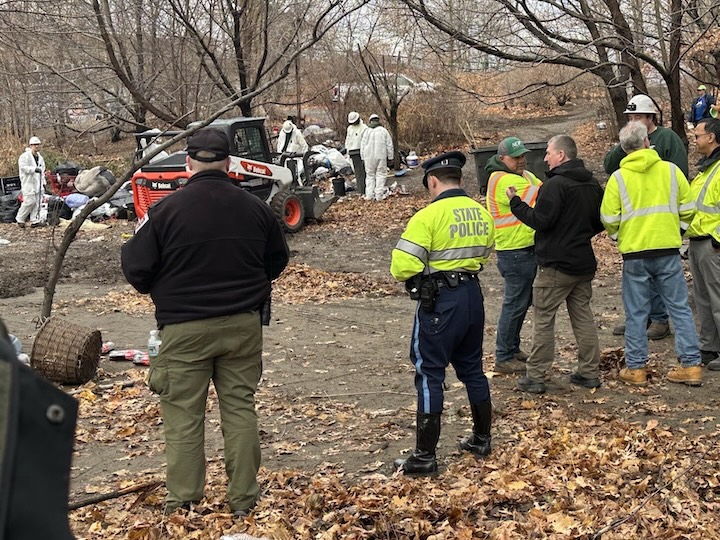
Above photo: Clearance of BU Bridge encampment. Warm Up Boston.
Catching Up With Warm Up Boston About Tent Sweeps, Shelter Limits, Drug Dangers.
And The Criminalization Of People Living On The Streets.
It’s been more than half a year since the state’s Department of Conservation and Recreation spent four days clearing out an encampment near the BU Bridge in Cambridge, and Gemma Byrne has yet to see any of the people who were displaced by what one witness described as “the most inhumane sweep she has seen in her approximately 10 years of being unhoused.”
Byrne is an organizer for the material aid and harm reduction program Warm Up Boston, which distributes supplies to encampments and has developed connections with their residents. Homelessness and fringe housing get more attention in the bitter cold months, but the work continues in the heat, as do haunting memories of what came last December.
“The majority of folks affected by this sweep were over 50 years old with serious health conditions,” she said. ”One resident was incredibly sick throughout the process and was offered no sympathy from the state.”
According to Byrne, residents slept a total of eight hours over four days in harsh conditions without a properly insulated tent.
Justine Golpayegani, an organizer at Warm Up Boston, said during that sweep and countless others like it, people’s possessions, including IDs, driver’s licenses, birth certificates, and housing forms, are frequently destroyed. These documents are necessary for people to access services for housing and employment. Such experiences are among the increasing number of hurdles facing the region’s most vulnerable residents.
A Disproportionate Impact On Undocumented Individuals
A tent ban took effect in Boston on Nov. 1, 2023, making it illegal for people to set up tents and tarps on public property. The city frames the ban as improving safety, but advocates call it a violent erasure.
Considering such measures combined with skyrocketing costs without rent control, the lack of low-threshold housing options, and changes to the Right to Shelter law that will further restrict who can access shelter, capping the number at 4,000 by the end of this year, advocates say unhoused residents are criminalized for existing and trapped in a cycle of trauma.
“For the past three years, thousands of families have been arriving in Massachusetts from other states and other countries seeking shelter,” the Office of Gov. Maura Healey wrote in a January press release. By April 15, the number of families in the shelter system dropped below 5,000. The state celebrated the reduction, but housing advocates say that, among other problems with that calculus, the new restrictions disproportionately harm immigrant families (notably, ICE has arrested 1,500 undocumented people in Massachusetts).
An Unprecedentedly Unaffordable Boston
Golpayegani said the biggest threats to unhoused people are city and state policies that criminalize their survival and forcibly remove the places they’ve built for themselves while they seek housing.
Housing has become increasingly unaffordable in Boston. Per the Numbeo Cost of Living Index and other analyses, it is one of the most expensive cities in the US. More than 27% of renters spend more than half of their income on housing. Boston also doesn’t have rent control, so landlords can legally charge however much they want for rent.
“It’s not affordable to pay rent in Boston anymore,” said Teena Hallett, a harm reductionist at Smoke Works Harm Reduction and former program manager at Access, Harm Reduction, Overdose Prevention and Education (AHOPE). “Working-class people that were able to live in Boston at one point can’t afford to live there.”
According to the Massachusetts Trial Courts, 26,474 eviction cases were filed statewide in 2024. One study shows that the unhoused population in Boston increased by 27% from 2022 to 2023.
“We have so much more in common with the unhoused than we do the billionaire and landlord class,” Miguel Maron, an organizer at Warm Up Boston, said. “It is just a sort of intrinsic reality that we’re all just a personal tragedy, a medical emergency, a lapse in employment away from being out on the streets ourselves.”
Serving The Unhoused Around Boston Year-Round
Warm Up Boston is on the front lines, meeting the unhoused community where they’re at.
“Many of these people who we see on a weekly basis, they’re on lists for [public] housing, they’re waiting, but services take years and years and years to access, and so they’re trying to build a home for themselves in the meantime,” Golpayegani said. “The biggest threat to their well-being is when police come and tear down the place that they’ve built as a home while they’re waiting for housing. It’s very destructive.”
Warm Up Boston serves an estimated 100 people per week, distributing at encampments and throughout downtown Boston. In the colder months, the group provides comforters, blankets, hats, socks, and gloves. As it heats up, volunteers distribute 180 pounds of ice for coolers and 20 cases of water weekly.
“We’re very much in solidarity with the people we’re serving,” Golpayegani said. “We’re out there building relationships with them, in many cases, very long relationships, and really being guided by what they feel will best help them and empowering them to come up with that.”
The Physical And Psychological Toll Of Being Unhoused
Not having proper housing can take a severe physical toll on people. They’re often exposed to the elements, and in the winter, they endure subzero temperatures, which can place them at risk for hypothermia.
Exposure to heat, combined with the higher rates of chronic cardiovascular and respiratory issues among unhoused individuals, places significant stress on the body and can be dangerous. The unhoused community struggles to stay cool without access to essential resources like air conditioners, refrigerators, and laundry facilities.
But it’s not just the physical toll; it’s also psychological.
“A resident has told me that losing their heater wasn’t the worst thing that’s happened to them, but rather losing a small chain, worth maybe two dollars, that belonged to their mother. It was tossed in the trash, still easily accessible, and they were denied the right to retrieve it,” Byrne said. “There are psychological effects when you are treated like your existence is an eyesore to the public that needs to be violently swept away. People are not unaware of services, there simply aren’t enough resources to secure what should be basic human rights.”
Many people are grappling with childhood trauma, compounded by the trauma of being unhoused, the violence that often accompanies that situation, and experiences of incarceration, according to Hallett, the harm reductionist. She said it’s overly simplistic and careless to view someone solely through the lens of their drug use without understanding the underlying reasons for their behavior.
“If you are living outside and really don’t have access to anything you need, it makes sense that people might be chaotically using [drugs] to sort of cope with that,” Hallett said.
Drugs, Stigmas, And The Resulting Hurdles To Housing
The criminalization of drugs adds yet another troubling factor for unhoused people. Maron, the Warm Up Boston organizer, explained, “The risk of overdose from fentanyl and other comorbidities, such as infections and other sorts of things are incredibly intrinsic to living on the street. Also, the medical systems that they are operating under are not suited for long-term care for people with substance use disorder and opioid use.”
Hallett said landlords don’t want to rent to people if they know they’re actively using drugs or have a Section 8 Voucher—there’s a lot of stigma attached.
“People think that people who use drugs are dirty, that they don’t care about themselves or their community, that they don’t want to have a job, or they don’t want to work, that they don’t have aspirations or other things in their life that they care about,” Hallett said. “Just essentially that they’re lazy and don’t mean anything, and they will never amount to anything or care about anything until they stop using drugs. And that’s very much not the case.”
Maron added, “The fact of the matter is, almost everyone in our society uses drugs, whether it be alcohol, prescriptions, or more illicit fare. But the main criminalization occurs to the most marginalized members of our community, whether they be sex workers, whether they be just street homeless individuals.”
Frontline workers navigating the increasing systemic pressures and dwindling resources are at the heart of Boston’s harm reduction movement. Hallett witnesses these challenges firsthand at Smoke Works, an organization that distributes pipes, test strips, outreach kits, and more.
“Last year, we distributed almost 2 million pipes to programs in 41 states and Puerto Rico . . . it’s roughly 400 programs,” Hallett said. While Smoke Works is structured as an LLC and has so far avoided the direct blow of federal funding cuts, Hallett explained that the broader harm reduction ecosystem is under strain.
“A lot of the programs and organizations that we provide harm reduction supplies to have been impacted [by major cuts],” she said. “We have seen an increase of weekly applicants in our MAP [Material Aid Program] inbox and other organizations are spending down their budgets with us before their funds are taken away.”
Hallett continued, “There is a lot of fear and uncertainty right now, but a lot of folks who have been doing this work for a long time remember what it was like to operate without federal funding and be underground, so I am hopeful that we will continue doing what needs to be done to make sure the people we serve have access to supplies no matter what.”
“That’s Not Long-Term Care”
Even those who qualify for subsidized housing or emergency assistance programs often find themselves in a bureaucratic maze, according to Elizabeth Aldred, a senior attorney at Greater Boston Legal Services.
At a rally earlier this year, Alfred described a client who struggled to find a place to rent with a voucher due to her history of being evicted. When the client finally got into free state public housing, the unit didn’t have a refrigerator. She needed HomeBASE to buy the refrigerator, as she couldn’t afford it on her own. But under the shelter program’s rules, she wasn’t allowed to receive HomeBASE assistance while she was technically still stabilized.
“She had to wait until the HomeBASE was approved and that whole process was done so that she could get a fridge, so that she could move into the state public housing system,” Alfred said.
Once someone manages to get into housing, the system often fails to support their transition. Hallett emphasized that simply handing someone keys isn’t enough. “Especially people who have been on the street for a long time, it’s a huge transition to move into housing,” she said. “You’re getting taken from a community where you’re around people all the time to being kind of isolated. It’s important for it to be supportive, low-threshold housing.” (Low-threshold housing is defined as housing that does not have strict requirements about abstinence or engagement in treatment and services.)
Maron echoed this concern: “Giving somebody a house makes it a lot easier for people to focus on their substance use and their recovery.” He pointed to the defunding of two key programs—low-threshold housing at the cottages at Shattuck and at the EnVision Hotel in Boston—as a major step backward.
“These were sort of the stop gap from street homelessness to being housed for the first time,” Maron said. “And the fact that the traumatizing experience of being unhoused leads to a real drop in people’s abilities to function in normal housing without supportive networks—that gets totally ignored.”
Instead, the system churns through people, often enriching private landlords in the process. “The landlords have taken the check from the city, put another coat of paint in, and then they just repeat the process over again with somebody else,” Maron said. “That’s not long-term care.”
He pointed out that most funding from the Boston Housing Authority doesn’t go toward building affordable housing but rather to semi-private enterprises and property managers.
“That money could be going to new, sustainable, state-run options that actually focus care on people and keeping them housed, instead of just taking a percentage of their social security and funneling it to private developers and equity groups,” Maron added.
The Real Root Of The Housing Problem
For Maron, the root of the housing crisis is clear.
“Capitalism [created] this system that we’re living in,” he said. “It creates homelessness. It necessitates homelessness. The private possession of property for profit is a direct contributor to homelessness as a phenomenon.”
Boston’s systemic response to homelessness has left unhoused people in a constant state of instability and danger. Tent bans, encampment sweeps, and the criminalization of drug use punish people for trying to survive rather than offering paths to stability.
“Every encampment is a community, and we really fail people when we don’t provide things like porta-potties and hand-washing stations and just literally, like, trash cans on the street,” Hallett said.
Advocates across the housing justice landscape are calling out the systemic failures and urging bold policy reform. At a rally earlier this year, Carolyn Chou, the executive director of Homes for All Massachusetts, said, “We know we need homes for people, not profit. We need policies like rent control. We need to ban no-fault evictions. … We cannot allow children and families to be on the street and to give up the right to shelter as a state in one of the wealthiest states in the country.”
Organizers at Warm Up Boston say the city has scrapped even the pretense of person-centered policy.
“We’re really seeing an abandonment of even that framing of homeless-centered policy making . . . to solve these issues,” Maron said. “[Warm Up Boston’s] at a point where we can do [mutual aid] while also demanding changes and protecting people’s rights to shelter and other sorts of things that should be universal.”
In the meantime, the group continues in its efforts to support the unhoused communities they serve, distributing supplies throughout the seasons.
“The work goes on,” Maron said. “It’s very much the nitty-gritty, back-in-the-trenches of keeping people fed and safe.”