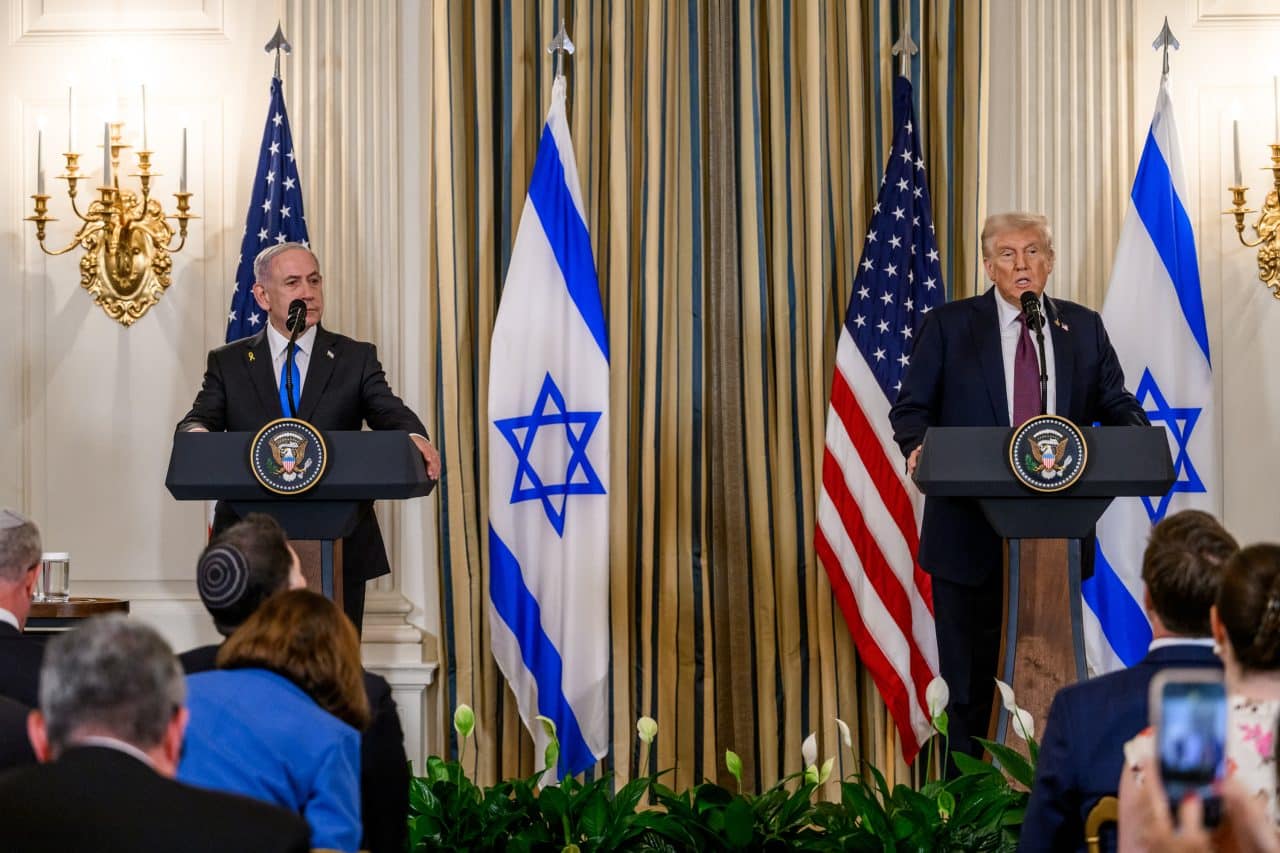
Above photo: U.S. President Donald Trump and Israeli Prime Minister Benjamin Netanyahu hold a joint press conference announcing the U.S. peace plan for Gaza, Monday, September 29, 2025, at the White House. White House/Joyce N. Boghosian.
Here’s What It Didn’t Accept.
Hamas just accepted Donald Trump’s “peace” plan. Here’s what Hamas didn’t accept, how Trump reacted, and why Netanyahu was blindsided.
The response of Hamas to U.S. President Donald Trump’s “peace” plan to end the war in Gaza came in late on Friday. It sparked immediate and conflicting reactions.
Five days after the U.S. president first announced his plan, the Palestinian movement gave its answer in a statement announcing that Hamas announced its “approval for the release of all hostages — living and dead – according to the exchange formula included in President Trump’s proposal.” Hamas added that it was ready to enter talks “to discuss the details.”
In a move practically unheard of by a U.S. president, Trump shared Hamas’s statement on his account on Truth Social:
“Based on the Statement just issued by Hamas, I believe they are ready for a lasting peace,” Trump said, adding that “Israel must immediately stop the bombing of Gaza, so that we can get the hostages out safely and quickly!”
Minutes later, Trump announced Hamas’s acceptance of his plan in a live address at the White House, considering the event “a big day, unprecedented in many ways.” Trump added that he “looks forward to having all [Israeli] hostages come back to their parents,” stressing that “we have to put the final word in concrete.” The U.S. President thanked Arab and Muslim states for “helping me put this together,” promising that “everybody will be treated fairly.”
Hamas’s response to Trump’s plan came a day after the Israeli army sealed off Gaza City. Israeli Defense Minister Israel Katz issued a “final warning” to the estimated 500,000 Palestinians still in the city, announcing that those who decide to remain will be considered “terrorists or supporters of terror.”
Netanyahu ‘Surprised’ Amid International Approval
Qatar, Egypt, and Turkey also accepted Hamas’s response, while French President Emmanuel Macron said that the “release of all hostages and a ceasefire in Gaza are within reach,” and UK Prime Minister Keir Starmer said Hamas’s response was “a significant step forwards.”
Trump’s near-immediate positive response to the Hamas statement was reportedly met with “surprise” by Israeli Prime Minister Benjamin Netanyahu, according to an unnamed Israeli official who spoke to Israel’s Channel 12. Netanyahu had held a deliberation on the Hamas response to Trump’s plan before the U.S. President published his Truth Social statement. According to Channel 12, the Israeli Prime Minister considered the Hamas response a rejection of Trump’s framework.
Netanyahu had reportedly stressed the need to coordinate with the U.S. on a response, so it would not seem that Hamas had accepted the Trump deal, according to Channel 12, which also cited Israeli officials saying that the Hamas response “could pave the way to a deal.”
What Hamas Accepted
In its official statement, Hamas praised “the Arab, Islamic, and international efforts, as well as the efforts of U.S. President Donald Trump, aimed at halting the war on the Gaza Strip, achieving a prisoner exchange, allowing immediate entry of humanitarian aid, rejecting the occupation of the Strip, and opposing the displacement of our Palestinian people from it.”
Hamas’s statement then announced the movement’s acceptance of Trump’s prisoner exchange formula, which would see the release of 250 Palestinians from Israeli prisons in exchange for the release of all Israeli captives. The statement added that Hamas was ready to “immediately enter into negotiations” through Qatari and Egyptian mediators to “discuss the details.”
The statement also affirmed Hamas’s readiness to hand over the administration of the Strip to a Palestinian commission of independent “technocrats,” which would be formed “based on Palestinian national consensus and supported by Arab and Islamic backing.”
Most importantly, the Hamas statement addressed the other parts of Trump’s plan concerning the future of Gaza and the “legitimate rights of the Palestinian people,” affirming that it must be subject to a “comprehensive national position” based on international law and UN Resolutions. This position would have to be discussed as part of a “unified Palestinian national framework,” which Hamas said it would participate in “with full responsibility.”
What Hamas Didn’t Accept
But the Hamas statement also skirted over a number of key parts of Trump’s plan that have been widely regarded as a non-starter for Palestinians, as it would prevent Palestinians from administering their own lives and forestall the prospects of a Palestinian state.
These included the clause in Trump’s plan about forming a “board of peace” headed by the U.S. President, the widely-reported potential participation of former British Prime Minister Tony Blair, and the deployment of international and Arab forces to “demilitarize” Gaza. Most importantly, the statement made no mention of the demand for Hamas and other resistance factions in Gaza to disarm.
Following the statement, Hamas’s head of international and legal relations, Mousa Abu Marzouq, told Al Jazeera that Hamas was concerned with the first nine points of Trump’s 20-point plan, which related to ending the war, ending the occupation of Gaza, humanitarian aid, and who would rule the Strip.
Abu Marzouq added that these issues required further negotiations, asserting that some of Trump’s points were “unrealistic,” including the release of all captives within 72 hours. He also noted that the plan did not include any clear framework for how the Israeli withdrawal would take place.
Refusing A ‘Mandate In New Form’
Abu Marzouq affirmed that Gaza must be ruled by “an independent commission of technocrats, and this is what we agreed on with the rest of the [Palestinian] factions in Cairo,” referencing the inter-Palestinian agreement back in August to form an independent commission to run Gaza based on an Egyptian proposal.
As for the clauses of Trump’s plan concerning the future of the Palestinian Authority (PA), the future of the Gaza Strip, and the future of a Palestinian state, Abu Marzouq said that these issues could not be decided upon by Hamas alone. “Hamas is part of the Palestinian people, but there are other parts,” Abu Marzouq said. “All the national factions, the national movement in all its colors, the PLO—which represents the Palestinian people—and the Palestinian Authority, which is already engaged in a political process with the occupying state. All of them are partners in drawing the future of the Palestinian people.”
The Hamas official called on Egypt to initiate dialogue with all Palestinian parties to reach a common position on these issues. Abu Marzouq added that “it is absolutely impossible that this national consensus would accept a mandate on any part of the Palestinian people,” opining that the proposal for the administration of the Strip by a “board of peace” was a “mandate in new form,” referencing the post-World War I British Mandate over Palestine over a century ago.
Regarding disarmament, Abu Marzouq said that Hamas would hand over its weapons to a Palestinian state “on the first day it is established,” asserting that Hamas could not continue to be an armed organization under a Palestinian state.