
Above photo: The Cradle.
The Mediterranean Arc.
The tripartite alliance between Greece, Cyprus, and Israel is deepening as a security and political nucleus for a broader project aimed at linking the Mediterranean to the Indian Ocean and encircling China’s growing influence in West Asia and southern Europe. Turkiye views this alliance as a direct strategic threat to its regional ambitions and national security.
“One of the most important concerns is the visible and invisible areas from which Turkiye is being encircled. The visible areas of encirclement are alliance networks that have been formed to Turkiye’s detriment. We are aware of them and are developing diplomatic measures to respond. If diplomatic measures cannot be developed for specific issues, then the matter is referred to the military and security institutions – and more follows from there.”
– Hakan Fidan, Turkiye’s foreign minister
Turkish Foreign Minister Hakan Fidan’s words earlier this month were a clear declaration that the relatively calm waters of the Eastern Mediterranean have become the front line in a wider geopolitical conflict.
The threat that “Turkiye will strike first” was not only directed at Greece, Cyprus, or Israel, but at the new security architecture forming on the edge of the west, what can be called the “Mediterranean Arc.” This tripartite strategic partnership has evolved beyond a regional coalition countering Ankara’s ambitions. It now forms a critical node in a broader geopolitical constellation known as the Indo-Mediterranean Rim – the central stage of intensifying competition between the US and China across Eurasia and beyond.
It was aimed squarely at a new western-aligned military axis taking shape under Washington’s watch. At its core lies the Greece–Cyprus–Israel triangle – a strategic outpost now hardwired into the broader struggle for Eurasian dominance.
While Turkiye accuses others of “encircling” it, it has simultaneously strengthened its regional influence through military agreements with Balkan countries, built a military arc around Greece, and implemented the Libya maritime deal, which Athens considers a violation of its sovereignty.
Energy as pretext, hegemony as purpose
The massive natural gas discoveries in the Eastern Mediterranean basin – Tamar and Leviathan off the coast of occupied Palestine, Aphrodite near Cyprus, and Egypt’s Zohr field – triggered a shift in regional alignments. What was once a net energy-importing region now promises to become a strategic export hub.
The transformation coincided with Europe’s growing desperation to replace Russian gas following Moscow’s military operation in Ukraine. The Mediterranean’s gas reserves, suddenly seen as a geopolitical windfall, brought Israel into sharp focus as a “reliable partner.”
To protect and export these new resources, unprecedented political and security cooperation emerged. After decades of regional isolation, the gas bonanza offered Tel Aviv a strategic ticket to forge closer ties with European neighbors.
In 2019, the East Mediterranean Gas Forum (EMGF) was formed in Cairo to institutionalize these shifting alliances. But its real function lay in drawing a red line against Turkiye. The EMGF excluded Ankara entirely – an exclusion that was not incidental, but structural.
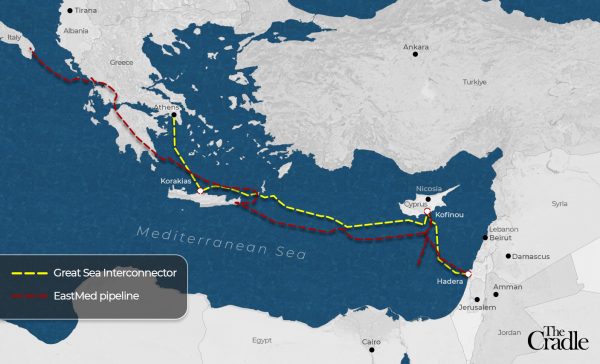
Out of this framework emerged two cornerstone projects: the EastMed pipeline, a 1,900-kilometer subsea gas conduit to Europe via Greece and Cyprus; and the so-called Great Sea Interconnector, a deep-sea electric cable linking Tel Aviv to the European grid.
Their scale – $6-billion-plus in costs, extreme seabed depths, and unresolved technical hurdles – has not dampened western enthusiasm, because these projects are tools of political entrenchment, not just economic ventures.
They serve a larger purpose, anchoring Israel in European infrastructure to such a degree that its security becomes indivisible from Europe’s energy sovereignty.
NATO’s southern flank tightens
Historically, Greece and Cyprus played modest roles as the EU and NATO’s southeastern fringe. But with the emergence of the “Blue Homeland” (Mavi Vatan) doctrine under President Recep Tayyip Erdogan – a maritime expansionist policy asserting Turkiye’s sovereign rights over vast maritime zones in the Aegean, Eastern Mediterranean, and Black Sea – their status has changed.
The doctrine, advanced by Turkiye’s naval establishment, challenges Greek claims over dozens of islands and rejects Cyprus’s unilateral declaration of an Exclusive Economic Zone (EEZ). Ankara sees these zones as extensions of its own continental shelf, vital to its energy and defense autonomy.
The Mediterranean Arc has thus become a joint mechanism for counterbalancing Turkiye – moving beyond diplomacy to deep, coordinated military cooperation. Joint drills like the annual NEMESIS naval exercises and Noble Dina war games have become routine, focusing on gas platform protection, counter-terrorism, and SAR operations – boosting trilateral operational synergy.
The turning point came with Cyprus’s deployment of Israel’s advanced Barak MX air defense system. With a 400-kilometer range, Barak MX offers Nicosia the capacity to down advanced Turkish drones like the Bayraktar, and effectively establishes a localized anti-access/area denial (A2/AD) bubble in the Eastern Mediterranean.
With a range of 400 kilometers, it enables Nicosia to threaten Turkish UAVs and jets far beyond its airspace. It also establishes a mini A2/AD zone – a strategic umbrella designed to block Turkiye’s projection of power.
For Nicosia, this marked a reversal of its humiliation in 1998, when it was forced to backtrack on the S-300 missile deal under NATO pressure. Now, with Tel Aviv’s backing, Cyprus is repositioned as a militarized outpost in the Eastern Mediterranean.
Tel Aviv’s western entrenchment
The Mediterranean Arc formalizes Tel Aviv’s absorption into the western security apparatus. Gone is Ben Gurion’s “periphery doctrine” – an older strategy to partner with non-Arab states like pre-revolution Iran and Ethiopia to circumvent Arab hostility. Now, Israel is building a hard security perimeter on its western flank.
The credibility of this alliance was tested in June 2025, during the brief but intense escalation between Israel and Iran. On the eve of Tel Aviv’s “Operation Rising Lion,” its entire civilian air fleet was covertly relocated to airports in Cyprus and Greece. While officials denied coordination, flight tracking data and local reports confirmed the operation.
Despite official denials, evidence suggests the US base at Souda Bay, Crete, served as a launchpad for American refueling aircraft backing Israel’s long-range raids. Greek Patriot batteries were also reportedly deployed to shield the base.
This quiet, reliable support in a moment of existential crisis brought Athens and Nicosia into Israel’s inner defense planning circle. It signaled a shift from interest-based ties to a strategic partnership based on trust and necessity.
The Indo-Mediterranean Rim: Washington’s encirclement playbook
What transforms the Arc from a regional scheme into a global fault line is its central role in Washington’s Indo-Mediterranean corridor – a maritime route designed to bypass Chinese influence across the Indian Ocean, Red Sea, and Mediterranean.
This is the infrastructure skeleton of a grand containment strategy: one that converges with I2U2 (India, Israel, UAE, US), and the India–UAE–Saudi–Jordan–Israel corridor – a supply chain that Tel Aviv has leaned on more heavily since the Sanaa-based Yemeni armed forces disrupted Israeli shipping in the Red Sea.
India, facing increased alignment between Pakistan and Turkiye, sees the Arc as a strategic counterweight.
Indian Prime Minister Narendra Modi’s visit to Cyprus during Israel’s Operation Rising Lion was a calculated political message to Ankara. The emerging alignment evokes a revival of the old “Golden Road” linking India to Europe – now a counter to China’s New Silk Road.
Joint forums like the India–Greece–Cyprus Business Council, and expanding military-industrial cooperation between India and Israel, are also noteworthy developments.
Beijing views the Arc as a latent threat to its Belt and Road Initiative (BRI). China’s state-owned COSCO already controls 67 percent of the Port of Piraeus, a key node in its European logistics chain. Under Chinese management, the port has become one of the busiest in Europe.
Yet Greece, while China’s economic partner, is also a forward post of the NATO alliance, conducting joint exercises with Israel and hosting a permanent US naval presence. This duality puts Athens at the center of the contest between Atlanticism and multipolarity.
Fault lines and fragilities
Despite its ambitions, the Mediterranean Arc is not without fissures. In March 2025, the Great Sea Interconnector project was suspended after Greece froze payments to its French cable supplier. Italian vessels conducting seabed surveys withdrew following Ankara’s dispatch of five warships to the region in mid-2024.
Even Cyprus has raised eyebrows. Its Finance Ministry stated that independent studies had flagged the cable project as economically non-viable under current conditions. The announcement prompted speculation about Nicosia’s ability – or willingness – to bankroll the venture.
An ongoing EU corruption probe into the project’s early phases has only added to the strain.
Yet the most acute threat comes from Turkiye. Ankara has made clear that any regional energy initiative that bypasses it is unacceptable. It has deployed naval assets, threatened enforcement measures, and continues to contest maritime boundaries with hard power.
The Mediterranean Arc is no sideshow. It has become one of the sharpest pressure points in the global order now taking shape. What began as a regional compact around energy flows is now a hardened perimeter in Washington’s campaign to outflank its rivals in East and West Asia.
In these waters, the dividing lines of the 21st century are being laid, not negotiated. And whether this western-backed axis endures or implodes under the weight of internal strains and external resistance will shape the next chapter of global order.
