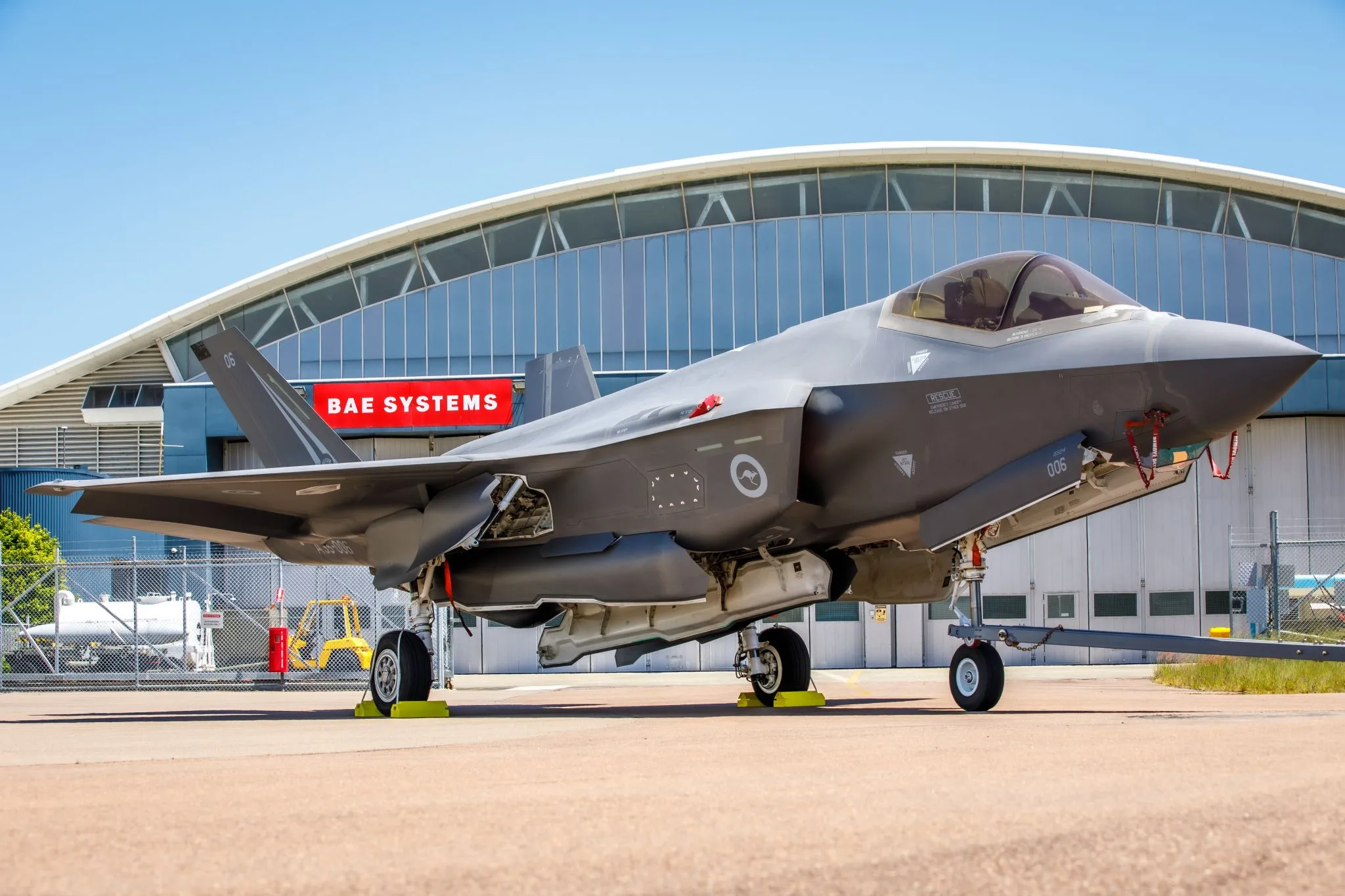
Above photo: RAAF Base Williamtown just north of Newcastle in NSW is the home base for Australia’s fleet of 72 F-35 Joint Strike Fighters and hosts the BAE Systems-Lockheed Martin maintenance hangar storing F-35 parts and components. Australian Department of Defence via Declassified Australia.
Revelations of secret F-35 fighter jet parts shipments to Israel have exposed a yawning hole in Australia’s sovereign national defence.
Exclusive reports by Declassified Australia of at least 71 packages of F-35 fighter jet weapons parts being exported from Sydney to Israel have revealed that Australia has forfeited control over the plane’s spare parts stored here for Australia’s fleet of F-35s.
Australia has signed up to a system where, at a moment’s notice, those “parts and components” may be whisked off the shelves at the RAAF Williamtown Air Base in New South Wales on the whim of a foreign state to be exported to a foreign country in a distant war zone.
“What you’re probably talking about is items that Lockheed Martin imported into Australia to support the maintenance and sustainment of our fleet and then needed to move around to someone else. They are entitled to do that under the F-35 global supply chain mechanism.” — Hugh Jeffrey
While it may be known to defence experts and insiders, this was the surprise public admission by a senior Defence official, Deputy Secretary Hugh Jeffrey. He was responding to questions about the F-35 parts exports, that had been earlier revealed by reports in Declassified Australia, during a Senate interrogation by Greens Senator David Shoebridge last month:
“These are U.S.-owned goods. They’re managed by Lockheed Martin. Australia does not direct the export of those goods. It does not control the export of those goods. If it’s resident in Australia, it needs to issue a permit for those goods to be moved offshore.”
Put simply, if the United States, or its defence contractor Lockheed Martin, want to allocate Australia’s F-35 spare parts inventory away from Australia’s defence to a war elsewhere, it can. And it does. We have the receipts.
A newly leaked shipping document seen by Declassified Australia, confirms the “lethality” of these parts. The document reveals the latest shipment is a part for the 25mm four-barrel cannon on the F-35 fighter jet. It was covertly transferred on a commercial passenger flight last week, sent from the Williamtown Air Force base in Australia to the Nevatim Air Force base in Israel. (Full details of this shipment are below.)
Risk To Australia’s F-35 Spare Parts Inventory
At any time, to further their own national interest, the United States may take possession of essential spare parts and components stored in Australia for the RAAFs fleet of 72 F-35s.
In peacetime, this could be inconvenient. In a time of conflict, taking essential parts could mean the effective grounding of numbers of Australian F-35s.
The seriousness of this lack of sovereign control of Australia’s essential defence cannot be overstated.
Acquiring the F-35 has been “a game changer” for Australia’s defence strategy, providing a credible deterrence in the region and a robust defence of Australia’s northern approaches.
However, Australia’s continental defence, based so much upon the deterrence and strike capabilities of its F-35 fighter jets, depends upon the goodwill and the needs of Australia’s U.S. ally. And when U.S. national interest is at stake, goodwill might be in short supply.
In a circumstance of war or conflict, the U.S. fleet of F-35s will be used in a heightened pace of operations. Aircraft will require significantly increased maintenance, as the Israeli Air Force is finding in its relentless, brutal war against Gaza.
In fact, even normal peacetime operation of the F-35s depends upon a huge amount of sustainment for maintenance and repairs.
A U.S. Government Accountability Office (GAO) study in 2023 found persistent serious supply chain delays for the F-35s. Even before the high pace of the Gaza war, “installations were able to fill an average of 75 percent of requisitions from the stock of parts and supplies kept at F-35 installations, but had to go off installation to fill 25 percent of the requisitions for parts and supplies”.
In any armed conflict that breaks out between the U.S. and China, the U.S. F-35s will be heavily used, both for short-range strikes in the region and with refuelling tankers for long-range strike missions against targets in China.
The pace will be relentless; the rate of maintenance and repairs will need to escalate quickly. Parts stores will be plundered and, once bare, U.S. eyes will look to its Joint Strike Fighter (JSF) Partners to supply the parts they need.
Under the Joint Strike Fighter program, Australia holds parts for Australia’s fleet of F-35s, and RAAF Base Williamtown is being developed as a regional hub to hold parts for partner countries of Japan, South Korea and U.S. bases in the region.
None of the leaked shipping documents seen by Declassified Australia show parts presently being sent from Australia to any country other than Israel.
Australia has been a partner in the United States’ multilateral Joint Strike Fighter JSF Program’s Production, Sustainment and Follow-on Development (PSFD) Memorandum of Understanding, since it was signed by the Howard Liberal government in Washington in December 2006.
Australia has no priority rights over the F-35 parts; the JSF agreement assures that is the case. It does however need to issue an export approval for the parts leaving Australia.
Both Canada and Denmark who are also partners in the JSF Program, have both been surprised by this same issue with F-35 parts being taken from their reserves and being sent to Israel, in disregard of the nations’ foreign policies.
The lure of access to spare parts for Australia’s F-35s could potentially be used as leverage by the U.S. to get Australia involved in a future conflict of their choosing.
However conversely, Australia too has leverage with the U.S., if the countries unhappy with this arrangement could unite their efforts to withhold spare parts unless provided with an assurance they would not go to a third country breaching human rights law, like Israel.
If the RAAF F-35s are being used close to Australia’s shores to guard against perhaps a blockade of ports or even to fight off attack, the U.S. may assess that purpose as being secondary to their own needs to fight its adversary close to their main area of interest of Taiwan. Australia’s JSF spare parts stores can theoretically be stripped bare by a needy U.S. Air Force.
This is a most serious vulnerability in Australia’s defence. But it is not the only one, as Australia’s F-35s also depend on access to U.S. software adaptations and maintenance for the F-35’s Mission Systems that control sensors, data links, navigation and weapons control.
The Australian alliance with the U.S. has always put the defence of the United States higher than the defence of Australia — though that is not often spoken out aloud.
A 2023 U.S. government report to the U.S. Congress by the Congressional Commission on the Strategic Posture of the United States, is titled “America’s Strategic Posture,” and it spells it out:
“The Commission believes it is in the U.S. national interest to maintain, strengthen, and when appropriate, expand its network of alliances and partnerships.
“These relationships strengthen American security by deterring aggression regionally, before it can reach the US homeland, while also enabling U.S. economic prosperity through access to international markets.”
Let that sink in. The aim of America’s alliance with Australia is for “deterring aggression regionally” so conflict can never “reach the U.S. homeland”.
The goal of U.S. national defence, as stated here by the U.S., is to fight wars and conflict in the regions, in order to protect “the US homeland”. Plus, as a bonus, it can also boost “U.S. economic prosperity.” Think AUKUS here.
And you thought the Alliance was because they liked us.
F-35 Fighter Jet Cannon Part Sent From Sydney Last Week
New leaked shipping documents seen by Declassified Australia show that just a week ago yet another F-35 fighter jet part was shipped from Williamtown RAAF base to Israel’s Nevatim Airbase, home of Israel’s F-35 fleet. It arrived there last Monday, Nov. 24.
The leaked documents show the shipment from the Williamtown RAAF Base was labelled “Gasket, Ammunition Holder” and marked as a “JSF” (Joint Strike Fighter) part from its source company “Lockheed Martin.” It is almost certainly for the 25mm GAU-22/A four-barrel cannon fitted to Israeli F-35s that can fire 3,300 rounds per minute and is used to devastating effect on Gaza.
Despite the government’s emphatic declarations to Parliament and the public that all F-35 parts exported to Israel are “non-lethal,” this part is indisputably a “component or accessory” of a very lethal weapon on the F-35 fighter jet.
Export or transfer of this “Gasket, Ammunition Holder” for the JSF from Australia is controlled under Australia’s DSGL Munitions List where it is included under section ML4 as “components and accessories” for “equipment for launching, deploying” any “explosive devices.”
Being on the DSGL Munitions List requires Defence Department export approval, and the defence Minister must oversee all defence exports to Israel. The Defence Department has repeatedly failed to respond to questions submitted by Declassified Australia about the approvals for F-35 parts exports.
Lockheed Martin Australia refers all questions about the parts exports from Australia to “the U.S. government.”
After being couriered down the Newcastle Freeway to Sydney from RAAF Base Williamtown, the package was flown out from Sydney International Airport in the cargo hold of a commercial passenger plane, Thai Airways flight TG472. This happened on Saturday afternoon, Nov. 22 at 3.25pm.
The baggage handlers, the airport staff, the flight crew, and the passengers aboard the flight were completely oblivious to the secret military cargo loaded on board the passenger plane.
After transferring to its connecting flight, another passenger plane, El Al Israeli Airlines flight ELY84, touched down at Ben Gurion International Airport in Israel, on Sunday 10.45pm, local time. Then it was delivered to its destination at Nevatim, the base for the Israeli Air Force’s three F-35 squadrons that are continuing to inflict so much devastation on Gaza.
The export of this Ammunition Holder Gasket for the F-35 fighter jet’s four-barrel cannon is just the latest in the massive ongoing export of F-35 parts from Australia to Israel that have continued unbroken since October 2023.
Australia’s sovereign defence capability stands fatally flawed by the binding contract of the JSF MOU, depending on the whims of the United States. In any major Indo-Pacific war, America is highly likely to call upon Australia’s stock of F-35 spare parts — leaving RAAF short of parts to keep our F-35s in the air, defending Australia’s northern approaches.
This is an intrusion on Australia’s sovereignty that has dire consequences, not only for the suffering people of Gaza, but potentially for the people of Australia.
Peter Cronau is an award-winning investigative journalist, writer, and film-maker. His documentaries have appeared on ABC TV’s Four Corners and Radio National’s Background Briefing. He is an editor and cofounder of DECLASSIFIED AUSTRALIA. He is co-editor of the recent book A Secret Australia – Revealed by the WikiLeaks Exposés.