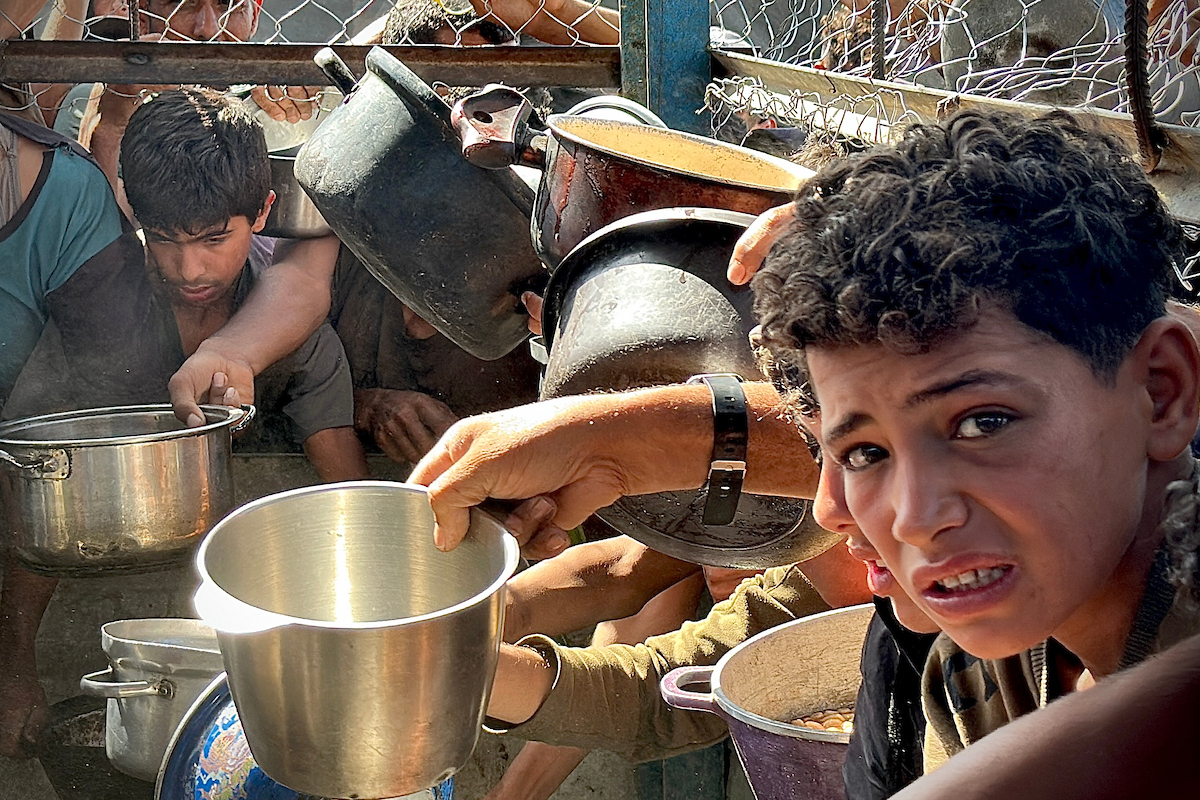
Above photo: Palestinians wait in long lines to receive pots of food distributed by charitable organizations, as they face food crisis, in Al-Mawasi area in Khan Yunis, Gaza strip on May 25, 2025. Moaz Abu Taha/APA Images.
Illnesses that were manageable before the war are turning deadly amid “catastrophic levels” of food insecurity in Gaza.
And 19 months of genocide have now led to the spread of new diseases, reaching record numbers.
Red bumps began to appear on 8-year-old Muhammad al-Mughanni’s fragile body a few days ago. At first, his mother didn’t think much of them. “I thought it was part of his usual allergic reactions,” she told Mondoweiss. Muhammad had suffered from a skin allergy before the war, and his condition had worsened in early 2024. “Once he gets bitten by a mosquito, the bite area swells and turns red, causing intense itching that leads to scratching and bleeding,” explained Um Muhammad. “It becomes so painful.”
Day by day, the bumps grew larger. They swelled, developed boil-like heads, and came with relentless itching. Concerned, she took him to the only available medical clinic in the school-turned-shelter where they were staying. He was diagnosed with a case of chickenpox.
Since the beginning of the war, Muhammad has been living with his parents, three siblings, and fifteen extended family members in a 60-square-meter classroom at the al-Daraj School in central Gaza City. They lost their home in al-Shuja’iyya, in eastern Gaza, and sought refuge at the school alongside tens of thousands of other displaced families. They all now share the same bathrooms, mattresses, and belongings. Al-Daraj is part of a five-school complex in the area that shelters over 9,000 displaced people following recent Israeli attacks against eastern Gaza City. Each school has only one medical clinic, struggling to serve people daily.
Sanitation is almost nonexistent. In many schools, including most of Gaza’s makeshift shelters, at least 50 people share a single bathroom. These facilities are filthy and overburdened. Tents line the schoolyards and gates. Waste accumulates in corners, and vendors sell products in the middle of the crowded yards.
Muhammad’s diagnosis came on a Thursday. With clinics closed on Fridays, his mother panicked. “I couldn’t wait until Saturday. I feared the chickenpox would spread more across his body,” she said. With his father unemployed since October 2023 and food increasingly unaffordable — “We can barely buy a kilo of wheat flour,” she said — she was forced to buy chickenpox cream herself for 18 NIS. “Though it might seem cheap — before the war, we’d get it for free — and I had to borrow money just to buy it.”
She now visits the school clinic every day, hoping for enough cream to last one more night. “Some days they give me 3 millilitres, other days maybe 5. It depends on what’s available. I live day by day.”
Skin diseases have been rising sharply as summer intensifies. Dr. Mahmoud al-Af, a general practitioner at a medical clinic in the Asad al-Saftawi School near al-Daraj, says that skin diseases have “exploded” since the summer. “For the past month, I’ve been treating 30 to 40 cases per day, and I expect that number to rise to 60–70 as temperatures increase,” he told Mondoweiss.
Before the war, conditions like scabies and lice were manageable. Treatment required basic medication and hygiene. Now, overcrowding, shared living spaces, and limited hygiene supplies have made containment nearly impossible, the doctor says. Secondary infections, fever, and pneumonia are becoming more frequent.
By mid-2024, recorded cases of scabies and lice surpassed 96,000, mostly among displaced children. Chickenpox cases rose to nearly 9,274. “Amidst the massive numbers of affected people, we suffer a serious deficiency in access to medicines,” a pediatrician in Gaza told Mondoweiss. “We’re forced to treat patients with whatever limited quantities we receive from the Ministry of Health.”
The doctor explained that doctors are no longer handed full strips of painkillers. “Each patient gets one or two tablets, just enough for that day,” he explained. “As for other medications like antibiotics and children’s syrups, we don’t have enough bottles to give each patient their full treatment. When we receive 15 bottles a day, we dilute the medicine with sterile water and dispense it in syringes—3 or 5 millilitres at a time, depending on the required dose. Patients return daily for the next dose.”
Rise of disease due to poor sanitation
Gaza’s crumbling infrastructure is making things worse. Piles of waste and open sewage fill neighborhoods, with children playing nearby as insects swarm near displacement centers. This hazardous environment has led to outbreaks of several illnesses, including hepatitis.
According to Dr. al-Af, hepatitis cases have ranged from two to ten cases daily over the past month in the school. The outbreak has become unprecedented in 2025. By the end of 2024, Gaza’s Health Ministry reported at least 100,000 suspected hepatitis cases, primarily type A, which spreads through contaminated food, water, and overcrowded and unsanitary bathrooms.
Amid these widespread outbreaks, children with rare and chronic illnesses are facing a battle for survival without the essential care that once kept their conditions under control.
Six-year-old Noor al-Huda al-Hajjaj suffers from a rare chronic condition known as Epidermolysis Bullosa (EB), a genetic skin disease she has lived with since birth.
“Any minor trauma or even scratching causes blisters to form on her skin,” Abdelraouf, her 41-year-old father, told Mondoweiss. “Those wounds must be treated immediately to avoid infections and long-term complications.”
Before the war, Noor’s condition was relatively stable. Her family had access to necessary medication, regular follow-up care, and a specialized health routine from her family.
“We had access to saline solutions, medical gauze, soft cotton clothing, creams like Silvazine and Dektazol, and even special mattresses to prevent skin damage,” her father said. “It cost us about 1,000 shekels a month [around $280], but it kept her condition under control.”
That stability has since been shattered. Since the family was forced to flee their home in eastern Gaza, Noor, alongside her parents and 5 siblings, endured nearly ten separate displacements. Noor’s condition started to deteriorate the moment they were relocated to a tent in southern Gaza in December 2023.
“The extreme heat inside the tents made things worse for her sensitive skin,” her father explained. “She’s constantly exposed to mosquito bites and ant stings. She scratches, and it causes severe wounds and bleeding.”
Without consistent control over the hygiene of her environment or medical supplies, Noor’s condition has worsened dramatically. “Her wounds bleed heavily. Her hemoglobin dropped, and now she’s suffering from anemia,” her father said. “Being malnourished, her body is vulnerable, and she can’t resist or defend against viruses. Her body doesn’t respond to treatment.”
Her father adds that the medications and supplies that once kept her condition manageable are now either completely unavailable or have become prohibitively expensive. “The same items that cost us 1,000 shekels a month before the war — if we can even find them — now cost two or three times as much,” he said.
Noor’s case, while rare, illustrates how children with chronic illnesses are at extreme risk in times of war, not just from violence, but from the slow erosion of medical care, hygiene, and stability.
According to the Head of the al-Dawli Pharmacies Group, Dr. Muhammad al-Sheikh, “the crisis extends beyond skin diseases. Chronic conditions such as diabetes and hypertension, once under control, now claim lives due to the lack of treatment,” he said.
“We are witnessing repeated deaths from diseases that were manageable before,” al-Sheikh added. “This is no longer just a healthcare crisis. It’s a humanitarian disaster.”
Why malnutrition aggravates child disease
The temporary ceasefire in January brought brief relief after nearly 15 months of famine and deprivation. But by early March, as the war resumed, Israel reimposed a stricter blockade, choking the flow of food, aid, fuel, and medicine into Gaza and dramatically worsening the humanitarian crisis. According to the March 2025 report of the Integrated Food Security Phase Classification (IPC), the UN body tasked with monitoring famine , much of the Strip, 470,000 people, have reached “Phase 5: Catastrophe/Famine.” The entire population is experiencing “acute food insecurity,” with 96% of all of Gaza experiencing “acute food insecurity,” and 22% of the population suffers from “catastrophic levels.” UNICEF and the World Food Programme (WFP) have issued dire warnings noting that 71,000 children and 17,000 mothers “will need urgent treatment for acute malnutrition.”
“Children are the most affected when it comes to infections and contagious diseases,” said Dr. Ibrahim al-Salhi, a pediatric specialist, in an interview with Mondoweiss. He cited several contributing factors to the surge in illnesses among children: overcrowded camps and makeshift schools, a lack of awareness around hygiene and sanitation, and a behavioral innate tendency among young children to explore the world through touch and taste, often putting contaminated items in their mouths. These behaviors, combined with weak immune systems and exposure to environmental risks, significantly heighten the danger, al-Salhi said.
Malnutrition, al-Salhi explained, compromises immunity at the most basic level. The absence of essential nutrients, particularly protein, zinc, and iron, weakens the body’s first line of defense, including the skin, in turn leaving children vulnerable to viral and bacterial infections. “A fragile immune system not only makes children more likely to get sick, but also slows recovery and prolongs the course of treatment,” he added. “Especially under these conditions, with extreme shortages of medicine, many children are now suffering from anemia, muscle loss, and developmental delays.”
With military operations intensifying again in areas like eastern al-Shuja’iyya, northern Jabalia, and southern Khan Younis, hundreds of thousands of Palestinians have been displaced from northern Gaza to Gaza City, the Gaza Government Media Office said last week. In response to the mass evacuations toward central Gaza, UNICEF reported the forced closure of at least 21 malnutrition centers last April. According to the Ministry of Health, 57 children have died from malnutrition in just the past three months, and nearly 60,000 are currently suffering from it. That number, they warn, will likely rise if the siege continues.
Dr. al-Salhi emphasized that children suffering from severe malnutrition require therapeutic treatment formulas designed to sustain them even if they receive no other nutrition. These formulas provide adequate amounts of protein, fat, iron, zinc, and calories. However, once the treatment ends, children need access to a healthy and balanced diet to prevent relapse, something increasingly impossible under a total blockade. “Even children who are not currently malnourished will likely fall into malnutrition if this continues,” he warned. “They, too, require nutritional support alongside proper food.”
Despite the importance of nutritional supplements, al-Salhi noted, they’re not suitable for everyone. Infants under six months and children with allergies or digestive disorders often can’t tolerate these supplements. Proper treatment requires follow-up care under medical supervision and a structured plan, neither of which is currently feasible. “Under these circumstances, with arbitrary airstrikes and no access to medical resources, there is no functioning system to help children recover,” added the pediatrician. “All we can offer them are therapeutic formulas for those with severe malnutrition or supplements, and even those barely help.”
Walaa al-Bakri, a child psychologist working with an international NGO, says that hunger and wartime conditions has also had deleterious effects on children’s mental health. “Some children have stopped speaking altogether. Others tremble at every noise. Some cry in their sleep because they are hungry,” al-Bakri said.
The World Health Organization recently issued a warning about the imminent collapse of Gaza’s entire health sector. Only 19 out of 36 hospitals remain operational. The rest have been damaged or destroyed by Israeli attacks or rendered ineffective by a lack of electricity, fuel, or supplies. The hospitals that are still functioning are overwhelmed, under-resourced, and unable to absorb the volume of patients.