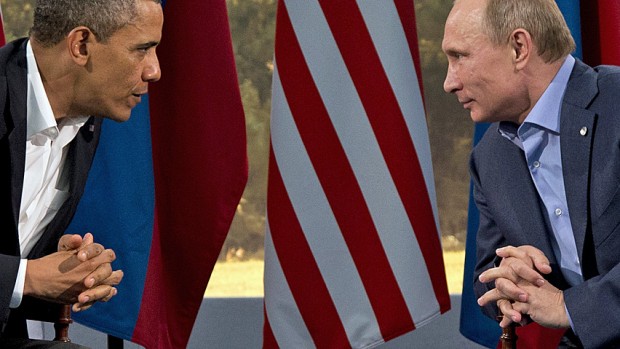
Economic Warfare with Russia Could Cost US Taxpayers and the World Economy
The Eagle has taken on a Bear, and the Bear is Ready
It is interesting that in the same week where President Obama has announced significant changes to the Cuban economic blockade, saying that the 50 year embargo has not worked, his administration is pursuing economic warfare with Russia. As the Vineyard Saker points out:
“You get that? Obama admits that 50 years of sanctions and attempts to isolate a small island right off the coast of Florida has not worked. And then he announces that he will impose more sanctions on Russia, the biggest country on the planet, and that he will isolate Russia, even though Russia now has full access to the biggest economy on the planet?! Is that not the height of stupidity and self-delusion?”
Adding to the stupidity of the economic warfare against Russia is the impact it could have on the United States, Europe; indeed the whole world economy. As was said in an article published on our economic police website by Paul Mobbs:
A new financial crisis is threatening to dwarf the ‘subprime’ mortgage debacle. Cheap money from central banks has fuelled some $1.3 trillion of risky investments in high-cost ‘unconventional’ oil and gas. Now, with oil sinking below $60, all that paper is turning to junk – and that’s putting the entire economic system at risk.
Ellen Brown’s article below goes into how the too-big-too-fail banks in the United States have now protected themselves from this crash by putting the taxpayers on the hook for their losses. Taxpayers covering derivatives trading by Wall Street was a key issue in the recent omnibus funding bill. Brown points out how the US and Saudi Arabia are using oil as a tool to crash the ruble since Russia depends greatly on oil as a major source of income. This will also negatively impact Saudi Arabia’s main adversary in the Middle East, Iran, and will undermine a major US rival in Latin America, Venezuela. The oil war is having lots of impacts, but not just on US adversaries.
Indeed, this is a bad time for the US economy to see massive drops in oil prices. Making matters worse for the US economy is that commodity prices in a wide variety of areas are already falling. Economist Jeffrey Frankel points out this could be a sign of deflation and is very likely linked to the Federal Reserve tightening up the money supply. It is not only oil seeing a drop it is commodities across the board: “The price of iron ore is down, too. So are gold, silver, and platinum prices. And the same is true of sugar, cotton, and soybean prices. In fact, most dollar commodity prices have fallen since the first half of the year.”
While writing about commodities, Frankel also notes that other currencies are dropping in value: “The euro is down 8% against the dollar since the first half of the year and the yen is down 14%.” The drop in the ruble is also impacting other European countries. The Swiss National Bank has switched to a negative deposit rate for some deposits, as it seeks to stabilize its currency and avoid excessive growth of its national currency. This means customers will be charged by the bank for parking their cash instead of earning interest on money left there.
The managing director of the Association of German Chambers of Industry and Commerce, Volker Treier, warned that “one in three companies will have to fire employees or cancel its projects” in Germany. Germany industry also notes Russia turning to Asia, reporting that ten percent of German companies have said that their long-term Russian partners are turning away from Europe toward Asian markets.“Thirty-six percent of companies assume that they have to cancel their projects,” said Treier.
Who is being hurt most by the economic war with Russia? “Germany and Poland will lose the most trade with Russia, and neighboring Finland and Baltic states Lithuania and Latvia will lose a bigger proportion of their GDP. Norway will see fish sales to Russia disappear.” The top three EU food suppliers to Russia in 2013, Germany, Poland and the Netherlands, will be hit hardest. On the other hand in “the US the effect will be very limited, as agricultural exports to Russia are about one tenth of one percent of total US gross domestic product of about $144 billion, according to the US Department of Agriculture.”
Europe and the former Soviet satellite nations are learning that the US will risk their economic stability in order to fight its war with Russia.
And, how about Russia? The US media is cheering the “victory” of economic warfare with the rapid drop in value of the ruble. But will this be a victory?
Former world bank staffer and geopolitical analyst, Peter Koenig, describes how countries are increasingly breaking from the dollar by trading in local currencies. He points to a $400 billion gas deal between Russia and China and a smaller contract in November all to be denominated in rubles and renminbi, not dollars. He writes:
“BRICS – Brazil, India and South Africa – plus the members of the Shanghai Cooperation Organization (SCO) – China, Russia, Kazakhstan, Tajikistan, Kirgizstan, Uzbekistan and considered for membership since September 2014 are also India, Pakistan, Afghanistan, Iran and Mongolia, with Turkey also waiting in the wings – will also trade in their local currencies, detached from the dollar-based western casino scheme. A host of other nations increasingly weary of the decay of the western financial system which they are locked into are just waiting for a new monetary scheme to emerge.”
He says that “Russia is playing a clever chess game, diplomacy at its best. Instead of sabre rattling – Russia is coin rattling” and describes how the gold backed ruble could in the end reign supreme. He also describes the potential of Russia and China flooding the market with dollars — both have lots in reserve — and undermining the dollar. This economic war could get very messy and unpredictable.
Simon Black, an international investor, describes how the ruble has stronger fundamentals than the dollar. He points to two facts. He writes about the capital assets of the central bank as a percentage of their balance sheet to determine net assets. “The US Federal Reserve only has a basic capital ratio of 1.26%. Talk about razor thin. (This is down from 4.5% just a few years ago). That means if the value of the Fed’s assets declines by only 1.26%, the issuer of the world’s dominant reserve currency becomes insolvent.” Regarding Russia “On the other hand, the Russian central bank’s ratio is 12.5%—literally almost TEN TIMES GREATER than the Fed. Capital cushion is crucial because when the unsuspected happens, this is what can help keep you afloat.”
The second metric he looks at is gold, a real asset that is behind the currency, looking at gold reserves as a percentage of the money supply. He writes: “In Russia, it’s 6.2%. And rising. Last year it was 5.5%, and the central bank is continuing to heavily stockpile more. How much gold backs the dollar? Precisely zero point zero percent. Zilch. Nada. The Fed doesn’t own gold. It loudly proclaims this on its own website: ‘The Federal Reserve does not own gold.'”
Black concludes: “with no gold and pitifully razor thin solvency levels, it really wouldn’t take much of a shock to topple the dollar.”
Of course, there are serious problems in the Russian economy: too dependent on oil, corrupted by oligarchy. In his end of year press conference Putin recognized the need for change and promised change over the next two years.
While Russia would not go to the IMF for financial help it doesn’t need to, China is ready to help. The encircling of Russia by an expanding NATO and the encircling of China with the Asian Pivot, combined with the Trans Pacific Partnership attempting to isolate China in Asia, and the Trans Atlantic Trade Partnership tying the US and Europe together at the expense of Russia, is all leading to closer ties between Russia and China. China signaled it was ready to help, when Premier Li Kequiang said at the meeting of the Shanghai Cooperation Organization on December 15th, “To help counteract an economic slowdown, China is ready to provide financial aid to develop cooperation.”
The growing alliance between China and Russia, which the aggressive US policy against both countries is encouraging, is a significant one. China’s reserves — the world’s largest — stood at $3.89 trillion at the end of September. Russia had $373.7 billion at the end of last month, according to data compiled by Bloomberg.
Putin made his most important statement at the end of his annual press conference expressing what is at stake for Russia and showing the grit of the nation. Putin said:
You know, at the Valdai [International Discussion] Club I gave an example of our most recognisable symbol. It is a bear protecting his taiga. You see, if we continue the analogy, sometimes I think that maybe it would be best if our bear just sat still. Maybe he should stop chasing pigs and boars around the taiga but start picking berries and eating honey. Maybe then he will be left alone. But no, he won’t be! Because someone will always try to chain him up. As soon as he’s chained they will tear out his teeth and claws. In this analogy, I am referring to the power of nuclear deterrence. As soon as – God forbid – it happens and they no longer need the bear, the taiga will be taken over (…) And then, when all the teeth and claws are torn out, the bear will be of no use at all. Perhaps they’ll stuff it and that’s all. So, it is not about Crimea but about us protecting our independence, our sovereignty and our right to exist. That is what we should all realize.
It is about “our independence, our sovereignty and our right to exist,” Putin said preparing his people for a critical battle in Russia’s history. Will Russia remain sovereign or be under the thumb of US hegemony? The US eagle has taken on a bear. The bear seems better positioned than the eagle realizes.
KZ
Russian Roulette: Taxpayers Could Be on the Hook for Trillions in Oil Derivatives
The sudden dramatic collapse in the price of oil appears to be an act of geopolitical warfare against Russia. The result could be trillions of dollars in oil derivative losses; and the FDIC could be liable, following repeal of key portions of the Dodd-Frank Act last weekend.
Senator Elizabeth Warren charged Citigroup last week with “holding government funding hostage to ram through its government bailout provision.” At issue was a section in the omnibus budget bill repealing the Lincoln Amendment to the Dodd-Frank Act, which protected depositor funds by requiring the largest banks to push out a portion of their derivatives business into non-FDIC-insured subsidiaries. Warren and Representative Maxine Waters came close to killing the spending bill because of this provision. But the tide turned, according to Waters, when not only Jamie Dimon, CEO of JPMorgan Chase, but President Obama himself lobbied lawmakers to vote for the bill. It was not only a notable about-face for the president but represented an apparent shift in position for the banks. Before Jamie Dimon intervened, it had been reported that the bailout provision was not a big deal for the banks and that they were not lobbying heavily for it, because it covered only a small portion of their derivatives. As explained in Time:
The best argument for not freaking out about the repeal of the Lincoln Amendment is that it wasn’t nearly as strong as its drafters intended it to be. . . . [W]hile the Lincoln Amendment was intended to lasso all risky instruments, by the time all was said and done, it really only applied to about 5% of the derivatives activity of banks like Bank of America, Citigroup, JPMorgan Chase, and Wells Fargo, according to a 2012 Fitch report.
Quibbling over a mere 5% of the derivatives business sounds like much ado about nothing, but Jamie Dimon and the president evidently didn’t think so. Why? A Closer Look at the Lincoln Amendment The preamble to the Dodd-Frank Act claims “to protect the American taxpayer by ending bailouts.” But it does this through “bail-in”: authorizing “systemically important” too-big-to-fail banks to expropriate the assets of their creditors, including depositors. Under the Lincoln Amendment, however, FDIC-insured banks were not allowed to put depositor funds at risk for their bets on derivatives, with certain broad exceptions. In an article posted on December 10th titled “Banks Get To Use Taxpayer Money For Derivative Speculation,” Chriss W. Street explained the amendment like this:
Starting in 2013, federally insured banks would be prohibited from directly engaging in derivative transactions not specifically hedging (1) lending risks, (2) interest rate volatility, and (3) cushion against credit defaults. The “push-out rule” sought to force banks to move their speculative trading into non-federally insured subsidiaries. The Federal Reserve and Office of the Comptroller of the Currency in 2013 allowed a two-year delay on the condition that banks take steps to move swaps to subsidiaries that don’t benefit from federal deposit insurance or borrowing directly from the Fed. The rule would have impacted the $280 trillion in derivatives primarily held by the “too-big-to-fail (TBTF) banks that include JPMorgan Chase, Bank of America, Citigroup, and Wells Fargo. Although 95% of TBTF derivative holdings are exempt as legitimate lending hedges, leveraging cheap money from the U.S. Federal Reserve into $10 trillion of derivative speculation is one of the TBTF banks’ most profitable business activities.
What was and was not included in the exemption was explained by Steve Shaefer in a June 2012 article in Forbes. According to Fitch Ratings, interest rate, currency, gold/silver, credit derivatives referencing investment-grade securities, and hedges were permissible activities within an insured depositary institution. Those not permitted included “equity, some credit and most commodity derivatives.” Schaefer wrote:
For Goldman Sachs and Morgan Stanley, the rule is almost a non-event, as they already conduct derivatives activity outside of their bank subsidiaries. (Which makes sense, since neither actually had commercial banking operations of any significant substance until converting into bank holding companies during the 2008 crisis). The impact on Bank of America, Citigroup, JPMorgan Chase, and to a lesser extent, Wells Fargo, would be greater, but still rather middling, as the size and scope of the restricted activities is but a fraction of these firms’ overall derivative operations.
A fraction, but a critical fraction, as it included the banks’ bets on commodities. Five percent of $280 trillion is $14 trillion in derivatives exposure – close to the size of the existing federal debt. And as financial blogger Michael Snyder points out, $3.9 trillion of this speculation is on the price of commodities. Among the banks’ most important commodities bets are oil derivatives. An oil derivative typically involves an oil producer who wants to lock in the price at a future date, and a counterparty – typically a bank – willing to pay that price in exchange for the opportunity to earn additional profits if the price goes above the contract rate. The downside is that the bank has to make up the loss if the price drops. As Snyder observes, the recent drop in the price of oil by over $50 a barrel – a drop of nearly 50% since June – was completely unanticipated and outside the predictions covered by the banks’ computer models. The drop could cost the big banks trillions of dollars in losses. And with the repeal of the Lincoln Amendment, taxpayers could be picking up the bill. When Markets Cannot Be Manipulated Interest rate swaps compose 82% of the derivatives market. Interest rates are predictable and can be controlled, since the Federal Reserve sets the prime rate. The Fed’s mandate includes maintaining the stability of the banking system, which means protecting the interests of the largest banks. The Fed obliged after the 2008 credit crisis by dropping the prime rate nearly to zero, a major windfall for the derivatives banks – and a major loss for their counterparties, including state and local governments. Manipulating markets anywhere is illegal – unless you are a central bank or a federal government, in which case you can apparently do it with impunity. In this case, the shocking $50 drop in the price of oil was not due merely to the forces of supply and demand, which are predictable and can be hedged against. According to an article by Larry Elliott in the UK Guardian titled “Stakes Are High as US Plays the Oil Card Against Iran and Russia,” the unanticipated drop was an act of geopolitical warfare administered by the Saudis. History, he says, is repeating itself:
The fourfold increase in oil prices triggered by the embargo on exports organised by Saudi Arabia in response to the Yom Kippur war in 1973 showed how crude could be used as a diplomatic and economic weapon.
Now, says Elliott, the oil card is being played to force prices lower:
John Kerry, the US secretary of state, allegedly struck a deal with King Abdullah in September under which the Saudis would sell crude at below the prevailing market price. That would help explain why the price has been falling at a time when, given the turmoil in Iraq and Syria caused by Islamic State, it would normally have been rising. . . . [A]ccording to Middle East specialists, the Saudis want to put pressure on Iran and to force Moscow to weaken its support for the Assad regime in Syria.
War on the Ruble If the plan was to break the ruble, it worked. The ruble has dropped by more than 60% against the dollar since January. On December 16th, the Russian central bank counterattacked by raising interest rates to 17% in order to stem “capital flight” – the dumping of rubles on the currency markets. Deposits are less likely to be withdrawn and exchanged for dollars if they are earning a high rate of return. The move was also a short squeeze on the short sellers attempting to crash the ruble. Short sellers sell currency they don’t have, forcing down the price; then cover by buying at the lower price, pocketing the difference. But the short squeeze worked only briefly, as trading in the ruble was quickly suspended, allowing short sellers to cover their bets. Who has the power to shut down a currency exchange? One suspects that more than mere speculation was at work. Protecting Our Money from Wall Street Gambling The short sellers were saved, but the derivatives banks will still get killed if oil prices don’t go back up soon. At least they would have been killed before the bailout ban was lifted. Now, it seems, that burden could fall on depositors and taxpayers. Did the Obama administration make a deal with the big derivatives banks to save them from Kerry’s clandestine economic warfare at taxpayer expense? Whatever happened behind closed doors, we the people could again be stuck with the tab. We will continue to be at the mercy of the biggest banks until depository banking is separated from speculative investment banking. Reinstating the Glass-Steagall Act is supported not only by Elizabeth Warren and others on the left but by prominent voices such as David Stockman’s on the right. Another alternative for protecting our funds from Wall Street gambling can be done at the local level. Our state and local governments can establish publicly-owned banks; and our monies, public and private, can be moved into them. Ellen Brown is an attorney, founder of the Public Banking Institute, and author of twelve books including the best-selling Web of Debt. Her latest book, The Public Bank Solution, explores successful public banking models historically and globally. Her 200+ blog articles are at EllenBrown.com.