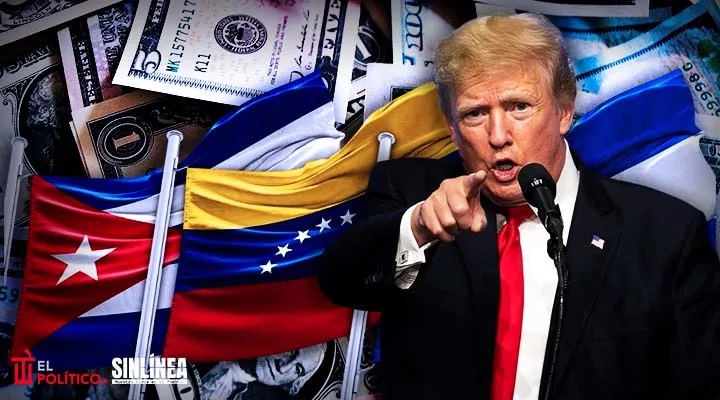
The United States announced that it will allocate $1.8 billion to foreign aid projects with a political and strategic vision. According to a document sent to Congress, $400 million will go to Latin America, aimed at confronting the “regimes” of Nicaragua, Venezuela, and Cuba.
The Trump administration’s plan seeks to redirect resources toward programs to curb the influence of governments labeled by Washington as “anti-American,” extending its reach to Europe and Greenland in order to “contain China’s advance in strategic sectors.” This narrow and unilateral vision, which prioritizes Washington’s economic and security interests, far from promoting international cooperation based on mutual respect and solidarity, is based on a logic of confrontation that jeopardizes regional and global stability.
More of the same, money from US taxpayers, from ordinary citizens, who see their economic and social opportunities, their access to health care, education, and a decent retirement diminish day after day, while the White House squanders millions to change governments that do not bow to its interests.
As you know, the progressive dismantling of the U.S. Agency for International Development (USAID), a classic agency of foreign subversion, covered by the umbrella of humanitarian aid and development cooperation, now allows the current administration to dispose of substantial resources at will. This decision, taken at the beginning of Trump’s term, also led to massive layoffs and an alarming reduction in food and medicine shipments to countries facing deep crises. The official notification, dated September 12, also states that the diverted funds will be used to strengthen U.S. global leadership by diversifying critical mineral supply chains and promoting investment in strategic infrastructure.
In the Latin American context, in particular, the strategy seeks to isolate and weaken the governments of Cuba, Venezuela, and Nicaragua, which embody alternative models of political and social development, evidencing a new escalation of the old US interventionist doctrine. Latin America, marked by its history of interventions and economic blockades, is once again suffering the consequences of an imperialist vision that disregards the right of peoples to decide and advance their own national projects.
On the other hand, the commitment to contain China’s presence extrapolates commercial competition to a geopolitical arena where threats and fears translate into measures that can escalate international tensions. Greenland and Europe are not immune to this dispute, illustrating a Washington that seeks to assert its hegemony through the global reconfiguration of strategic spaces and natural resources.
Ultimately, the strategy announced by the White House represents a renewed focus on conflict that overshadows the multilateral cooperation and understanding necessary in an increasingly interconnected and complex world.
For Cuba and its sister countries in the region, it is a clear reminder that the defense of sovereignty and self-determination remains a current and vital challenge in the face of external pressures. International aid must be directed toward social justice, equitable development, and the overcoming of structural inequalities, not toward servility to imperialist interests that only perpetuate dependence and regional fragmentation.
In this scenario, the call for unity, solidarity, and political resistance could not be clearer or more urgent. Latin America must strengthen its sovereign integration and its firm voice against these attacks that seek to relegate it to a mere playing field in global geopolitical struggles.