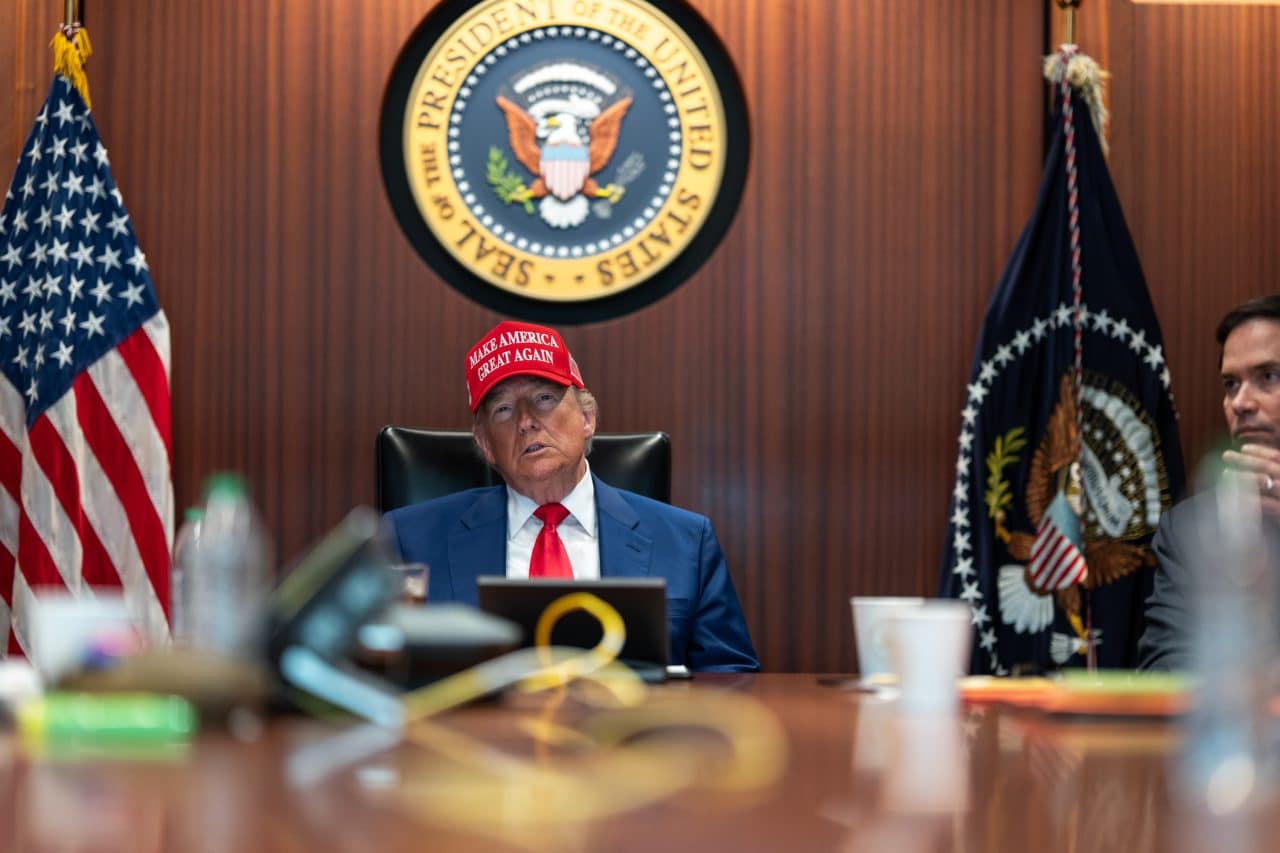
Above photo: A photo released by the White House of Donald Trump in the White House Situation Room on June 21, 2025 in preparation for the U.S. attack on Iran. The White House.
The 12 days of fighting between Iran and Israel, along with the U.S. intervention, left a deep impact on all three countries.
Where do each stand now that the fighting has stopped, and what comes next?
The fighting between Israel and Iran, sparked by an illegal and entirely unprovoked attack by Israel, has abated for the moment. After the United States did what Israeli Prime Minister hoped it would do and bombed Iran’s underground nuclear facilities, including the one at Fordow with bunker buster weapons, U.S. President Donald Trump told Israel to stop its attacks and reinforced that order when Israel sent dozens of bombers toward Iran shortly after the ceasefire was enacted, claiming a response to two Iranian missiles.
The entire battle, fought on the basis of a fictional threat of Iran being close to acquiring a nuclear weapon, demonstrated how Israeli Prime Minister Benjamin Netanyahu can manipulate intelligence, politics, and ignorance in the U.S. to provoke American action. But it also demonstrated that the United States cannot be forced to act when it is unwilling to do so and, more importantly, that when it decides to stand firm, the United States absolutely does have the power to rein Israel in.
But the twelve days of bombing and missile exchanges between Iran and Israel, as well as the American intervention, left the situation quite different from before the escalation started. We can set aside Donald Trump, Benjamin Netanyahu, and Ayatollah Ali Khamenei’s claims of victory for the political necessities they are, but we do need to see what’s changed and what that might mean going forward.
Israel
No one knows better than Israeli officials what a sheer, fearmongering scam the entire “Iran nuclear issue” is. They know quite well that any Iranian consideration or preparation for a nuclear weapon occurred more than two decades ago, and it was little more than preliminary steps while the issue was being debated at the highest levels of the Iranian government.
They know as well that the only way to ensure that Iran or any other country doesn’t develop a nuclear weapon is through a diplomatic agreement. If this was their concern, they would have backed the 2015 Iran nuclear deal, as a good many Israeli military and intelligence officials did. The politicians, of course, did not.
The purpose of this sham is and has always been to create a regime-change bloc in Washington and Brussels with the goal of an attack on Iran that would force the Islamic Republic from power.
With Donald Trump in the White House, a more security-minded era dawning in Europe, and the Israeli success in asserting its destructive capabilities in Lebanon, Syria, Yemen, Iraq, and the Gaza Strip, this was the opportunity Netanyahu had been dreaming of since he first entered politics.
But it failed.
Netanyahu found himself unable to pull the United States into a regime change war in Iran. As with Gaza and Lebanon, Israel demonstrated beyond a doubt that it was capable, and more than willing, to cause extreme destruction and a sickening amount of death. Yet for all that bloodshed and rubble, Hezbollah still exists in Lebanon, Shi’a and other militias allied with Iran still dot the region, Ansar Allah remains in its position in Yemen, and Hamas continues to endure in Gaza.
The political changes Netanyahu sought have not come through war, despite the suffering Israel has so viciously caused. Wars rarely spur change, and when they do, they are not the changes the warmongers expected (see Iraq and Libya for examples).
Instead, at least for the moment, the considerable opposition to the Islamic Republic within Iran has been muted as the country unites in its outrage, grief, and opposition to the Israeli and American attacks. Eventually, that opposition will emerge again, but Israel’s actions have done nothing to help them.
For those in Israel, and those who support Israel, who continue to believe this was about an Iranian nuclear weapon, the full assessment remains to be seen, but it is almost certain that Trump’s boast of having “totally obliterated” Iran’s nuclear program is false.
The location of Iran’s stockpile of enriched uranium is unknown, but early indications are that Iran still has it, which means they moved it before the U.S. attack. That is emblematic of the so-called “success” of this mission.
Iran’s nuclear facilities have been badly damaged, that is certain. Some may be permanently unusable. But such facilities can be repaired or rebuilt. Israel murdered, in the most criminal sense of that word, numerous Iranian nuclear scientists, but others remain. You can’t erase knowledge with knives, guns, or car bombs.
Whether by months or a few years, Israel and the U.S. set back the theoretical timeline for Iran to build a nuclear weapon, but they did not destroy or limit Iran’s ability to do so. On the contrary, the belligerence of the United States and the unbound and widespread violence of Israel had already caused many Iranians to change their minds about pursuing a nuclear weapon, making that support a majority in the country.
These attacks on Iran, the worst on Iranian since the Iran-Iraq war that ended in 1988, have not only strengthened public support, but they sent Iran the message that it should end cooperation with international nuclear regulatory bodies and withdraw from the Nuclear Nonproliferation Treaty (NPT). Whether Iran pursues that course remains to be seen, but Israel’s actions only encourage such actions.
In short, Israel’s attacks made the possibility of an Iranian nuclear weapon far more likely, not less, even if it stretched the potential timeline for Iran to create one. In reality, that timeline did not even exist before. It very well might now.
All of this is added to the rising hostility toward Israel throughout the region. Though that hostility is mostly based on Israel’s genocide in Gaza, the unbridled violence Israel has unleashed throughout the Middle East is only aggravating the anger. Arab dictatorships hold that rage in check with massive repression, but such tactics can only work for so long.
Moreover, as that rage grows, so too does the likelihood of attacks on Israelis. Of course, this is the lifeblood of Netanyahu’s political existence, and those of his right-wing cohorts. But it is not sustainable, and it may well end without warning. Israeli citizens have not been made safer in the past two weeks, but have been put in more danger.
Still, Netanyahu will probably reap great benefits from what is now perceived as a victory. Too many Israelis quickly forgot their own disappointment with “Mr. Security” in the wake of his disastrous failure on October 7. But in every way that matters, Israel is in a worse position now than it was two weeks ago.
Iran
The Islamic Republic also emerges battered and bruised, though it has a few positives to point to.
Prior to the American attack on Iran’s nuclear facilities, Iran was girding up for a long encounter with Israel. But it was a difficult path that lay ahead.
Israel was starting to run low on interceptor rockets for its various defense systems, and it was showing. Hits on Israeli targets by Iranian missiles were becoming more frequent and more impactful, despite the fact that Iran was firing fewer missiles.
This was an advantage for Iran, but it was often overstated. The United States had several options to at least partially restock Israeli rockets; the most likely one being to use some of the U.S.’ own stockpile.
But even if Iran enjoyed a temporary advantage in being able to overwhelm Israel’s air defenses, its rocket supply would eventually dwindle, and Iran doesn’t have a benefactor like the United States to come to its rescue. Russia is busy elsewhere.
That gave rise, at least in Washington, to concern that Iran would, at that point, turn to destabilizing the Gulf states with attacks from its militia partners, which it had to that point told not to act in Iran’s defense. Combined with the closing of the Strait of Hormuz, which Iran was threatening to do before the ceasefire, this amounted to the threat of a regional war that frightened the United States and Europe.
Israeli agents were able to penetrate Iran on large scale, planting not only operatives but also weaponry that crippled Iran’s defense before Israeli jets even dropped their first bombs. The resulting mass arrests in Iran, numbering over 700, including six executions so far, are an authoritarian sign of weakness for the government.
Iran’s air defenses were rendered completely useless in a matter of hours by Israel. It will be some time before Iran can address its new vulnerability to attack.
Iran can claim it survived attacks by the neighborhood bully, Israel, but the reality is plain for all to see: the United States put a stop to the fighting because Trump was not interested in a war of regime change and his friends in the Gulf did not want to see the fighting spread to them.
Still, Iran did prove that it was capable of defending itself very well, even if only to a point. True, the U.S. and Israel would probably have had to invade Iran, at enormous cost, to achieve the Israeli and neoconservative dream of regime change. But the ease with which Iran’s air defenses were compromised is a lasting strategic image from this encounter.
The United States
Judging the outcome from a U.S. point of view is a bit more complicated.
For Donald Trump, this was a win. He managed to “address” the boogeyman of an Iranian nuclear weapon in a way that would satisfy most Americans and that, in the end, did not confirm the fears of his MAGA base.
While many in Trumpworld were opposed to the U.S. acting in any way against Iran, this was not due, on the whole, to a love of peace or concern over the dangers to civilians in Iran. It was based on an isolationist urge to avoid American entanglement in a new Mideast war.
Because that was the root of the concern, Trump had an option, which he chose, to attack Iran’s nuclear facilities and then end the fighting. In order to do this, he communicated his intentions to Iran beforehand, allowing the Iranians to move at least some equipment, their uranium stockpile, and, most importantly for avoiding the war’s expansion, its personnel out of the line of fire. Iran responded in kind, warning the U.S. about its retaliatory strike against the Al-Udeid airbase in Qatar.
The debate over the damage to the nuclear installations goes on, but Trump has appeased his MAGA isolationist base, while also appealing to those of his followers who worship his purported “strength” and “toughness.”
Neocons are, of course, quite frustrated, but since they pinned so much of their argument on the threat of an Iranian nuclear weapon, they will need to regroup before they can really criticize this operation that was not aimed at regime change.
Trump continued his long-standing practice, shared with other presidents, of establishing the United States as an independent, rogue actor that willfully disregards international norms and laws. This angered the United Nations and countries in the Global South. Trump, of course, doesn’t care about that.
What he does care about is the fact that NATO and Europe fell in behind him, something they didn’t do during his first term. NATO’s new chief, Mark Rutte, put on a cringeworthy display of fawning at Trump’s feet during the NATO summit. But Trump has now gotten European leaders to agree to buy billions of dollars more in weapons from mostly American weapons manufacturers, agreeing to spend 5% of their respective nations’ GDP on security. They will fall well short of that goal, doubtless, but the sales will still increase appreciably.
The neocons and their fellow war hawks in the Democratic Party didn’t get the regime change war they wanted. They will wait until there is definitive proof that Iran can still reassemble its nuclear program, and will try to use it to press Trump for a new war, in the neocons’ case, and for political points as well for the Democrats.
Meanwhile, the U.S.’s already tattered standing among people not only in the Global South but also in much of Europe—where popular sentiment, like that in the U.S., contrasts sharply with that of their elected officials—has taken another beating. Most people understand that Trump has completely destroyed the credibility of international treaties, particularly the NPT, and reinforced the American reputation for deception and untrustworthiness.
On the other hand, if Trump does try to pursue some kind of détente with Iran, it could be a meaningful move. It’s hard to see that happening, given the absolute lack of trust between Trump and anyone in Iran. But Trump did pull the leash on Netanyahu, and the Iranians know it.
This episode should remove the excuse for any president that they are somehow powerless to stand up against Israel’s desires. No Israeli prime minister ever wanted anything from the U.S. more than Netanyahu wanted a regime change war from Trump. He said no and even stopped Israel from reigniting the fighting. He could do the same in Gaza. All that’s required is the will to do it.