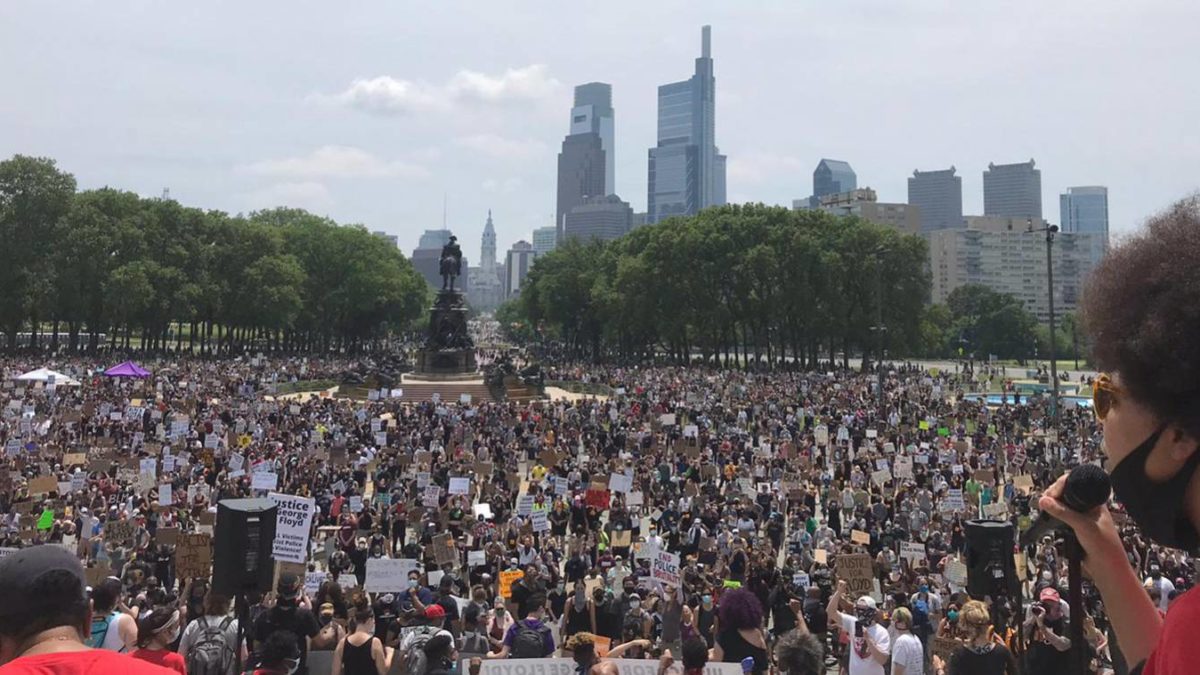
Above photo: Tens of thousands march in Philadelphia in June 2020 against racism. Liberation News.
Black Socialist Organizer Marks Juneteenth.
Peoples Dispatch speaks to Rachel Domond, Black socialist organizer and artist, on the real story of Juneteenth and the tasks for this generation of Black radicals
Amid the chaos of mass protest of Trump administration policies, such as the systematic targeting of immigrant communities, the drive towards potential catastrophic war with Iran, and attacks on free speech, this year marks the 160th anniversary of Juneteenth, a holiday celebrated by Black communities that marks the end of slavery in the US.
To mark this day, Peoples Dispatch spoke to Rachel Domond, a young Black organizer and visual artist, who for years has organized Black communities and is a part of the movement for socialism, as a member of the Party for Socialism and Liberation.
Peoples Dispatch: This year marks 160 years since Union Army Major General Gordon Granger issued the order that officially proclaimed the freedom of the last enslaved people in Galveston, Texas. Can you describe the significance of this day in today’s context – as Donald Trump escalates attacks on immigrants, including Black immigrants, and proposes massive cuts to social programs such as Medicaid and SNAP that millions of working class and poor Black people rely on?
Rachel Domond: There is a war currently being waged against Black, immigrant and working class communities at large, and many of the gains that our people have fought for and won are at risk. Yes, we have a federal holiday now to celebrate the end of slavery. But this comes at the same time the billionaires in power seek to overturn all of the rights that civil rights organizers and others fought to secure over recent decades, such as SNAP, Medicaid, and most of the other critical social programs that people rely on to survive.
The lesson here is that under our current capitalist system, everything that we win is always at risk of being taken away, and therefore, we can’t allow ourselves to become comfortable with what we have without continuing to not only fight to defend it, but demand more.
This historic milestone for the Black liberation movement should remind us just how much further we need to go, and how it will take all of us to get there.
PD: Growing up in this country, what were you taught about Juneteenth and the emancipation of enslaved people? Do you feel like what most people are taught in schools encapsulates the true history of Juneteenth?
RD: Every right that we are able to take for granted today was achieved through tireless struggle by millions of people. That is a history in general that the tiny elite who rule this country are constantly seeking to disconnect us from.
The Civil War, a revolution waged by Black and white troops alike, is a prime example of the whitewashing of our history. In public school while growing up, I was taught that Abraham Lincoln was the benevolent leader who, one day, decided to free the slaves with the Emancipation Proclamation. The fact that nearly 2.5 million white troops and 200,000 Black troops fought, in many cases to the death, to defeat chattel slavery, is never a primary factor in any of that. And that is intentional. If the majority of people recognized that the end of slavery in the US was actually a result of millions of people standing up, getting organized and fighting for it, that would change the narrative so often perpetuated onto us that poor and working class people are incapable of taking charge over their own lives. It would defeat the idea that all change must be made in the ballot box or by laws signed by the people in power.
But the truth is, the only reason laws have ever changed in an institutional way is because a large section of the population has decided that it wasn’t working for them, and decided to get organized to do something about it. The only reason Juneteenth was made a federal holiday was because millions of people took to the streets against racism in 2020, not because Joe Biden decided to care deeply about fighting for an end to the oppression and exploitation of Black people.
PD: 160 years later, what is the legacy of the system of slavery today? What does it mean to fight for “full liberation”?
RD: Today, we enjoy more Black CEOs, elected officials and people of wealth than ever before, but that means absolutely nothing for the cause of Black liberation.
In fact, all it really does is falsely convince us that racism no longer exists because of these achievements. In reality, the majority of Black communities are still plagued by deep inequality in the forms of poor housing conditions, inadequate public education, insufficient wages, not to mention high unemployment rates due to job discrimination and unequal opportunity, soaring rates of mass incarceration and violent policing, disgustingly disproportionate poor health outcomes, and more.
Where I’m from in Boston, the median wealth of Black families is just $8, compared to a median wealth of more than $200,000 of white families. This is no coincidence, but is all by design. Meanwhile, we are taught to idolize the handful of Black leaders and misleaders that have assumed positions in the very system that maintains these injustices.
To fight for full liberation, we first need to recognize that we are not free. We must stop convincing ourselves that we are unworthy, or that our people are asking for too much, or that we should just settle for holidays that commemorate our history. We are deserving of lives of dignity and respect, where our children and elders can thrive, and where every day doesn’t have to feel like a struggle. Yes, chattel slavery has ended, but are we really free if we have to get up and go to work everyday in order to survive? If we have to hustle to make ends meet and keep a roof over our heads? If we can’t enjoy our right to determine our own future?
PD: Given the circumstances today amid Trump’s presidency, what do you feel is the task of this generation of Black organizers?
RD: Today, as Black organizers, it is as critical as ever to internalize the words of Assata Shakur: “it is our duty to fight for our freedom, it is our duty to win.”
No longer can we afford to sit idle, or simply talk on the internet about all that’s wrong with society. We must do. We must learn from those who have fought before us and carry on the torch. We must build genuine links within our communities. We must bridge our struggle for Black liberation with all of the just struggles of the time, for immigrant rights, for women’s and queer rights, for environmental justice and for an end to wars. Our struggles are all interconnected, and we must recognize that any gains made for Black people in the past have never been done by Black people alone, nor will they be made by Black people alone in the future.
Our struggle isn’t simply about race and defeating white supremacy, it’s about ending the system that exploits us all and allows for the perpetuation of racism at the root, capitalism.