This interview is also available on podcast platforms and Rumble.
The meddling and infiltration of governments in Latin America by the United States is a huge chapter of its 20th century history. One of the most egregious and blatant examples of intervention was in Chile, where the democratically elected socialist president Salvador Allende was overthrown by the CIA-backed military coup in 1973.
The ensuing years saw violent repression of student activists, labor leaders, journalists, leftwing politicians and dissidents at the helm of a brutal military dictatorship led by Augusto Pinochet. Among the victims of this ruthless crackdown were two American citizens, Charles Horman and Frank Teruggi.
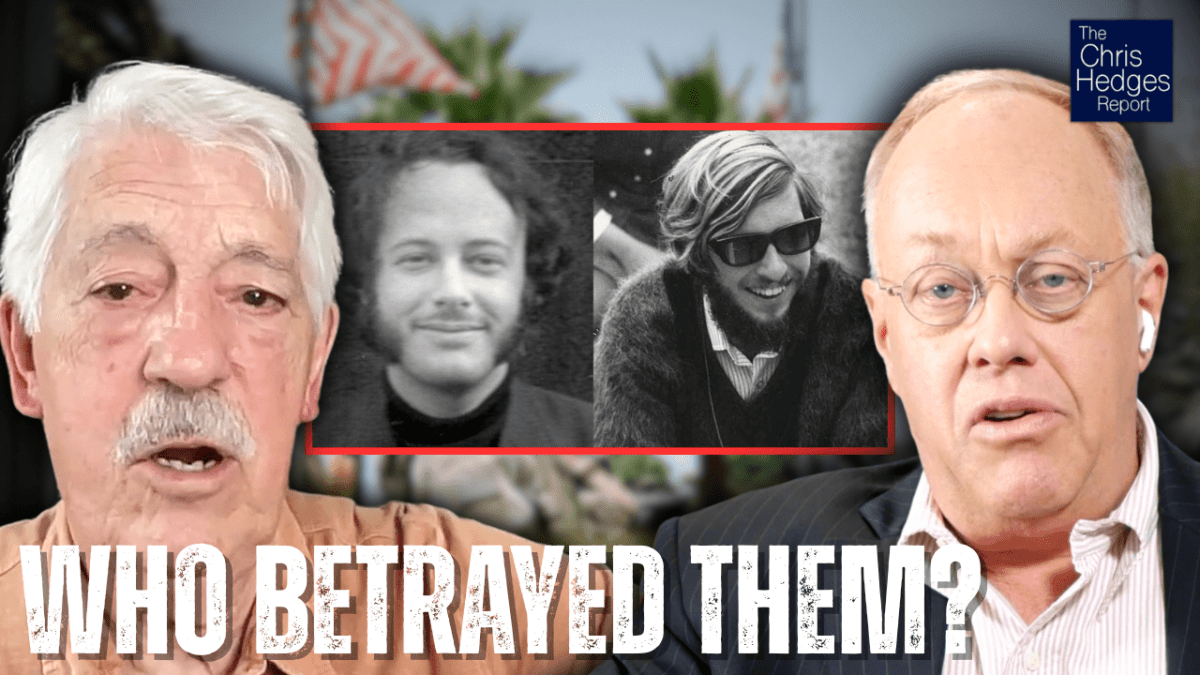
Joining host Chris Hedges on this episode of The Chris Hedges Report is journalist John Dinges who, in his new book Chile in Their Hearts: The Untold Story of Two Americans Who Went Missing After the Coup, dives into their involvement in Chile at a time where grand hope quickly turned into great despair.
Chris Hedges: In the late 1960s and early 1970s thousands of young people flocked to Chile, many of them fleeing rightwing dictatorships in countries such as Bolivia, Argentina, Brazil and Uruguay. Chile’s democracy stood in stark contrast to the police states they came from, ones that engaged in severe political repression, blacklisting, political assassinations, torture and the disappearances ultimately of tens of thousands of student activists, labor leaders, journalists, leftwing politicians and dissidents.
In 1970 the socialist Salvador Allende was elected Chile’s president. His election saw a further influx of leftwing Americans, many part of the anti-war movement in the United States, as well as Europeans, swelling the numbers of foreigners to some 20,000. Being in Chile then, as John Dinges writes, was to experience the most exciting political experiment in Latin America, one that rivaled Fidel Castro’s victory in 1959 in Cuba.
Dinges, who worked as a reporter in Chile from 1972 to 1978, in his book Chile in Their Hearts looks at this period of initial promise and then dark tragedy when Allende was overthrown and killed or committed suicide in a CIA-backed military coup in 1973. He focuses on the lives and execution by the Chilean military of two idealistic young Americans, Charles Horman and Frank Teruggi.
Joining me to discuss his book is John Dinges who was a correspondent for The Washington Post and later managing editor of National Public Radio. He is also professor emeritus of Journalism at Columbia University. His other books include Assassination on Embassy Row, Our Man in Panama and The Condor Years: How Pinochet and His Allies Brought Terrorism to Three Continents.
John, in the beginning of the book, you lay the kind of social climate, cultural, political climate, and I thought that was very important. Frank [Teruggi] came out of a religious background. Charles [Horman] went to Harvard, but one of the things that you, I think correctly, point out is that these were not, as portrayed in the 1982 movie “Missing,” which was based on the murder and disappearance of Charles, these were not political neophytes.
So talk about, you were there, you arrived in Chile, what is it, a year before the coup? And I want you, because both of us went to Latin America, I went a little later, but we both started as seminarians. So talk about the kind of fertile ground and the importance of Chile and the climate at the time.
John Dinges: Well, we went to Chile because we had hope and that’s a religious term as well as a political term. We came out of the 1960s protest movement. I was a journalist. I had left the seminary in 1967. I was studying in Austria and having to avoid the draft and avoid being sent to Vietnam, that really radicalized me.
And as I became a journalist, I began to focus on Latin America. When Allende was elected in 1970, I was working the desk at the newspaper in Iowa, and I wrote the headline. And the headline said, “Marxist Victor.” And it’s a front page story.
Maybe it was my decision, I can’t remember, to put it on the front page, but I was intensely interested in what was going on as a young journalist in Iowa. So Charles Horman is kind of a reflection of what I was going through. Also a journalist, a freelancer. In other words, we had some legitimate journalistic credentials, but at the same time, we weren’t establishment journalists.
We both went down there as freelancers. Neither of us was particularly successful in those years in terms of getting a lot of things published. But we were very interested in documenting what was going on during the Allende government. We thought that what we had failed to accomplish, what the progressive movement had failed to accomplish in the United States in the 1960s, could be recovered and could be successful in Latin America.
The idea that Latin America could be a model for the rest of the continent, maybe even for other countries around the world, by combining democracy and social change was a magnificent idea that made us change our lives to go down there. Thousands of Europeans, Americans, Latin Americans, we flocked to Chile thinking that this could be the future.
Chris Hedges: And let’s talk about what the climate was like. You’ve written three books on Chile. It’s kind of dominated a lot of your own work. I want to talk about that at the end because you stayed on and lived under the [Augusto] Pinochet dictatorship. There are probably some parallels to what we’re undergoing currently in the United States.
But let’s talk about that. I mean, immediately when he’s elected, [Richard] Nixon and [Henry] Kissinger target Allende and they actually are hoping for a military coup. They are assassinating… And we should be clear, Chile had a functioning democracy, was it for decades? I mean, was it 50, 100 years or something?
John Dinges: More than a hundred years.
Chris Hedges: More than a hundred years. So they had a functioning democracy. Allende is elected in a fair election. And what were the kinds of programs he intended to institute and why did he immediately earn the animus of the US government?
John Dinges: Allende’s program was a revolution with vino tinto, with red wine and empanadas. It was a very popular, very populist appeal. It called for a kind of democratic socialism, not like in Europe, certainly not like the communist experiments in Eastern Europe, but a mixed economy, really coming out of the United Nations economic development ideas of the 1950s.
The idea of state intervention to create a manufacturing base in a Latin American country and at the same time to change agriculture away from the large farms that were dominated by large owners, very rich owners who did not farm the land productively. So agrarian reform on the one hand and industrial development on the other hand, these are the two legs of the experiment.
The social part of it, the cultural part was, I think, maybe not more important, but it was the thing that came across to us more immediately. It was literature. It was [Chilean poet and former Senator of the Republic of Chile] Pablo Neruda. It was music. There was a revolution in music, popular music. The country had become very liberal, almost like the counterculture in the United States. Sexual mores, for example, were very similar to what they were in Latin America, I mean, what they were in the United States.
And this, of course, for young people going down to South America, it was a continuation of the freedom that we had experienced in the United States. And people, for example, Allende created a publishing house called [Editora Nacional] Quimantú. And they published editions of books from all over the world. [Albert] Camus, [Ernest] Hemingway in very cheaply produced paperbacks, which were available for under a dollar, and they were sold in kiosks all over Chile.
And you saw factory workers in the buses reading books. This was an incredible literary revolution in a very poor country. I don’t want to portray Chile as an abject, poor, non-functioning country. This is a country with a very high educational level. Public school system had been functioning very well for most of the period of Chile’s democracy, which went back many years.
And Allende grabbed all of those elements and put them together into a social experiment, which at the beginning seemed to be very successful. The economy grew at 8% in the first year of his government. I don’t want to go into the economic details of that, but it largely had to do with stimulating the economy and raising people’s wages and raising the pensions of retirees. This caused an immediate economic boom which lasted for more than a year.
And so there was a lot of hope. Right in the middle of that was when I arrived and when Frank Tarucci and Charles Horman arrived in Chile in 1972. Things still looked pretty good. There was now more opposition in 1972. But you asked about the U.S. opposition. It’s important that one of the revelations that I have emphasized in my book, and I say revelations because the general set of knowledge that people have about this period focuses on the 1973 coup, which actually the United States was not directly involved in.
But in 1970, when Allende was actually elected in September of 1970, the United States, under the direction of Henry Kissinger, immediately ordered the CIA to carry out a military coup. And they did it. It was financed, organized, all of the participants were directly involved with CIA direction. And it resulted, it was unsuccessful. It was intended to prevent Allende from being inaugurated so that he couldn’t be confirmed by Congress, which was a necessary step in the process.
The unsuccessful coup resulted in the assassination of the head of Chile’s armed forces, the top Army General in the country was killed by a group of young people who were under the direction of these military people that the CIA had recruited to try to carry off this coup.
Henry Kissinger has never really had any accountability for his involvement in that, and it’s something that I’ve always emphasized in my writing. The evidence is very clear that the United States was responsible for that attempted military coup.
Chris Hedges: And then they made war on the country. You have to talk about copper, of course. I was at Anaconda. But because Chile’s economy is rooted in copper production, or much of its exports are certainly rooted in copper.
And there were a couple points in your book that I didn’t know. One is the idea that Pinochet, who orchestrated the coup and of course the United States wanted it and they understood that they wanted it. But he didn’t tell Washington that he carried it out. I didn’t know that until I read in your book and then we’ll talk about the misperceptions about Frank and Charles.
But talk about, so you had a kind of, although they failed in blocking Allende from coming to power, the CIA poured tremendous assets into destroying the Chilean economy and undermining the power of Allende and of course encouraging the military, as again it’s from your book, Pinochet was brought up I think it was to the Panama Canal Zone, if I remember, and wined and dined and it was very clear that if he carried out a coup he would have U.S. backing.
So you had this war against Allende funded and often directed by the United States. Explain what took place. And it began almost immediately when Allende took power.
John Dinges: Exactly. When the attempted military coup failed, I have some documents in which Kissinger then lays out the strategy. He presents them to Nixon. He actually orchestrated the meeting so that his view would prevail and that Nixon would support his plan. His plan was to make sure that Allende in government could not be successful and he lays this out in this amazing strategic document.
His fear is not that a new Cuba is going to take over in Latin America. His fear is that it will be a democratically legitimate revolution and that this will become a model for the rest of Latin America. And that’s what has to be destroyed. He says things like, if we don’t make sure this, if we don’t signal to the rest of the countries that we will not permit an experiment like this to be successful, we will lose our credibility.
In other words, we will lose the domination that we have had for so long in Latin America. So the rationale for opposing Allende was, to say the least, a contradiction with the U.S. affirmation of democratic principles that the country was based on and still was based on.
The destabilization was the strategy. It basically had two parts to it. Propaganda. The United States actually financed the most important newspaper in the country to the tune of more than $10 million was approved to support this newspaper, which was always kind of unstable economically, keep it going as an organ of propaganda against the Allende government.
And then international pressure on companies to not deal with Chile, international loan programs, the World Bank, the IMF [International Monetary Fund], all of the international loan programs were cut off for Chile. OPEC [Organization of the Petroleum Exporting Countries], which is an investment export-import fund that the United States… everything that the United States could control directly or influence in international finance was cut off from Chile to attempt to strangle the economy from the outside.
Inside, the United States but not alone, fomented opposition. The opposition, I don’t want to portray that as a creation of the United States. It definitely was the result of the agency of the Chilean opposition, which was considerable. There was some financing of this from the United States.
So among the things that they did were terrorist activities, not assassinations necessarily, although there were a couple assassinations, but for example, destroying electric pylons around the country, fomenting a trucker strike so that you basically stopped the transport of food and industrial goods among factories.
Chile is a very long, long country. It’s more than 2,000 miles long. So transport by truck is really the only way that things get around in the country. And often they have to go long distances. So for example, flour was cut off, which was brought in, was imported to a large extent from other countries, was cut off from the port side so that it couldn’t get to the factories that were manufacturing foodstuffs. That sort of thing was very important.
And you mentioned the copper. The United States, the copper mines, copper was the wage of Chile, as Allende called it. It was more than 50%, way more than 50% of foreign income for Chile. And Chile expropriated the American copper mines with a promise of compensation. But the interesting thing was that for the first time, a government expropriated a foreign asset and said, we’re going to figure out what the excess profits were of your past running of these businesses, of these mines.
And so Allende calculated, his economists calculated, how much excess profit there was and they deducted that from the compensation that was due to Anaconda, which is the name of the copper company.
Chris Hedges: Well, let’s be clear, the Dulles brothers, they weren’t around then, but the whole creation and use of the CIA was essentially to protect extractive industries like Anaconda. So there’s a long tradition of using American intelligence assets to protect the interests of multinational corporations like Anaconda. This had a long trajectory in American policy going way back to the 50s and maybe even earlier.
So let’s talk a little bit about Charles and Frank. You knew them. You knew one better than the other. And in some ways, your book is a refutation of the 1982 movie “Missing” in terms of the storylines. A great movie, but there are a couple huge fallacies, as you point out. One, of course, revolving around their executions, but also because they paint them as naive, innocents, which they were not.
They were both politically astute and sophisticated and came out of the left. But let’s talk about them.
John Dinges: Well, Frank and Charlie were products of the 1960s, “The Movement,” as we called it back then, the progressive movement, anti-war pro-civil rights. Frank was inspired by liberation theology. He was younger. He was only 24 when he arrived in Chile and Charlie was 30.
I set out to find out why they were killed and what the motive was and whether or not the United States had anything to do with it because the movie strongly implies that the United States approved and actually targeted, may have fingered them for execution by the Chileans. I thought that might have been true. I mean, the United States had done some pretty terrible things and was deeply involved in this period.
And of course the movie portrays them as kind of innocents abroad. I had a major moment in my reporting when I talked to one of Charlie’s friends, a movie maker named Richard Pierce. And Richard in my interview, this is very early on in the process, said, “I was deeply upset by the portrayal of Charlie. Why they didn’t have the guts to portray him as he really was.”
And as he really was, according to his best friend, was a deeply political young man who was committed to the defense of the Allende government to the extent that he had asked Richard Pierce for money to buy weapons for the defense of the Allende government. Charlie was up in New York in August. This is the month right before the military coup. And Dick Pierce and three other people told me that they were approached, asking for money.
And he said, Charlie said, it was to buy weapons for the defense of the workers movement in Chile. Not for armed struggle, this was defense of the government because they feared that a military coup was in the offing. Those are political acts.
Chris Hedges: And let me just interrupt, John, because at the end we’ll talk about that, it was clear what was coming and so they were arming militias within factories to try and defend themselves from the military takeover.
John Dinges: Exactly. And there had been an attempted coup in June of 1976…
Chris Hedges: Not ‘76.
John Dinges: I’m sorry, 1973, a kind of dry run by elements within the military. It fleshed out who were the most pro-Allende among the military, and then they were then isolated and eliminated from resisting the coup that finally did come.
And it’s in that period that Allende is promising that there will be weapons distributed. And I was there, I was going out to the factories called “the cordones,” the industrial belt around Santiago. There were 500 factories that were under the control of the government. Half of those factories were taken over in this period after that initial unsuccessful military coup by the military.
So the heart of the, where the power of the revolution was felt was in these factories. And they were given the task, not really an appropriate task, but they were given the task at this time of being the defense. They were the bulwark against the coming coup that everybody thought was coming. And people were talking very openly about arming them.
In that context, Charlie goes to New York and tries to raise money, which he did. He raised, according to my calculation, over a thousand dollars, which was a lot of money in the black market back in Chile and brought it back to Chile. What he did with it after that, I lost track of it. But the important thing was that this was kind of an open conversation that we have to defend ourselves. There was a lot of talk about weapons, but I’ve got to say what we discovered that is the most astounding.
For all of this talk about defense, weapons, very few weapons actually showed up in those factories. I interviewed factory union workers, people that were in charge of the union movement and remember, these are factories actually controlled by the unions at the time and they described on the day of the coup waiting for what they were promised were trucks that were going to arrive with weapons and none of the weapons, none of the trucks ever arrived.
They had people there waiting including some people who were not workers who would come to join them to be part of the defense. The weapons simply did not arrive. The resistance that we at the moment thought was going to materialize simply never happened. And in fact, the factory workers were sitting ducks for the military when they, in the days following the coup, went around and captured all of these factories, put all of these workers who were hoping to defend the process, they took them to the National Stadium.
More than 7,000 people were arrested in those early days, just taken to the National Stadium. Most of them were workers. Many of them were, of course, Allende officials, people who worked for the government, but the large majority of them were people who were in these factories who were then rounded up and to the stadium and put in this makeshift prison.
Chris Hedges: So, I remember from the book, it was because Allende got cold feet. The Cuban embassy was apparently stockpiled with weapons, but it was Allende that blocked distributing them. Is that correct?
John Dinges: Yeah, I wouldn’t say it was cold feet. I would say it was an attack of good sense. It would have been a bloodbath if he had distributed the weapons. We know now there’s been some really good research based on Cuban sources about, so we can quantify how many weapons there were. There were a lot of weapons, but nowhere near what would have been needed to resist against a united army.
The fact that the army was united… if the army had split, you would have had a kind of civil war, but the army did not split. And so it would have been the Allende supporters with the few weapons that they had. And even if you had brought a couple thousand weapons in addition, it would have been a horrible thing. And that is what Allende decided in those last days. And it’s very clear from the speeches that he gave, he spoke five times on the radio on the morning of the coup.
I actually recorded one of the last one, his farewell, and he makes it clear. He says, don’t allow yourself to be humiliated, but don’t sacrifice yourself. He did not call for resistance. He did not call for people to take up arms against this attempted coup because he knew that it was not going to be possible and thus doing it in that way, he avoided the bloodbath.
And I don’t know the mechanics, the Cubans say that Allende definitely sent the message not to distribute the weapons that were in the Cuban embassy. But there were other caches of weapons by the MIR [Movimiento de Izquierda Revolucionaria], the leftist revolutionary movement. I’ve spoken to the people that were involved in that.
Frank Teruggi, for example, was living in a house with a member of the MIR’s military arm called the Fuerza Central and they had a system of safe houses which they had set up precisely to mount a defense in case there was a military coup. And they had some weapons, they described to me the number of weapons but it would be a few dozen safe houses with maybe a hundred weapons or so.
It simply would have been inadequate. The people that described what they were doing to me realized very quickly that resistance, armed resistance at the time of the coup was futile. And they attempted to regroup to mount a resistance movement underground, which they did for the first couple of years. And that also was stamped out by the Chilean secret police in the most brutal fashion.
Pinochet becomes a symbol of the secret police and effective repression, killing more than 3,000 people, disappearing half of them using this technique in which you not only arrest somebody, torture them, kill them, but you then hide their bodies.
You dispose their body in a way that nobody will find the body and then you deny that they’re in custody so that the families have no solace. The families are told that they’re whining, that their loved ones have left the country, that husbands left their wives. That’s why they can’t be found. They attempted to humiliate the people that were left behind by claiming that the people that they had killed were actually alive someplace else. It was a pernicious, cruel technique called the disappearances.
Chris Hedges: Let’s talk about September 11th, 1973. Let’s talk about you, Charles and Frank on that day. What happened, what it was like, and then you can go into what you discovered in your book happened to them.
John Dinges: So the word was, in Santiago at the time, was that if there was something that happened, if it looked like there was a coup, that people were supposed to go to your places of work or to go to the factories. And that’s where the resistance would be mounted. And so I and my friends, the people that I was living with, and I was doing it as a journalist.
I’m not saying I was going out there to take up weapons, but I wanted to go to where the story was, and so I went on Vicuña Mackenna Avenue out toward the cordón, out toward the factory belts, and walked on foot for several miles to get to where these factories were to see what was going on in the factories. And very quickly, it was clear that the resistance was not happening.
And the workers said, turn around, protect yourself, go back home. As I was walking out on this avenue, trucks of soldiers were driving by. They had not yet attacked the factories, but they were still coming from bases into the center of Santiago. Those are the soldiers that we saw.
Frank Teruggi did the same thing. He and his friends left his house. He lived not very far from where I lived, but he went to a different cordón. He went to the Macul cordón, which was near the University of Chile, one of the campuses of the University of Chile, where he actually had been studying. And with his friends, some Brazilian friends, some Chilean friends, they went to a factory out in that area.
And they had the same experience. They actually picked up some weapons. Some of the Brazilians told me that they picked up some weapons on the way and went to a factory. Nothing was happening. They turned around. Frank went back home. The Brazilians joined up with a group of mere militants. They actually took over a police station in that neighborhood near the university and they held it for four hours.
But as the afternoon wore on, he told me that they got a call from somebody in the leadership, get out of there, you’ll be massacred if they get around to trying to retake that. So they abandoned the police station they had taken over and they described to me going around Santiago trying to find points of resistance and determining there is very little resistance and then it became a matter of finding a safe place to hide and of course they got rid of their weapons and they just tried, they went into survival mode.
So Frank was not, as far as I know, involved in any of these resistance activities. But he was associated with people who were very deeply involved in the armed resistance activities. He goes home and he thinks that he’s going to be okay. He has a house in which something like eight people are living, all of whom are members of the MIR, the Leftist Revolutionary Movement.
He was a member of the student association that was organized by MIR, but he wasn’t, he actually tried, but he was turned down for membership in MIR because he was a foreigner. And so he thinks, he has a US passport, he tells his friends, many of his friends, the Brazilians, an Uruguayan couple, they all go into embassies after a few days to seek asylum.
But Frank and his friend David Hathaway, who I talked to, thought they were protected by their US passports, that nothing was going to happen to them. So they stayed behind in the house. And of course, they were wrong. The house was targeted because of the past association and was raided about a week and half after the coup and Frank was taken first to a police station and then to the National Stadium.
There, we have eyewitnesses who saw him in the torture chambers, that he was in very bad shape. He appealed to them that if they got out, that they should say that they are not just Latin Americans and Chileans, that they are actually American citizens among the prisoners and that he was sure that the American embassy would come to his aid.
And I actually documented on that very day, September 20th, there were conversations in Washington, D.C., in which the State Department was discussing whether or not they actually had access to the National Stadium and avoiding the question.
Chris Hedges: We should be clear, John, this is where they held, what was it, it was like 3,000 people and they set up a torture chamber and an execution site in the stadium. It was quite notorious. Was the number 3,000 people in the stadium or something like that that they held?
John Dinges: There were 7,000 people in the state who were held at the stadium as of the first, by the end of September. So three weeks after the coup. This is a number that comes from the Red Cross. There was a place called the Caracol, which is a bike track or bicycle racing track and the dressing rooms for this small little stadium off to the side, the dressing rooms were used as a torture center.
There were Brazilians, Uruguayans, and Argentine, I’m sorry, Bolivians military as part of the interrogation because many of the prisoners were from those countries. And that’s where the terrible tortures took place. When they executed them, they took them out of the stadium and took them out in the streets and dumped the bodies in the streets.
There was gunfire. It’s really unclear where they were killing these people because none of the bodies were ever found inside the stadium. All of these people were taken outside of the stadium so they could have deniability as to what was really happening.
Chris Hedges: And Frank’s body is found on the street pretty quickly.
John Dinges: Frank was found and Charlie was also, according to my investigation, was also in the stadium, similarly beat up and his body was also taken out on the street. Both of them were taken to the morgue. And the disappearance part was that Charlie’s body was prevented from being identified. His body apparently was at the morgue the entire time.
I suspect that it was put off someplace, in a special place out of view. There were bodies all over the corridors in the morgue and people were allowed, in some cases, to go in and look to inspect to see if they could find the people that were missing. People from the U.S. Embassy went in there, people from the Red Cross.
People were allowed to look for bodies in there and Frank was, and Charlie was never seen. So I think he was sequestered. Now, Frank was, I mean, these are terrible things to talk about and I talk about them sometimes too cold. I don’t need to be cold in talking about them, but these are the facts. Frank’s body was there and was identified almost immediately from fingerprints.
I have the documents showing that his fingerprints were compared to his identity card within 48 hours. And then a couple days later, a friend of his, Steve Volk, actually came into the morgue and was shown the body that they thought might be his and he positively identified him. So there was no question in the case of Frank.
But in the case of Charlie, that fingerprint process that was routine and also actually quite efficient was subverted in the case of Charlie. And I found evidence of that which actually, the evidence was developed by a Chilean detective who was trying to find out what happened. And he actually was able to show that the process of identifying Charlie was sidetracked by somebody from the foreign ministry who basically said, don’t confirm the identity of this person. Don’t show the fingerprint documents to anybody in the U.S. consulate.
So it took a month before Charlie’s body was actually identified. And when it was identified, it wasn’t by U.S. officials, it was identified by two Chilean soldiers who had been assigned. And this is one of the things that’s, one of the mysteries of what was happening at the time, that there were actually people in the Chilean military who were doing what in effect was the right thing to do.
They were trying to find out what happened to this American and they actually were able to get around the hiding of the body that was taking place and they found his body, they found the fingerprint documents and they were able to actually identify where the body was being kept and that was a month after the [inaudible].
Chris Hedges: And of course, from the movie, his father from New York comes down, that’s the whole, Jack Lemmon plays that figure in the movie. Let’s talk about the U.S. Embassy because I think your book says yes and many people theorized and it was, as you said at the beginning, certainly possible that the U.S. Embassy had a hand in green lighting these executions. You argued that that’s not the case.
However, the U.S. State Department doesn’t come off very well in your book. First of all, they deny asylum to American citizens. Every other embassy is overflowing with people who are taking refuge in these embassies, and of course, including Chileans, and then given safe passage out.
The United States refuses to allow any asylum, and it buys into the fictitious story for many years that Charlie wasn’t killed by the Chilean military, but he was killed by leftists dressed up, I mean it’s absurd, leftists in military uniforms. But let’s talk about the role of the state because they loved Allende and they immediately sacrificed their own citizens to prop up the [Pinochet] dictatorship.
John Dinges: The Pinochet dictatorship. So one of the documents that I found, and I found it in Chilean archives, not in the U.S. archives, is a message from the U.S. embassy to the Chilean foreign ministry, I think it’s the 28th of September, saying, it’s our pleasure to inform you that the U.S. embassy has not given asylum to any U.S. citizens or to any other people.
And I talked to people in the state who were in the embassy at the time, and there were two kinds of people in the embassy. There were people who were good people, who wanted to do the right thing, who understood that there were massacres going on, and that they should be reporting this up factually to Washington. And then there were the people that were directed following the directives of Henry Kissinger to defend. And there’s a directive to not put any pressure on the Pinochet government regarding human rights, that also was from Henry Kissinger.
So not only did they not give protection to U.S. citizens, it wasn’t that Charlie actually sought the protection, it’s not that he was turned away or anything like that but the signal from the embassy to the military, to the Chilean military, was we don’t have anything to do with protecting anybody, not our citizens, not anybody else’s citizens.
It basically was a green light to do what they thought needed to be done to carry out the repression. The embassy received Mr. Horman, Charlie’s father, a businessman, lives on the Upper East Side, actually in a penthouse, in New York City. Not a tremendously rich person, but a prosperous gentleman who voted Republican.
He was able to enlist the help of Jacob Javits, a progressive, what used to be, used to exist, liberal Republicans, to help in the search for his son. And he goes down there thinking that the U.S. Embassy, of course, is going to spare no effort to find his son. And he discovers one thing after another showing that the investigation had no energy to it, that in fact, in many cases, he was misled. And knowing that he had been misled, he is susceptible to developing the theory that the U.S. must have known about it, that the Chileans would not have killed an American without informing their friends in the U.S. embassy.
But there’s one more important, really important element to this theory that the U.S. was involved in killing him. And that was a man named Rafael Gonzalez, who was a civilian intelligence agent working for the main intelligence agency of the Chilean military at the time.
And Rafael Gonzalez, for reasons that I explain in the book, in 1976, he comes forward, gives an interview to Joanne Omang and Frank Manitzas, friends of mine actually, journalists in Chile. And in this interview, he tells them that he saw Charlie Horman in the headquarters of the head of intelligence and that there was an American there who he presumed was a member of the CIA and that with the head of intelligence and this guy from the CIA, they decided that Charlie had to be executed because he knew too much, presumably about the U.S. role in the coup. That witness
Chris Hedges: Well, he’d had contact with the head of the mill group when the coup was taking place, that’s what kind of snowballed this theory.
John Dinges: Yeah, Charlie was in Valparaiso, in the port city, at the time of the coup. He was stuck there for five days with this young woman from New York, who was a friend of theirs. And in order to get back to Santiago, he gets a ride with the head of the U.S. military group, a man named Capt. Ray Davis. That’s the only contact that they had. And he comes back.
So the interesting thing is that Rafael Gonzalez, in telling this story, brings up the contact with the U.S. military. So I talked to Rafael Gonzalez, the man who made this initial discussion, this initial accusation saying the U.S. was involved, that the CIA approved the killing of Charles Horman. And I asked him, well, first of all, why he retracted the story very quickly and officially to the Chilean judge in testimony in 2003.
And I talked to him later when I was doing my investigation. And I said, well, where did you get the information about Charles Horman? How did you know about him? And he said it came from an article that had been written by a journalist you might know, William Shawcross, a very well-known journalist, British journalist. And he had written a story about the destabilization.
And in that story, tells the story of Charlie Horman in Valparaiso and that he gets a ride from the U.S. military officer back to Santiago. And those key details become the details that give credibility to his story in inventing this story that a CIA agent and the head of military intelligence decided to execute him because of what he had learned in Valparaiso.
The retraction was complete and he explains why he did it. It was to save him and his family. He had had a falling out with the Chilean military. He was in asylum in the Italian embassy. In order to build pressure to get himself out of the country with his nine-year-old kid and his wife, he invents this story and he says he thought he needed to do it to save his own life. And he realizes that it was a fabrication and that Ray Davis had nothing to do with this.
It’s one of these terrible, complicated mystery stories that occur in situations like this where, of course, truth is the first casualty of these kinds of confrontations. And people do whatever they need to do to save themselves.
And in this case, he invents a story about this murdered American in order to attract attention to himself so that he can eventually get out of Chile and he goes to Spain and eventually comes back to Chile and retracts the story and says, yeah, I invented the story, I got the details from this article in The London Times and that’s the truth. I’m telling the truth now.
I was lying back then and of course there’s unfortunately the idea this retraction does not occur publicly until 2001. So many people were invested in the story that Charlie Horman was killed as a result of orders from the U.S. government that there was a lot of resistance to saying that it didn’t happen that way.
And so in this book, unlike my previous books, there has been pushback from certain people that don’t want to abandon the notion that the U.S. was involved in the murders. And of course, my investigation is damning for what the U.S. did at this period. It’s my job and this has been my career, I document what happened, but I also document what did not happen.
It’s important to know what the U.S. did. It’s also important to know what they did not do. And in order to get the history straight, I have, in effect, exonerated the U.S. Embassy for killing two American citizens.
But at the same time, all of my work has been some of the most complete documentation of what the United States actually did do in its complicity with the human rights violations of the Pinochet government.
And as you mentioned before, encouraging the military to pull off a coup and to assure them that the United States would support them in whatever they did in overthrowing the Allende government.
Chris Hedges: Let’s talk about, just to close, John, since you stayed on after Pinochet took power in that dictatorship, what you saw, and I want you to draw parallels with what’s happening in the United States.
John Dinges: Yeah, those of us who watched a democracy destroyed, as I did in Chile, see what’s happening in the United States in a very different light. It is fearful because we see, number one, the way institutions are being destroyed and taken over. But even more problematic is that we see that people don’t understand what’s happening.
People have never experienced this in the United States. They don’t have a context with which to understand how our democracy is being systematically taken over. It’s not something that’s going to happen in the future. It’s something that we have seen this week. Washington, D.C. is now an occupied city and six Republican controlled states have sent troops, National Guard troops to beef up the military presence in Washington, D.C.
There are conflicts involved between the D.C. police who have, who are trying to resist, but really the law is on the side of, because D.C. is a federal enclave, so to speak, they don’t control, they can’t refuse this intervention, which is being totally abused. There is no emergency in D.C. This is just one example.
So when you see what happened in a place like Chile, where you have, we all know that the dictatorship was complete. We all know that the dictatorship resulted in the deaths of thousands of people. And we know that tens of thousands of people were tortured. Freedom of press was totally eliminated. Universities were taken under control. We have seen that in our personal experience.
And it’s difficult to explain that to Americans undergoing what we are undergoing in this country without appearing to be exaggerating. Oh well, things like that, of course, can’t happen in the United States. But they are happening and the progression is very similar to what happened in the dictatorship that was installed in Chile.
And so, the mass killing, of course, has not occurred. Hopefully it never will occur. But the fact that there are detention centers being constructed all over the country, supposedly for immigrants, illegal immigrants, to somebody like me who watched this, who lived through this in the six years that I lived in Chile, these detention centers are an infrastructure that will be used for everybody that’s a dissident, that the government wants to round up going forward.
It’s a very scary situation. Of course, I don’t want to speculate about what’s going to happen in the future in the United States, just to say that the echoes of what is happening with what happened in Chile and in Argentina and Brazil in the 1970s in Latin America is so clear and that it’s important to, I guess, share that experience with people to get them to really mount resistance to what’s going on before it’s too late, because it’s not too late.
We still have a free press. We still have civil institutions. We still have states that are autonomous to a certain extent, and which should be capable of resisting a federal takeover, a takeover by the MAGA forces. I hope that that kind of real resistance will occur and that no other state… California allowed the military to come in. I hope no other state allows that to happen.
Chris Hedges: Well, the erosion is rapid. I was in a street demonstration in Santiago, an anti-government street demonstration. They brought out those water cannons and sprayed everyone. And then the secret police descended on the crowd, their faces covered, and pushed people, captured people, and pushed them, kidnapped people, and pushed them in unmarked cars. And it looked just like an ICE [Immigration and Customs Enforcement] raid. When I saw those first pictures of ICE, I immediately was transported back to that moment in Santiago.
John Dinges: I was driving in early 1975, I was driving to work from my home in Santiago, toward the center of Santiago, and I saw a car had stopped another car and masked agents, actually they didn’t have masks, they got out of the car, they were dragging people out of the other car and capture them. People were stopped.
A woman, I remember, was in a car next to mine. I stopped as well. She was sobbing because she knew what was going on, that these people were being captured by the secret police. And in 1975, the proportion of people that did not survive such detentions was very high.
I mean, the methodology of capturing somebody, stopping their car, pulling them out of the car, whether you have a mask or not, is pretty standard methodology for repression. Whether or not they actually are executed and tortured is the next step. In Chile, that’s what happened to people. In the United States, we’re still at a preliminary stage.
Chris Hedges: Well, yeah, although we’re moving there fast. Thanks, John. I want to thank Diego [Ramos], Sofia [Menemenlis], Thomas [Hedges], Max [Jones], and Victor [Padilla], who produced the show. You can find me at ChrisHedges.Substack.com.