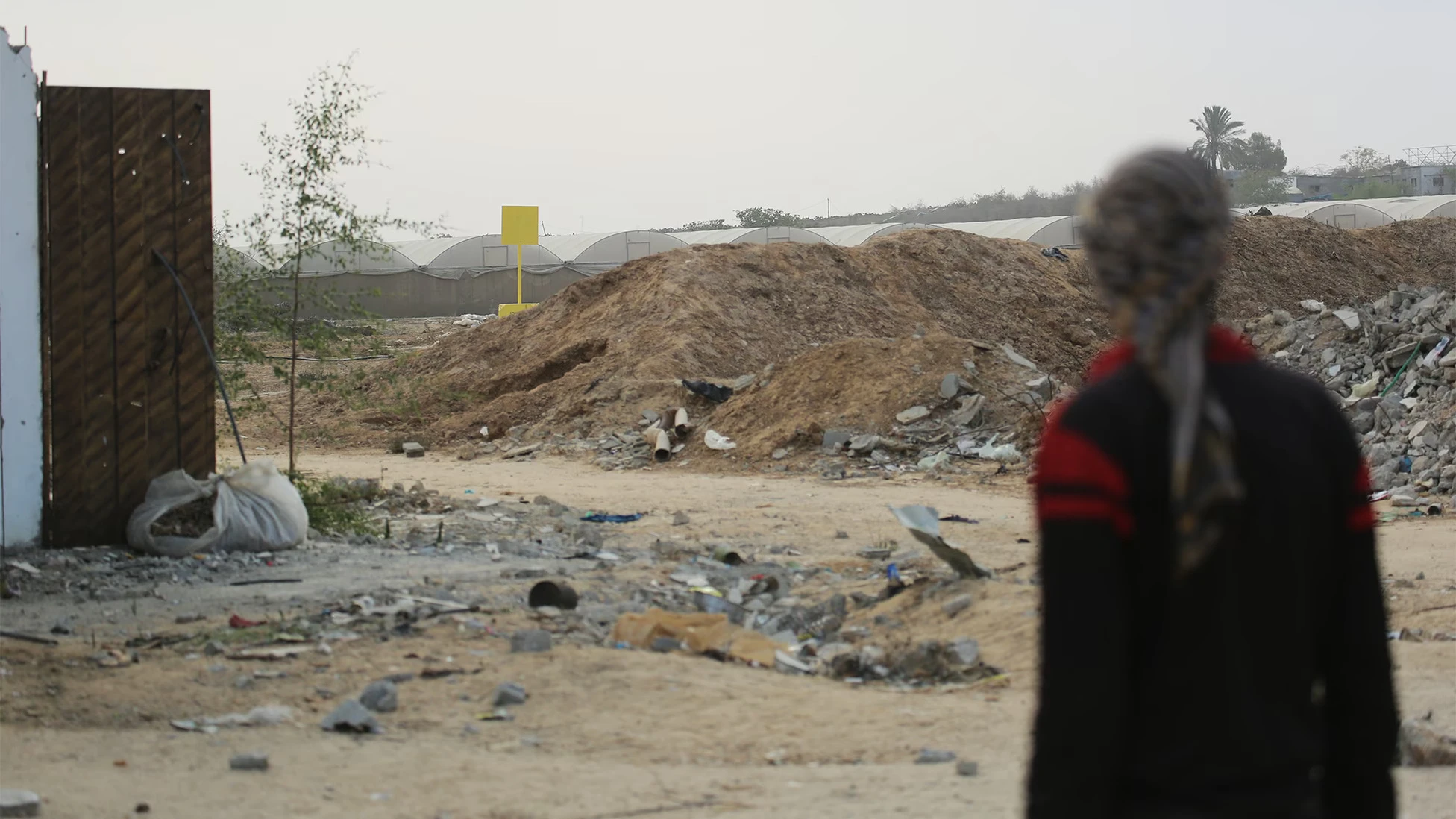
Above photo: Bashar Taleb/AFP.
The initiative includes a US-built military base for international forces.
And could cement a lasting partition of the strip.
US President Donald Trump’s administration is advancing a controversial plan to build what US officials called “Alternate Safe Communities” for displaced Palestinians inside the Israeli-controlled areas in Gaza that make up half of the strip, The Atlantic reported on 10 November.
According to The Atlantic, the initiative envisions a string of US-backed settlements for Palestinians screened and approved by Israel’s domestic intelligence service. Anyone – or their relatives – found to be affiliated with or supportive of Hamas would be barred from entry, effectively separating them from the majority still living under Hamas administration on the western side of what Israeli troops now call the “yellow line.” Those who cross this barrier without authorization have been repeatedly shot at by Israeli soldiers.
Lieutenant General Patrick Frank, tasked with executing Trump’s post-war “peace plan,” told officials that each community would include temporary housing for up to 25,000 people, along with schools and clinics.
A US engineering firm, Tetra Tech, has reportedly received the first contract to clear rubble and ordnance at a pilot site near Rafah.
The genocidal freak is back, this time documenting his unit patrolling with demolition excavators, demolishing what's left of northern Gaza behind the ceasefire's yellow line, with hysterical laughter and jokes as they watch displaced Palestinians' homes being flattened. https://t.co/TTxL7brZDY pic.twitter.com/UnmwIlPFuX
— Israel Genocide Tracker (@trackingisrael) November 8, 2025
The plan is supported by Trump’s son-in-law and former advisor, Jared Kushner, and real estate magnate and West Asia envoy Steve Witkoff, both involved in shaping Washington’s wider reconstruction agenda for Gaza.
But US State Department officials and humanitarian agencies have raised alarms that the communities could serve as controlled zones where residents are confined and monitored.
Those allowed in would not be permitted to return to areas still under Hamas authority.
Trump has said “no reconstruction funds will go into areas Hamas still controls,” promoting instead a “new Gaza” to be built under Israeli oversight and financed by “Arab and Muslim nations.” So far, none have agreed.
🔴 The BBC reported tonight that Israel has destroyed more than 1,500 buildings in an area under its control inside the Gaza Strip, beyond the “yellow line,” since the ceasefire.
According to the network, citing satellite images, “entire neighborhoods under Israeli army control… pic.twitter.com/tuSH8NXmwQ— Sameh Ahmed 𓂆 🇵🇸 (@PalPress24) November 12, 2025
Officials involved in the project admit that ownership of the proposed sites remains unclear and that no Palestinian representatives were consulted. Critics warn the plan resembles past US experiments in “strategic hamlets,” fortified enclaves meant to pacify restive populations, with predictable results.
The so-called yellow line now cuts Gaza in two, turning what was meant to be a temporary ceasefire demarcation into a hard barrier marked by Israeli concrete blocks and gunfire, raising fears of an entrenched partition.
Control of the Israeli-held half of Gaza is meant to pass to a yet-to-be-formed multinational force, but neither Israel nor Hamas has endorsed the idea. With no governing body in place, the “peace plan” remains little more than a blueprint drafted far from Gaza’s ruins.
The Wall Street Journal (WSJ) reports that US Vice President JD Vance joined Kushner in unveiling Washington’s proposal to restrict Gaza’s reconstruction to areas under Israeli control until Hamas is disarmed and removed from power.
Officials said Israel currently controls about 53 percent of the enclave under the Trump-brokered ceasefire, with maps marking a “yellow line” intended to shrink over time as conditions are met.
Arab states and mediators have reportedly rejected the plan, refusing to deploy forces or endorse any arrangement that cements Israeli control.
Meanwhile, the Israeli outlet Shomrim reported that Washington plans to establish a large military base near Gaza’s border to host international troops overseeing the ceasefire and post-war security arrangements.
The facility, expected to cost around $500 million and accommodate several thousand soldiers, would mark a major shift in Israel’s long-standing opposition to foreign involvement in occupied territories, and underscore the depth of US control over Gaza’s future governance.