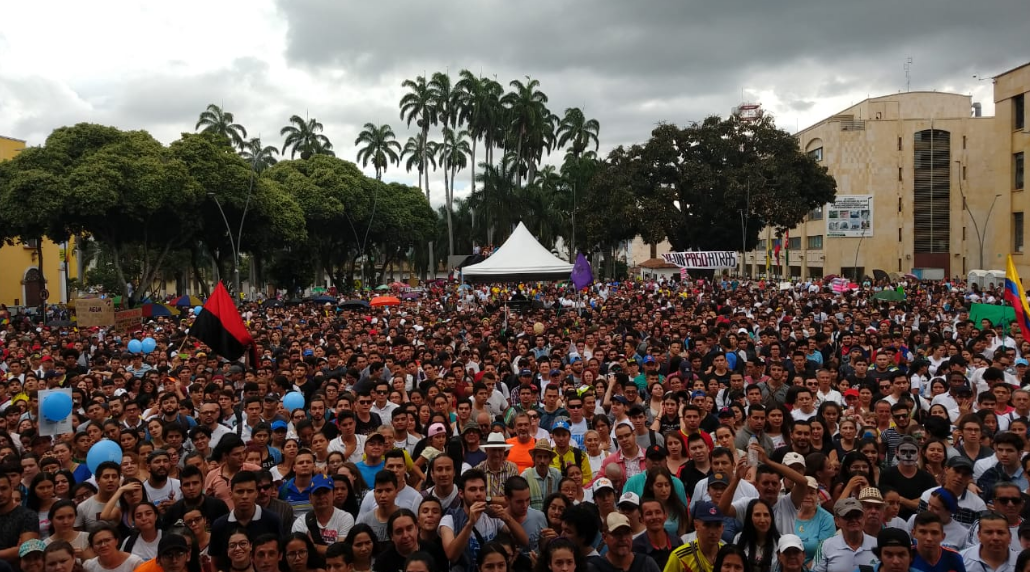
Above photo: A protest in 2019 to protect clean water in Bucaramanga, Colombia. Comité Santurbán Credit: Comité Santurbán.
Stonewalling Voices At Risk.
Canadian embassies are failing to stand up for activists in foreign countries who seek to protect their land and resources from exploitation by Canadian corporations.
Over the winter, hundreds of demonstrators in the city of Bucaramanga, Colombia denounced a Canadian gold mine owned by Aris Mining in the eastern Andean wetlands. They were rallied by the Comité Santurbán, a collective of activists protecting the vulnerable Santurbán watershed, known as a páramo, from industrial mining.
Opposition has been ongoing for at least 16 years. But this past December, members of the Comité were designated by a group supporting the Canadian mine as “persona non grata.” In October, they were labelled as “enemies of progress in Santander” and accused of being responsible for “the deterioration of the country’s heritage”.
Comité members rallied again in March, but this time, they gathered at the Canadian embassy in Bogotá. They wanted the Canadian government to know about the intimidation targeting defenders of the paramo, about their community’s rejection of the Canadian mine, and the systemic harassment and death threats facing activists across Colombia.
When human rights defenders come knocking, diplomats are supposed to practice a protocol known as Voices at Risk. Introduced by the Liberal government in 2016 and updated in 2019, Voices at Risk outlines 12 steps for diplomats to support human rights defenders who appeal with serious concerns stemming from Canadian corporate activity, or with threats to their communities and personal security. These steps include engaging with local authorities, attending trials and hearings, and supporting emergency assistance needs.
The Voices at Risk protocol is not mandatory, but it gives human rights defenders a pathway for credibility and access to the Canadian government.
When the Comité Santurbán appealed to the Canadian Embassy in Bogotá, they were not alone. Backed by a coalition of human rights organizations, the Canadian group Mining Watch and several UN Special Rapporteurs appealed to the Canadian and Colombian governments, and Aris Mining.
In Colombia, which has the highest reported rate of murdered land defenders in the world, the designation of activists as “persona non grata” is not taken lightly. Natalia Rincon, a member of the Comité, has described how opponents of big development projects in Colombia are frequently criminalized as being members of armed groups to legitimize their persecution and smear campaigns. According to Rincon, this type of delegitimization of environmental defenders has intensified since the Santurbán páramo was declared a temporarily protected zone under Colombia’s environmental policies that prohibit large-scale mining in ecologically critical areas.
The protection of human rights and environmental defenders against serious threats is an obligation under the Escazú Agreement. Introduced in 2018, this is a groundbreaking international law on conservation and human rights between countries in Latin America and the Caribbean. The Escazú Agreement protects communities’ rights to consent, rights of access to information, and transparency around development decision-making. In Colombia, this treaty has moved to the heart of grassroots environmental peacebuilding strategies, as many remote and rural communities remain affected by armed conflict.
Following the Comité’s appeal to the Canadian embassy in April, the Ombudsman’s Office of Colombia—the national human rights watchdog agency—called for an end to the stigmatization of Comité members and urged Santander’s government to protect environmental defenders.
Canada is not a party to the Escazú Agreement. But human rights defenders see diplomatic inaction as undermining Colombia’s own obligations under this treaty.
“We have received neither any communication nor channel for dialogue with the Canadian embassy,” Hernán Morantes, a lawyer and member of the Comité said in July. “Neither do we know if they’ve taken any action on this serious complaint we have made, and which UN officials have also laid out in their report.”
A Legacy Of Stonewalling
Historically, there has not been a way to seek redress in Canada for crimes committed or enabled by Canadian corporations. Some Canadians are working to change this, however, moved by the legacy of a martyred Mexican activist who sought help from a Canadian embassy.
In the early 2000s, the Canadian company Blackfire Exploration was keen on mining barite in the town of Chicomuselo in Chiapas. Mexican activist Mariano Abarca was known as the face of his community’s struggle against mining and to protect the watershed in the Chiapas.
After being beaten by three armed Blackfire workers and receiving death threats, Abarca took his community’s concerns to the Canadian embassy in Mexico City in July 2009. A 10 hour bus ride through the mountains brought him to the capital where he wanted to inform the Canadian government of Blackfire’s impacts, and to ask for protection.
The embassy refused to see Abarca, sending a representative to meet him in the street, Viviana Herrera of Mining Watch said. He was later detained without charge based on allegations by Blackfire executives. And four months later, on November 27, 2009, Abarca was killed. The company dismantled soon after his assassination.
“Because of the inaction and the omissions by the Canadian embassy, in this case, this environmental defender ended up being assassinated,” Herrera said, describing how the events in Chicomuselo shaped Canadian advocacy for diplomatic accountability.
It was well-known that Abarca was communicating with the Canadian embassy, including by email, Herrera continued. A coalition of Canadian human rights organizations and unions filed an access to information request to understand the relationship between the Canadian embassy and Blackfire. The Canadian embassy had neglected the community’s concerns and the threats against Abarca while promoting Blackfire to government officials in Chiapas, who were later accused of complicity in his murder.
Well over a decade later, Canadians have refused to give up on doing justice to Abarca’s memory and to the community of Chicomuselo. Abarca’s case was first brought to Canada’s integrity commissioner in 2018, but was ultimately denied on a technicality in 2022 by the Federal Court of Appeal.
“All the people with ties to the murder were contracted by the mining company and, to date, there has yet to be a serious investigation,” said José Luis Abarca, Mariano Abarca’s son as the coalition took the case to the Inter-American Court on Human Rights (IACHR) in 2021. The coalition had started with a case against the Mexican government, but by June 2023, they filed against the Canadian government for the embassy’s role in contributing to Abarca’s murder.
“We are not saying that the embassy had my father killed,” Luis Abarca testified. “But by denying him the necessary security, and by working only on behalf of the company, we consider that they put him at greater risk. If they had acted differently, things could have been different. My father might not have been killed.”
As it awaits admissibility, Abarca’s case is emblematic in the efforts to compel Canadian embassies to act on human rights complaints.
“This is the first time ever that the Canadian government is being challenged at the IACHR because of its omissions and inaction toward protecting an environmental defender,” Herrera explained.
The Rule Of Silence
“Canada’s record is so dismal when it comes to extractive industries,” said Mary Lawlor, incumbent UN Special Rapporteur on the situation of human rights defenders, who visited Canada last year.
Behind embassy doors, Canadian diplomats are protecting significant investments. Of the 1,396 Canadian mines reported in 2023, 225 are in South America, with assets valued at roughly $77.1 billion. In Central America and the Caribbean, 23 companies are reported to hold $24.5 billion in mining interests, while 120 companies in Mexico hold $11.3 billion.
“We all know that the non-binding measures like the UN guiding principles on business and human rights have failed spectacularly,” Lawlor said, reflecting on the past decade.
In order to fulfil its international obligations to protect human rights, she has called on the Canadian federal government to strengthen Voices at Risk guidelines, introduce mandatory human rights due diligence legislation, and empower the Canadian Ombudsperson for Responsible Enterprise (CORE).
In a field study of five Canadian embassies responding to human rights complaints about alleged retaliation in Mongolia, Guatemala, Ecuador, Greece, and South Africa, Lawlor said that only one out of the five cases was offered support in line with protocol.
Embassies need stronger mandatory language and clear reporting requirements, she said, not just for transparency but to improve “trust in Canadian officials.”
In tandem with Voices at Risk, CORE enables human rights defenders and communities affected by Canadian corporate activity to file human rights complaints with the Canadian government. While Voices at Risk is focused on protecting activists in their home communities, the CORE offers a pathway for investigation and legal recourse for Canadian companies, on Canadian soil.
Human rights monitors have been anxiously eyeing the CORE’s status since the end of Sheri Meyerhoffer’s mandate and the appointment of an interim ombudsperson. The position was held for a year until this past May, and has been vacant since.
Lacking enforcement powers and independence from the Trade Ministry, the agency came under review, but no update has been made public. The UN Special Rapporteur has also not received any information from the Canadian government. Ahead of this spring’s elections, the Bloc Québecois were the only federal party to explicitly refer to a review of CORE on their electoral agenda.
“Obviously a government has to put its citizens’ interests first, it has to be pragmatic,” Lawlor said. “But not to the extent that they’re willing to put up with their companies being responsible for the attacks and murder of peaceful people who are just trying to protect the rights of their communities, and their own rights.”
“Canada trades on its good name,” she added. “The only way that will work is if there is regulation through legislation, because otherwise the risks will remain as grave as ever.”
Aidan Gilchrist-Blackwood of the Canadian Network for Corporate Accountability (CNCA) said that member organizations are experiencing a continued deterioration of human rights protections. The CNCA has been calling for mandatory domestic due diligence legislation.
“Not only have we not seen action to address ongoing abuses, we’re seeing actions that are doing the opposite—that are removing existing safeguards or putting in peril existing institutions,” he said.
With Voices at Risk not implemented during two terms under Trudeau, little is expected to change under Carney.
And with CORE vacant since May, Gilchrist-Blackwood stressed that cases on human rights violations are sitting idle. The CNCA has appealed to recently appointed Trade Minister Maninder Sidhu, but have not received a response.
“To our knowledge, complainants were not given advance notice of the end of the CORE’s term,” Gilchrist-Blackwood said.
The United Steelworkers reported that a complaint by Bangladeshi garment workers was closed without investigation in December. “It’s a disturbing lack of transparency that really risks putting people in harm’s way.”
The failures of Voices at Risk and the vacancy at CORE are particularly dangerous in the wake of Bill C-5, he added. Rushed through Parliament in June, the internal trade bill overrides numerous protections for Indigenous rights and the environment in favour of accelerating nation-building projects like critical mineral development and major infrastructure projects.
“This could be a moment when Canada is rethinking global trading norms, putting in place measures that put human rights and labour protections and the environment first to the benefit of everyone,” Gilchrist-Blackwood said. “Instead, we’re seeing Canada be part of this race to the bottom.”