Skip to content

Net Neutrality

Google Hangout On FCC Internet Slow Lane Proposal, June 14

If you value the Internet, it's time to speak out - or risk being forced into an Internet slow lane. On Saturday June 14 at Noon ET (11am CT / 9am PT), Net2 Northern Michigan invites you to join an online round-table discussion to learn how to submit comments on the Federal Communication Commission’s proposed Internet rules, and what a potential loss of net neutrality could mean for you. Net2 has chapters around North America that create local-meetups for change makers in the technology and non-profit world. Whether you work in the business, education, nonprofit, or government sectors, or just use the Internet for personal communication, then you need to be aware of the full implications of what the FCC is proposing. The roundtable discussion will be broadcast as a Google Hangout and will be streamed to YouTube. The event is free and all are encouraged to participate.

Groups Not Aware They Were Members Of Telecom Front Group

What do an environmental group in Ohio, a small military radio program, and a network of rural hospitals in Texas all have in common? They appear on a list of coalition members for a group pressuring the government to abandon net neutrality—rules to prevent broadband providers from creating internet fast and slow lanes—but claim they did not intend to sign up for any such advocacy. Last week VICE reported on a number of groups, funded by the cable and cell-phone industry, purporting to represent consumer advocates while lobbying the Federal Communication Commission (FCC) to allow the creation of a two-tiered internet. Broadband for America, one of the groups we profiled seeking to prevent the FCC from reclassifying broadband as a public utility, claims to be a broad "coalition of 300 internet consumer advocates, content providers, and engineers." Not only is Broadband for America largely funded by a single contribution from the National Cable and Telecom Association (NCTA)—the trade group that represents Comcast, Cox, Time Warner Cable, and others—but a closer look at their member list reveals an almost random assortment of companies and community groups, many of which say they never intended to sign up for an anti-net neutrality coalition. Bob Calvert, the host of TalkingWithHeroes.com, a radio program listed as a Broadband for American member, told us that he is not familiar with the net-neutrality debate. "My program is a nonpolitical program supporting our men and women who serve and who have served our country and their families," said Calvert, in response to an inquiry from VICE.

Steve Wozniak To The FCC: Keep The Internet Free

To whom it may concern: I have always loved humor and laughter. As a young engineer I got an impulse to start a Dial-a-Joke in the San Jose/San Francisco area. I was aware of such humor services in other countries, such as Australia. This idea came from my belief in laughter. I could scarcely believe that I was the first person to create such a simple service in my region. Why was I the first? This was 1972 and it was illegal in the U.S. to use your own telephone. It was illegal in the U.S. to use your own answering machine. Hence it also virtually impossible to buy or own such devices. We had a monopoly phone system in our country then. The major expense for a young engineer is the rent of an apartment. The only answering machine I could legally use, by leasing (not purchasing) it from our phone company, the Codaphone 700, was designed for businesses like theaters. It was out of the price range of creative individuals wanting to try something new like dial-a-joke. This machine leased for more than a typical car payment each month. Despite my great passion and success with Dial-a-Joke, I could not afford it and eventually had to stop after a couple of years. By then, a San Francisco radio station had also started such a service. I believe that my Dial-a-Joke was the most called single line (no extensions) number in the country at that time due to the shortness of my jokes and the high popularity of the service.

Cable Companies Astroturfing To End Net Neutrality

Consumer advocates everywhere are demanding that the Federal Communication Commission continue down its current path for shelving net neutrality and allowing a two-tiered internet. That is, if cable company-created front groups and other industry-funded organizations are to be believed. The controversy, at the moment, rests on a legal distinction. A federal lawsuit filed by Verizon has forced the FCC into a corner by creating a standard under which effective net-neutrality rules­­—which ensure all internet traffic is treated equally—can only be reached, according to most analysts, by classifying the internet as a "common carrier," or in other words, a public utility. Such a distinction would allow the FCC to demand that internet service providers, like Comcast or Verizon, are not allowed to create internet slow lanes and fast lanes. To the surprise of probably no one, ISPs are enraged at the prospect of being classified as a utility and are fighting back. But the attacks are not fully transparent. Many of the organizations protesting a move toward classifying ISPs as a utility, which is the only likely option for enacting net neutrality, are funded by the ISP lobby.

Why Internet Start-Ups Support Net Neutrality

Back before the iPhone app store and then Google’s Android app store, building software to run on mobile phones was a loser’s game. You had to get the permission from Verizon or AT&T, and then you might have to sign an exclusivity deal and share profits and be at their whim. But, the Web has never required online services to get permission to launch or reach everyone. There are no trolls under bridges in the web kingdom. All you need to launch something that could reach millions or billions of people is, to paraphrase a poker saying, a silicon chip and a chair. That’s thanks to an open internet governed by principles known as Net Neutrality. It’s a simple enough concept: the companies that Americans pay to in order to get online — Comcast, TimeWarner Cable, Verizon, AT&T — should deliver the content that a user requests and not block sites or degrade service or play favorites. That open platform allowed me to start Contextly, back when I was a writer at Wired, using just my savings to pursue a vision for how online publishing could be made better for readers, writers and publishers. We show millions of content recommendations daily and there’s no way we could have afforded to pay AT&T and Verizon and Comcast for the fast lane to get our images loading quickly.

The Dangerous Uncertainty Over Net Neutrality

Last month, the FCC released a proposal for new rules concerning the open Internet, and now the public has four months to provide comment. Those proposed rules pay a lip service to an open Internet — something we strongly support — but their substance tells a different story. One of the most dangerous aspects of the proposal is the resulting uncertainty that startups and investors would face. Unfortunately, until and unless we have real net neutrality rules in place, that uncertainty is unavoidable. As any business owner will understand, when you’re trying get a startup off the ground, any uncertainty can be dangerous — enough to spook investors and stunt growth. In this way, startups and other business owners are already feeling the impact of the net neutrality debate. Jamie Wilkinson is the co-founder and CEO of VHX, an online video distribution company that helps artists connect directly with their audience. Watch Jamie explain how the uncertainty over net neutrality is already affecting his business. So, a speedy solution is required here. But it must also be the right solution.

FCC Chair’s Open Internet Rhetoric Does Not Match Reality

There’s an old phrase that we’ve all heard before: “Don’t believe everything you read in the paper.” This is good advice for most things. But it turns out that all the media reports about the FCC’s plans that would bring an end to Net Neutrality were 100 percent accurate. Despite FCC Chairman Tom Wheeler’s protests to the contrary, and his promise that he won’t allow Net Neutrality to slip away, the truth is that his proposal authorizes Internet service providers (ISPs) to discriminate against content and create slow lanes for all those who don’t pay special fees. The situation is dire. But there’s still reason to hope that we can radically change Chairman Wheeler’s mind — and this terrible proposal — by the time the FCC brings the plan to a vote this fall.

FCC Incest: Meet The Cable Cronies Who Control Net Neutrality’s Future

The fate of net neutrality has never looked bleaker, with the FCC's proposed rules basically dismantling the free and open internet that we know today. You can thank the agency's notorious revolving door for that; for years, FCC officials and the people they're supposed to be regulating have been playing a horrible game of telecom musical chairs. In fact, according to OpenSecrets.org, 18 industry leaders have both lobbied on behalf of Comcast and spent time in the public sector. Of those, 12 are currently registered as lobbyists for the anti-net-neutrality cable giant, five of whom have served tours with the FCC itself. And that's just Comcast. Of the 465 registered telecom lobbyists, almost 75 percent have gone through the government's revolving door. All that becomes a huge problem when you consider that these well-funded political mercenaries are basically schmoozing up their former colleagues on behalf of net neutrality's biggest enemies. What's more troubling, though, is that it's not just the bottom-feeders who have mixed loyalties. Some of the highest ranking appointed officials at the FCC have deep, vested interests in the very same companies they're supposed to be regulating. These are some of the worst offenders in the big, incestuous orgy that is the FCC-telecom revolving door.

FCC Chairman Tom Wheeler Sold Out The Internet–But Obama Can Fire Him…

When President Obama ran for election in 2008, he ran as a champion of net neutrality. He publicly announced his support for net neutrality and his commitment to keep the Internet open - especially by appointing a FCC chairman that would stand by those same ideals. But since President Obama appointed Tom Wheeler as FCC Chairman, the FCC has completely changed course on net neutrality. Just last month, Tom Wheeler proposed a rule to allow net discrimination and slow lanes to be created on the Internet. It’s clear to us now - Tom Wheeler is leading the charge to kill net neutrality. Tom Wheeler leads the FCC with a flawed vision and failed leadership. In the last two weeks, Wheeler has been reported as running the FCC into chaos over his decision to move forward with slow lanes. It’s time to fire Tom Wheeler.

Merger Protests Greet Comcast’s Annual Shareholder Meeting

Demonstrators gathered this morning outside Comcast Corporation’s annual shareholders’ meeting to show opposition to the company’s proposed merger with Time Warner Cable. Outside the Kimmel Center, Delara Derakhshani, policy counsel for Consumers Union, the advocacy arm of Consumer Reports, says a merger between the two media giants would result in worse customer service, higher prices, and fewer choices. “I would say that they’re sort of notorious for lousy customer service, and they’re just going to have less of an incentive, I think, to address customer needs,” she told KYW Newsradio. Meanwhile, Comcast spokesperson John Demming was on hand to read a written statement from Comcast: “The combination of Comcast and Time Warner Cable will bring significant benefits to consumers, including faster Internet speeds, net neutrality protection, a more reliable and more secure network, low-cost Internet access, and more diverse and independent programming to millions of Americans across the nation,” he read. But Steven Renderos, with the Center for Media Justice, doesn’t think the merger will help consumers at all. “All it really does is it puts Comcast in a position to have more power,” he said.

Net Neutrality: So … Now What?

On Thursday, the FCC released its proposal on how it intends to protect Net Neutrality in the wake of a January court case that tossed out the agency’s rules. And, just as we feared, the rules pay lip service to the idea of the open Internet while proposing solutions that would create a two-tiered Internet with fast lanes for those who can afford it — and dirt roads for the rest of us. But this doesn’t mark the end of the fight. In fact, Thursday was just the kickoff. So if you’re like most people I know and you care about this issue but don’t spend every waking moment following the intricate details, fear not. That’s what we’re here for. Is all hope for Net Neutrality lost? No. In fact, the momentum that’s built for real Net Neutrality over the last five months is unprecedented. Over the coming months, the public will have the opportunity to weigh in on FCC Chairman Tom Wheeler’s proposal. But we’ll also need to get the word out elsewhere — in town-hall meetings, with our elected officials, with the president, etc. The only reason Net Neutrality still has a fighting chance is because people are making a ton of noise about it. If we keep that up, we can win.

FCC Moves To Kill Net Neutrality, Says Internet Advocacy Groups

In the 21st century, the internet is our free speech, but in this country, we're losing our right to free speech. The internet was created with our public dollars as part of the public commons. It should never have been reclassified. We need to put it back [incompr.] reclassify it. This is our First Amendment right. NOOR: What triggered public and congressional outcry ahead of the meeting is a provision in the proposed rule that will allow providers to charge more for faster content distribution, a so-called internet fast lane. FCC Chairman Wheeler, a former telecom lobbyist, says his proposal will balance the interest of the public and those of internet service providers. TOM WHEELER, CHAIRMAN, FCC: We start with a simple, obvious premise: protecting the open internet is important for both consumers and economic growth. We are dedicated to protecting and preserving an open internet. NOOR: Digital rights advocates argue that by going ahead with the plan as written, the FCC will actually create a two-tiered system which favors telecom giants and media conglomerates.

These Companies Spend The Most Money To Kill Net Neutrality

With the Federal Communications Commission’s (FCC) decision to move forward with a controversial proposal that threatens net neutrality and the open Internet, lobbying activity looks like it has reached a fevered pitch. But for the companies involved—especially the telecom companies that are eager to be allowed to charge more for a “fast lane” of Internet service—lobbying has been at a fevered pitch for almost a decade. Going back to 2005 (when the phrase “net neutrality” first shows up in lobbying disclosure reports), the principle's biggest opponents (Verizon, AT&T, Comcast and their allies) have lobbied against net neutrality about three times as hard as the biggest proponents of neutrality (Level 3, Google, Microsoft and their allies). To better understand the lobbying dynamics around net neutrality, we took the long view and tallied up the 20 lobbying organizations that mentioned “net neutrality” or “network neutrality” most often in their lobbying reports between 2005 and 2013. In the top 20, we found an even split: 10 pro-neutrality organizations and 10 anti-neutrality organizations. But when it came to intensity, the lobbying was far from balanced. The top pro-neutrality organizations filed 176 lobbying reports mentioning net neutrality. But the top anti-neutrality organizations far outpaced them, filing 472 reports that mentioned net neutrality. That’s a 2.7-to-1 ratio.

How The FCC Will Make Its Rule On Internet

It’s been hard to go a day without hearing news about the Chairman of the FCC, Tom Wheeler, and his highly contested plan for the future of network neutrality. Google and Netflix signed a letter with nearly 150 other Internet companies calling on the FCC to reconsider its plan, which would purportedly bless the creation of “Internet fast lanes.” Over a million people across the country have spoken out against that idea, worried that a “pay to play” Internet will be less hospitable to competition, innovation, and expression. And while Chairman Wheeler and his fellow commissioners have been blogging about the FCCs proposal, no text has been released to the pubic. Not yet, anyway. But mark your calendars. This Thursday, May 15th, the FCC will finally unveil its “Open Internet” proposal. The last two weeks have been packed with statements, previewing what we can expect for Thursday, and it’s not pretty. It’s time for Internet users to make some statements of their own. The FCC is calling for public input – let’s make sure they get it. To help make that happen, we’re creating an easy tool to help the public speak out on May 15th and for the next 30-60 days while the FCC collects public comments on its proposed rules.

The FCC Is Listening To Net Neutrality Defenders

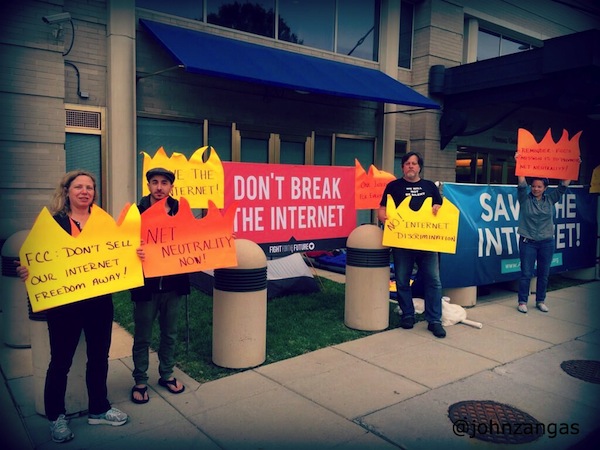
By 9:30 Tuesday morning, Washington was already well on its way to a hot and sticky afternoon. For the handful of protesters camped out in front of the Federal Communications Commission, the heat was all worth it. The demonstrators are calling on the FCC's chairman, Tom Wheeler, to abandon a proposal that allows Internet providers to charge content companies like Dropbox and Google extra for speedy and reliable service. They set up shop on a small strip of concrete and grass outside the FCC building on Maine Avenue in Southwest. When I visited, drivers whizzed past on a highway onramp just a few feet from the curb. While the traffic didn't feel unsafe, it kept the protesters mostly hemmed in. Orange and white tents from REI dotted the perimeter. It was hard to see whether anyone was inside them taking refuge from the heat. Drawing inspiration from the Occupy Wall Street protests of a few years ago, the demonstrators are asking the agency to reclassify broadband providers as utility companies, which would allow the government to issue a ban on speeding up or slowing down types of Internet traffic. The FCC is considering rules that would prohibit companies from blocking traffic but could give them the freedom to offer faster service to Internet companies like Netflix and Google that chose to pay a fee.
assetto corsa mods

Urgent End Of Year Fundraising Campaign

Online donations are back! Keep independent media alive. 

Due to the attacks on our fiscal sponsor, we were unable to raise funds online for nearly two years.  As the bills pile up, your help is needed now to cover the monthly costs of operating Popular Resistance.

Urgent End Of Year Fundraising Campaign

Online donations are back! 

Keep independent media alive. 

Due to the attacks on our fiscal sponsor, we were unable to raise funds online for nearly two years.  As the bills pile up, your help is needed now to cover the monthly costs of operating Popular Resistance.

Sign Up To Our Daily Digest

Independent media outlets are being suppressed and dropped by corporations like Google, Facebook and Twitter. Sign up for our daily email digest before it’s too late so you don’t miss the latest movement news.