Skip to content

Opium

The Taiping Rebellion And The Spectre Of Peasant Communism

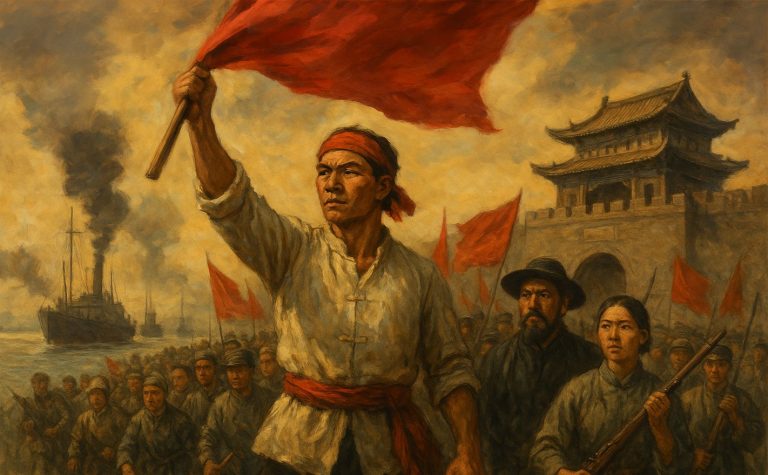
In the following article, originally published on his website Weaponized Information, Prince Kapone gives an acute analysis and mounts a trenchant defence of China’s Taiping Rebellion (1850-1864), generally regarded as one of the greatest peasant rebellions, as well as bloodiest conflicts, in human history. Describing it as the “spectre of peasant communism”, Kapone situates the rebellion against the background of the stagnation and decline of China’s feudal system, of the Qing dynasty in particular, and the way this opened up the country to imperialist depredations, most notably the British Opium Wars (1839-1842; 1856-1860). He explains: “The opium-induced decomposition of Chinese society was no accident; it was policy."

Taliban’s Massively Successful Opium Eradication Raises Questions

The Taliban government in Afghanistan – the nation that until recently produced 90% of the world’s heroin – has drastically reduced opium cultivation across the country. Western sources estimate an up to 99% reduction in some provinces. This raises serious questions about the seriousness of U.S. drug eradication efforts in the country over the past 20 years. And, as global heroin supplies dry up, experts tell MintPress News that they fear this could spark the growing use of fentanyl – a drug dozens of times stronger than heroin that already kills more than 100,000 Americans yearly.

The US Opium Wars: China, Burma And The CIA

By Jeffrey St. Clair and Alexander Cockburn for Counter Punch - You won’t find a star of remembrance for him on the wall of fallen “heroes” at CIA HQ in Langley, but one of the Agency’s first casualties in its covert war against Mao’s China was a man named Jack Killam. He was a pilot for the CIA’s proprietary airline, Civil Air Transport, forerunner to the notorious Air America which figured so largely in the Agency’s activities in Vietnam, Laos and Cambodia. Killam’s job was to fly weapons and supplies from the CIA’s base in Bangkok, Thailand, to the mountain camps of General Li Mi in the Shan States of Burma. Li Mi, Chinese in origin, was the leader of 10,000 Chinese troops still loyal to Generalissimo Chiang Kai-shek, who had been driven off the Chinese mainland by Mao’s forces and was now ensconced on Taiwan. Under the direction of the CIA, Li Mi’s army was plotting a strike across Burma’s northern border into China’s Yunnan province. But Li Mi’s troops were not just warriors in Chiang’s cause: they had also taken control of the largest opium poppy fields in Asia. The CAT pilots working for the CIA carried loads of Li Mi’s opium on their return flights to Bangkok, where it was delivered to General Phao Siyanan, head of the Thai secret police and a long-time CIA asset. Jack Killam was murdered in 1951 when one of these arms-and-drugs round trips went bad. His body was buried in an unmarked grave by Sherman Joost, the CIA’s station chief in Bangkok. The exiled Kuomintang (KMT) army of Li Mi was as much a proprietary of the Central Intelligence Agency as Civil Air Transport.
assetto corsa mods

Urgent End Of Year Fundraising Campaign

Online donations are back! Keep independent media alive. 

Due to the attacks on our fiscal sponsor, we were unable to raise funds online for nearly two years.  As the bills pile up, your help is needed now to cover the monthly costs of operating Popular Resistance.

Urgent End Of Year Fundraising Campaign

Online donations are back! 

Keep independent media alive. 

Due to the attacks on our fiscal sponsor, we were unable to raise funds online for nearly two years.  As the bills pile up, your help is needed now to cover the monthly costs of operating Popular Resistance.

Sign Up To Our Daily Digest

Independent media outlets are being suppressed and dropped by corporations like Google, Facebook and Twitter. Sign up for our daily email digest before it’s too late so you don’t miss the latest movement news.