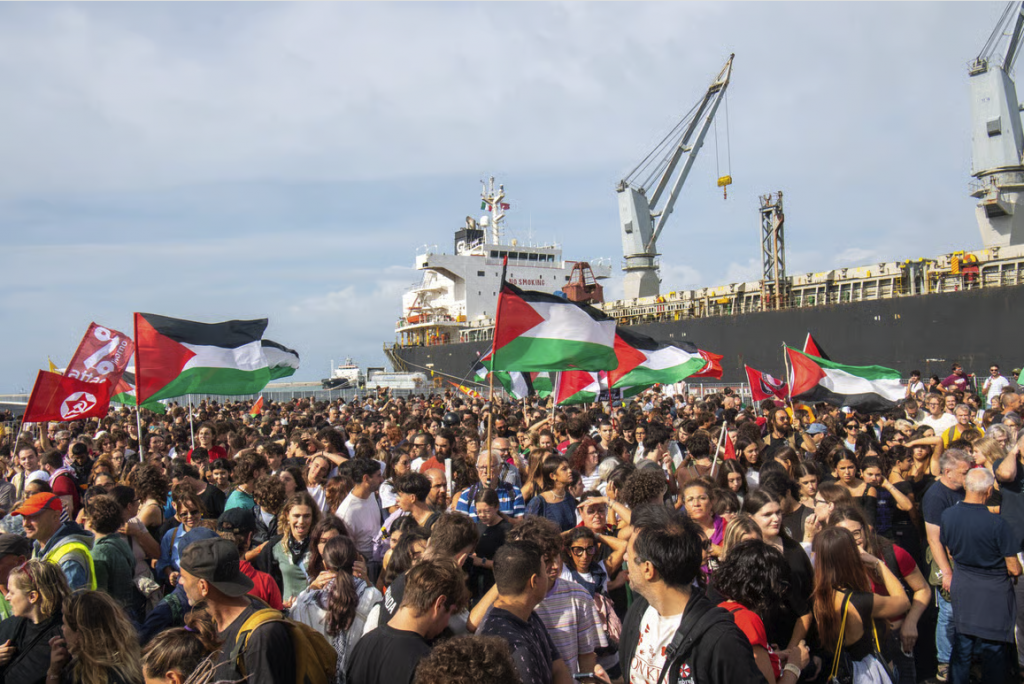
Delegations of dockworkers from across Europe and both sides of the Mediterranean held a large meeting in Genoa this weekend.
They are calling for a Europe-wide general strike to fight the Gaza genocide.
In a union hall overlooking the sea and stacks of shipping containers in the Port of Genoa, delegations of dockworkers from both sides of the Mediterranean gathered — answering the call of their colleagues in Genoa — for an international assembly. The objective: to organize against the genocide in Palestine and Israel’s rearmament, building on the day of strikes and mobilizations that shook Italy on September 22.
It was with emotion that Giovanni Ceravolo, a leader in the Unione Sindacale di Base (USB) for the port of Livorno, concluded this international meeting:
We will be able to call for a first day of Europe-wide mobilization against weapons, against genocide, against rearmament. All this embodies our future tasks. The assemblies that brought us together these two days are the first step.
The Power Of The Port Of Genoa
Arriving by plane, international delegations of dockworkers flew over the city’s immense industrial port, located in northern Italy — a first glimpse of its strategic position for European trade and the continent’s military industry: the port is 47 kilometers long, handling 48 million tons of goods each year. This strategic importance was further underscored when dockworkers shut down the port on Monday, September 22, setting off a strike that united the country’s other dockworkers in the struggle and blocked Italy’s main ports. This unprecedented mobilization against the genocide in Gaza, whose slogan “Blocchiamo tutto” (echoing French workers’ call to “Block everything”), was also taken up by workers in other sectors.
According to the USB, 90 percent of public transport and 50 percent of Italy’s railways were shut down. This historic day originated from the inspiring call made by a USB member and dockworker for the Port of Genoa at the end of August to respond with a total shutdown of the European economy in the event of an attack on the Global Sumud Flotilla:
If we lose contact, even for 20 minutes, with our comrades, we will shut down all of Europe! Between our union, all the port workers, and the entire city of Genoa, we ship between 13,000 and 14,000 containers bound for Israel. Nothing more will come out. We will launch a strike.
After the September 22 strike, momentum accelerated. While a new day of national mobilization will take place on October 4, as of this writing, dozens of Italian cities are witnessing rallies, blockades, and even university occupations against the genocide in Palestine. These actions express demands against austerity, the fight against the genocide in Gaza and Israeli colonialism, and opposition to militarization. At the international meeting of dockworkers that took place over the weekend, the workers stated their demands: “We are against genocide, against wars, and against this war economy that governments are imposing on us with austerity.” This spirit was captured in a single slogan: “Europe is rearming, war is getting closer, [we must] resist as they are in Palestine.”
A Working-Class, Internationalist Response Through Class Struggle
At the end of the meeting, the path forward was clear. All the delegations agreed on a common text, which will be submitted for approval to each national union. When it was read aloud to those present, the statement was met with thunderous applause. This applause was justified, because far from a simple declaration of principle, the text proposes a clear and historic plan of action: strikes and mobilizations against the genocide.
“It’s important that the response comes from the labor movement because we, as dockworkers, know exactly what’s on the ships passing through the port. For us, a strike is the most effective method,” a Genoese dockworker told Révolution Permanente.
Those speaking at the meeting repeatedly returned to the historic proportions of this declaration: for the first time since the beginning of the genocide in Gaza, the labor movement is preparing an international and coordinated response. While an initial strike date across Europe has yet to be announced, the demands are clear: an end to the genocide, the opening of a humanitarian corridor, and the refusal to allow ports to be used for the transport of weapons. The demands also include firm opposition to the “ReArm Europe” plan for militarization proposed by the EU, which would be financed, like the increase in military budgets across European countries, by anti-worker and austerity measures across the continent.
The question of the Palestinian people’s right to self-determination was a common theme throughout the meeting. As one speaker highlighted,
With courage, determination, and confidence in our cause, we invite all dockers to take matters into their own hands! We are many, we are powerful, we can do it, and we can win for a free Palestine!
Whether it’s the dockworkers of Fos-sur-Mer, Piraeus in Athens, Cyprus, or the Basque Country, all agree on the need for international coordination: “There’s a sense of solidarity [on the refusal to unload weapons] between ports,” explained Jean-Paul, a dockworker in Fos-sur-Mer in France and a member of the CGT.
The dockers also emphasized the strategic importance of the Mediterranean Sea, through which deliveries to the State of Israel pass and where, at this very moment, flotillas are making their way to Gaza. This is why port workers in Morocco and Turkey signed on to the declaration, even though they were unable to attend the meeting: “The port cities are all united against the genocide of the Palestinian people and against the sending of weapons [to Israel],” stated Riccardo, a worker from the port of Civitavecchia.
“The Dockworkers Taught Us: Blocking Weapons Is Not A Crime”
As the mobilizations in Italy have shown, many sectors of the labor movement have followed in the dockworkers’ footsteps. In addition to the education sector, where strike rates have sometimes reached as high as 70 percent in some cities, other sectors have joined the fight. This includes FILT CGIL, the Italian transport workers’ federation, which this Friday published a statement on the central role of dockworkers in the fight against genocide: they “represent the vanguard of the movement that mobilized and went on strike against the genocide in Palestine.” Speaking at the Genoa assembly, a USB transport unionist welcomed their call: “When Ricardo of CALP launched the call ‘Block everything’ and not even a nail would stick out of that port, it was a message that reached everywhere. We saw it on September 22, and today we are witnessing the emergence of a mobilization that could reach across Europe, and hopefully overseas.”
Young people and students also intervened to support the dockworkers’ strike. Speaking at the international assembly in Genoa, a group of researchers denounced the repression of research in the service of war. Alongside the workers, they are demanding an end to partnerships with Israeli companies in workplaces and schools.
“The dockworkers taught us: blocking weapons is not a crime.” This was the cry of the student procession that joined the demonstration on September 27 in Genoa, after the workers’ meeting. Across Italy, young people have heeded the dockworkers’ call and are still occupying universities and high schools today, while also reviving the pro-Palestine encampments, an initiative launched by the Palestine solidarity movement in the United States. In Genoa students from the Klee High School of Art occupied their school. Francesca, 18, told Révolution Permanente, “There’s an awakening of the working class. It is realizing the power it has to paralyze the economy. The high school students, who are the workers of tomorrow, are touched by this.”
And it is this awareness of the strength of the working class that is reflected in the actions at Italian ports. Whether in Ravenna, Taranto, or Livorno, dockworkers, accompanied by their supporters, blocked or stopped ships transporting materials for the genocidal enterprise of the State of Israel.
In Genoa, in addition to the nighttime demonstration called for this Saturday, September 27 — which brought together more than 50,000 people — dockworkers blocked the loading of an Israeli ship. But it didn’t stop there. On social media, workers indicated that they were monitoring all port activity and were “ready to return to the dock to block if necessary. This ship must not load anything for Israel.” This message is directed at all those complicit in the genocide: the workers are watching you, and they will let nothing pass.
The momentum of the last few days clearly shows that the dockworkers are not alone: on Saturday in Genoa, beyond the massive demonstration — which many families attended with their children — the surrounding communities shouted support for the march from their windows, and Palestinian flags flew from balconies. The entire Port of Genoa was awash in the colors of Palestine that evening. One in 20 people demonstrated that evening in the city: a clear sign of the awakening of Italian workers after years of passivity and their ability to unite all Italian cities in the struggle. Faced with the momentum of the movement, the CGIL, Italy’s largest and most influential trade union federation, has had to backtrack on its initial position to respond to the demands of the rank and file.
While the union had previously limited itself to Sunday demonstrations and vague calls for peace, the CGIL has now been compelled by its members to embrace the movement. The confederation boycotted the call for September 22 and attempted to divide the movement by calling for September 19. But many CGIL union members responded to the USB’s massive call on Monday. Pressure from the ranks is extremely strong; as the newspaper Il Manifesto explains, the union bureaucracies’ maneuver has sparked a wave of anger within the union’s ranks: the inboxes of each CGIL federation have been flooded with thousands of indignant emails, while some union members have returned their torn cards by mail to CGIL headquarters.
Faced with this historic pressure, led by grassroots unions, the country’s main union organization has finally come out in favor of calling a general strike if the flotilla is intercepted, alongside the USB. The result could be a united front that will finally enable the coordination of all workers on a national scale. In the immediate future, this front is expected to manifest during a major national demonstration called in Rome on October 4.
Dockworkers’ Anti-War And Anti-Imperialist Tradition
Although increasingly publicized, the dockers’ anti-militarist and anti-imperialist discourses are part of a long tradition of resistance to imperialism and support for colonized or oppressed peoples.
Jean-Baptiste, a member of the CGT Ports et Docks union in Fos-sur-Mer, explains that it is crucial for this call to be broadened “so that Mediterranean and European ports are even more aware of what is happening in Gaza and prevent the supply of weapons for the war to Israel, but also to all other countries at war.” He thus calls for the Italian dockworkers’ blockade method to be generalized by also paralyzing arms shipments that could fuel wars waged by other powers. This tradition is part of the political DNA of port workers: “In France, at the ports of Marseille and Fos-sur-Mer, we have a long history of fighting to refuse to load weapons for the wars in Algeria, Indochina, and Ukraine.” Jean-Baptiste also recalled the anti-imperialist struggle led by the CGT in 1950, when Marseille dockers blockaded the port to prevent the loading of American weapons bound for Vietnam.
Mario, a retired port worker from Genoa, told us that during the Vietnam War and the Pinochet dictatorship in Chile, ships carrying weapons bound for these countries were met with demonstrations, strikes, and blockades to prevent the loading or unloading of cargo, as well as to raise awareness among dockworkers in other ports in order to broaden the mobilization.
As was clear from the speakers at the international assembly of dockworkers, this political legacy is still very much alive. Riccardo Rudino, a dockworker from Genoa who is part of the CALP, stresses the importance of training a new generation of trade unionists who embrace the legacy of this anti-imperialist tradition, firmly opposing becoming “a cog in the European war machine.”
Lessons For The Entire Class
Ricky, a now-famous figure at the Port of Genoa, emphasizes the central role of the working class in the face of the violence in Gaza that we have witnessed over the past two years: “Throughout history, the working class has always had to redress the balance. When things go wrong, the workers take care of it.”
This is undoubtedly the tectonic shift brought about by the dockworkers of Italy. For decades, the Italian labor and trade union movement, like its international counterparts, has known almost nothing but defeats and setbacks. Confined for too long to losing compromises with employers, it may have forgotten its strength. But today, the dockworkers have revived an ancient tradition: blocking everything through strikes and methods of class struggle. Far from empty calls for the “responsibility” of states complicit in the massacres in Gaza, the dockworkers know that they can go much further, and that by taking the situation into their own hands, they are demonstrating that the European working class has the power to deliver a heavy blow to the governments complicit in the genocide, from Meloni and Macron to Starmer and Merz.
While the Italian working class will take to the streets on October 4, promising to paralyze the country, French workers will mobilize on October 2 against Macron and austerity. The example of the Italian workers should inspire us to make this date a major event — one that places at the heart of its demands the construction of a political general strike to oust Macron and the fight against the genocide in Gaza and for the right to self-determination of the Palestinian people.
For the first time in two decades, two of the most powerful workers’ movements in Europe will mobilize within a few days of each other. This major event could support the Genoa dockworkers’ call for a massive one-day strike across Europe and reshape the labor movement in Germany and Spain, while Catalan and Basque unions are already calling for a one-day strike on October 15. Beyond the austerity promised by Macron, French workers have a central role to play, and it is urgent that the union leaderships join the battle to drive a true European spring, one that can sweep away the reactionary policies of our governments and breaking the supply line that allows Israel to continue, horror after horror, the genocide in Gaza and the colonization of Palestine.
This article was originally published in French on September 29, 2025, in Révolution Permanente.