Skip to content

Guantanamo Bay

Judge: US Must Force-Feed Guantanamo Detainee

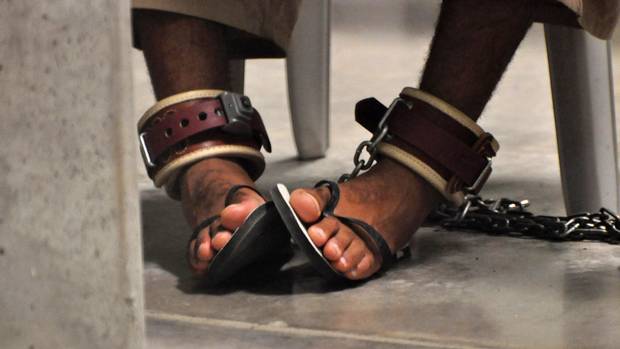
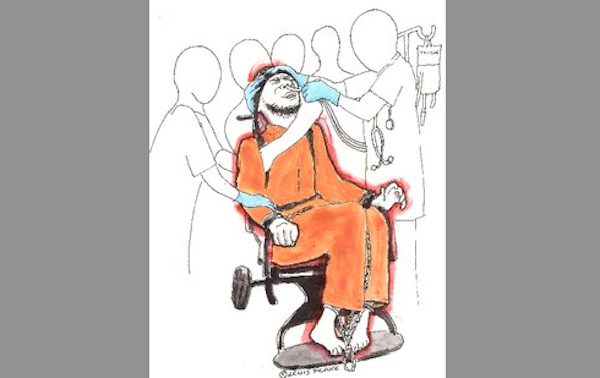
The U.S. 'must' force-feed a hunger striking Guantánamo detainee, according to a U.S. federal judge who late Thursday night lifted a temporary restraining order against performing the process—widely considered a form of torture—on Syrian inmate Abu Wa'el Dhiab. District judge Gladys Kessler said the decision was made because of the "very real probability" that Dhiab, who continues to be held at the detention facility despite having been cleared for release in 2009, might die. While issuing the decision, Kessler slammed the Department of Defense for inflicting what she described as "unnecessary pain" on those being held—both through force-feeding and the practice of "Forcible Cell Extractions," which Kessler halted in a ruling last week. "The Court is now faced with an anguishing Hobson’s choice," said Kessler.
Obama Administration Resists Efforts To Save Videos

Lawyers for the Obama administration have described as “frivolous” attempts to ensure that videos of force-feeding at Guantanamo Bay are not destroyed, in response to a case brought by a detainee over his mistreatment. Legal charity Reprieve, acting on behalf of Abu Wa’el Dhiab – who has been cleared since 2009 but continues to be held without charge or trial – had sought to ensure that videos showing his force-feeding cannot be destroyed by the military. However, the US Government is strongly resisting efforts to secure a court order preserving the videos, which could be crucial evidence for Mr Dhiab’s efforts to stop his force-feeding. Government lawyers did however admit that “there are approximately 140 to 150 FCE videos of [Mr Dhiab] between April 9, 2013 and February 19, 2014 [and] it appears that the vast majority of these videos are of FCEs in connection with enteral feeding or otherwise arguably related to enteral feeding.” An FCE, or ‘Forcible Cell Extraction,’ is the process by which detainees who do not wish to be force-fed are restrained, often violently, and taken to the force-feeding chair.

Judge Rules For Gitmo Prisoners, Stops Oppressive Actions

In a decision welcomed as "a major crack in Guantanamo's years-long effort to oppress prisoners," a federal judge on Friday ordered the United States to halt the force-feeding and "Forcible Cell Extractions" of a prisoner at the notorious offshore prison. The order from District Court Judge Gladys Kessler also requires the U.S. to preserve videotapes of the FCEs and force-feedings of the inmate, Abu Wa'el Dhiab. Forcible Cell Extractions or FCEs refer to when a team of guards forcibly remove from his cell a prisoner who refuses to submit to the torturous process of force-feeding. According to Reprieve, a UK-based rights group that represents 15 Guantanamo prisoners, including Dhiab, the 42-year old Syrian was arrested in 2002 in Pakistani, where he and his family were living, and was turned over the the United States. He has spent over a decade languishing at the prison, was never charged and was cleared for release in 2009. He is depressed and wheelchair-bound, the group says.

Guantanamo Detainee Reveals Brutal Punishment Of Hunger Strikers

A prisoner in Guantánamo Bay has revealed to his lawyers the increasingly brutal punishment meted out to detainees peacefully protesting their indefinite detention via hunger strike. Emad Hassan wrote in a letter to his lawyers: “One Yemeni is 80 pounds and he was brought to his feeding by the Forced Cell Extraction (FCE) team, Guantánamo's official riot police. Yesterday the F.C.E team beat him when they came into and out of his cell. He is 80 pounds with one broken arm. He cannot walk, just crawl from his bed to the faucet or toilet once he needs to use it! How can someone with this condition fight 8 armoured guards?” Emad, himself a Yemeni who has been on hunger strike since 2007 and cleared for release from the prison since 2007, has never been charged with a crime. He said in another letter: “As I write now, [a detainee] is vomiting on the torture chair, having been brought there by the Forced Cell Extraction (FCE) team. The nurse and corpsman have refused to stop the feed, or to slow the acceleration of the liquids.”

Global Day Of Action To Close Guantanamo & End Indefinite Detention

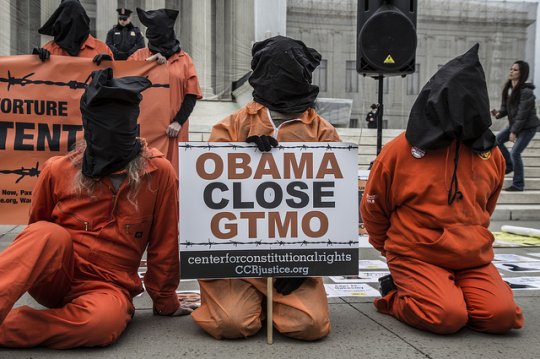
Not Another Broken Promise! Not Another Day in Guantanamo! On May 23rd of last year, President Obama again promised to close the detention facility at Guantánamo. His pledge came in response to the mass hunger strike by men protesting their indefinite detention and to the renewed, global condemnation of the prison. One year later, far too little has changed: few detained men have left the prison and hunger strikes and forced feeding continue. Join us in over 25 cities across the US and around the world to urge President Obama and Congress to end indefinite detention and close the detention facility at Guantánamo. So far, demonstrations, fasts, and vigils are planned in Chicago, Raleigh, New York City, Washington D.C., Baltimore, Buffalo, and Boston. Join Witness Against Torture June 27-30, 2014 as we gather together in Washington, DC to commemorate Torture Awareness Month. Our time together will include public witness with members of the Torture Abolition and Survivor Support Coalition (TASSC), community building, and planning for future events.

Global Call to Action to Close Guantanamo

Not Another Broken Promise! Not Another Day in Guantanamo! On May 23rd of last year, President Obama again promised to close the detention facility at Guantánamo. His pledge came in response to the mass hunger strike by men protesting their indefinite detention and to the renewed, global condemnation of the prison. One year later, far too little has changed: few detained men have left the prison and hunger strikes and forced feeding continue. Join us in Washington DC, New York City, Boston, Chicago, San Francisco, Hawaii, Germany, London, Sydney and in many more communities around the world to urge President Obama and Congress to end indefinite detention and close the detention facility at Guantánamo.

As War In Afghanistan Ends, Guantanamo Bay Stays Open

Typically, when a war ends, so does the combatants’ authority to detain the other side’s fighters. But as the conclusion of the US war in Afghanistan approaches, the inmate population of Guantánamo Bay is likely to be an exception – and, for the Obama administration, the latest complication to its attempt to close the infamous wartime detention complex. In December, when President Barack Obama and his Nato allies formally end their combat role in Afghanistan, US officials indicate there is unlikely to be a corresponding release of detainees at Guantánamo who were captured during the country's longest conflict. The question has been the subject of recent internal debate in the Obama administration, which is wrapped up in the broader question of future detention policy. Already human rights groups and lawyers for the detainees say they anticipate filing a new wave of lawsuits challenging the basis for a wartime detention after the war ends – the next phase in more than a decade of attempts to litigate the end of indefinite detention.

Guantánamo Protest at Korea Law Center Conference

Advocating “No War Criminals On Campus!” and “Shut Down Guantanamo, End U.S. Torture,” activists will demonstrate at the Korea Law Center’s Inaugural Conference, where John Yoo is among a day of speakers including high level Korean government officials and business representatives. As the Guantanamo prison camp remains open into its 13th year – and Obama’s promises to shutter it remain unkept -- 154 men remain imprisoned there. Most of them have never been charged with a crime. 76 were cleared for release by the US government years ago, 56 of them Yemeni. Since the prisoner’s hunger strike of over one year ago which thrust Guantanamo back into world headlines, approximately 40 men continue this strike.

5 Revelations Leaked From Senate Report Exposing CIA Torture

The controversy over a Senate investigation documenting the Central Intelligence Agency’s post-9/11 regime of global torture continues to generate headlines—even though the report has yet to be released. The Senate report has sparked a bitter war between the CIA and senators like Dianne Feinstein (D-CA), who accused the CIA of spying on those looking at CIA documents on torture. But while the official inquiry has not been published, dogged journalists have published key—and disturbing—details of what is contained in it. Based on CIA documents, senators on the powerful committee conducted a four-year long, $40 million inquiry into the CIA’s detention and interrogation program, which included torture tactics like the waterboarding of terrorism suspects, beatings and the smashing of suspects’ heads into walls. While the public may be aware of some of these practices due to past revelations, the information carries heavy weight because it is the Senate confirming many of those claims, which has oversight power over the agency.

Leaks Of CIA Torture Report Reveal Black Prison SIte

A Senate Intelligence Committee report provides the first official confirmation that the CIA secretly operated a black site prison out of Guantánamo Bay, two U.S. officials who have read portions of the report have told Al Jazeera. The officials — who spoke on condition of anonymity because the 6,600-page report on the CIA’s detention and interrogation program remains classified — said top-secret agency documents reveal that at least 10 high-value targets were secretly held and interrogated at Guantánamo’s Camp Echo at various times from late 2003 to 2004. They were then flown to Rabat, Morocco, before being officially sent to the U.S. military’s detention facility at Guantánamo in September 2006. In September 2006, President George W. Bush formally announced that 14 CIA captives had been transferred to Guantánamo and would be prosecuted before military tribunals. He then acknowledged for the first time that the CIA had been operating a secret network of prisons overseas to detain and interrogate high-value targets.

National Day Of Action Against Guantanamo May 23rd

On May 23rd of last year, President Obama again promised to close the prison camp at Guantanamo. His pledge came in response to the mass hunger strike by men protesting their indefinite detention and to the renewed, global condemnation of the prison. Since Obama’s speech, only 12 men have been released. 154 remain, nearly all of whom have never been charged with a crime. 76 were cleared for release by the US government years ago. 56 men are from Yemen, the largest national group at Guantanamo, but they remain subject to an effective moratorium on their release based on their nationality. No one from Yemen has been freed since the May speech. Up to 40 prisoners continue to hunger strike, and many are being subjected to forced feeding — a practice condemnedby international human rights organizations, medical associations, and members of the US Congress. New lawsuits in US courts lay bare the extreme cruelty of the forced feeding at Guantanamo.

FBI Accused Of Infiltration, Judge Halts Trial To Investigate

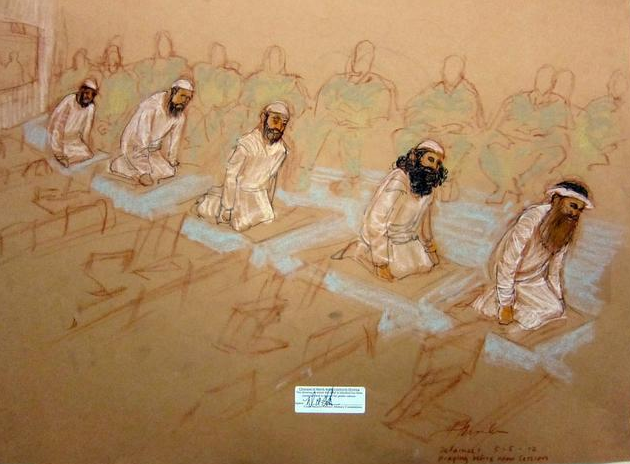
A military judge abruptly recessed the first 9/11 trial hearing of the year Monday after defense lawyers accused the FBI in open court of trying to turn a defense team security officer into a secret informant. If true, the lawyers argued, attorney-client confidentiality might be compromised in the case that seeks to put on trial and execute five men accused of orchestrating the Sept. 11 attacks that killed 3,000 people in New York, Pennsylvania and at the Pentagon. At issue, in part, was the publication in January of prison camp musings by the alleged 9/11 mastermind, Khalid Sheik Mohammed, by the Huffington Post and Britain’s Channel 4 website. Defense lawyers alleged Monday that in at least one instance, two FBI agents enlisted a civilian on the defense team of accused plot deputy Ramzi bin al Shibh as a confidential informant.

US Human Rights Record Criticized In UN Report

The UN has delivered a withering verdict on the US's human rights record, raising concerns on a series of issues including torture, drone strikes, the failure to close Guantánamo Bay and the NSA's bulk collection of personal data. The report was delivered by the UN's human rights committee in an assessment of how the US is complying with the International Covenant on Civil and Political Rights [ICCPR], which has been in force since the mid 1970s. The UN committee urged the US to overhaul its surveillance activities to ensure they complied with US law and conformed to US obligations under the ICCPR. In its 11-page report, the committee also criticised the US for failing to prosecute senior members of its armed forces and private contractors involved in torture and targeted killings.

Corrected Billboard Defends Transparency At Guantanamo

The ad was released from custody two weeks after a landmark lawsuit, Hassan v. Obama, was brought before U.S. District Court in Washington, D.C. to end force-feeding at Guantanamo Bay. Filed on behalf of Emad Abdullah Hassan, the lawsuit is the first case against forced-feeding since the U.S. Court of Appeals ruled that federal courts can hear challenges by detainees to conditions of their confinement. Hassan is a Yemeni national who has been detained at Guantanamo Bay for twelve years despite being cleared for release in 2009. He has been on hunger strike since 2005 and has allegedly experienced over 5,000 forced-feedings, a practice that is violent, abusive and illegal, according to his lawsuit.

Uruguay Agrees To Take Five Guantánamo Prisoners

Uruguay has agreed with the United States to accept some prisoners held in the much-criticized detention center at the U.S. military base of Guantanamo Bay, President Jose Mujica said on Thursday. The South American country had accepted the request by Washington to take some prisoners and would consider them refugees, Mujica told journalists while attending an unrelated farming event. "It's a request for human rights reasons," Mujica said. Mujica said Obama "has asked a bunch of countries if they can take some and I told him yes." "They are coming as refugees and there will be a place for them in Uruguay if they want to bring their families," said Mujica, who spent 14 years in prison before and during his country's 1973-1985 dictatorship. U.S. officials confirmed that talks about Guantanamo had taken place with Uruguay, but would not give more details. "The U.S. government maintains high level conversations with the Uruguayan government on various global affairs," the U.S. embassy in Montevideo said in a statement. "One of those has been the closure of Guantanamo, one of the Obama administration's priorities for its humanitarian implications."
assetto corsa mods

Urgent End Of Year Fundraising Campaign

Online donations are back! Keep independent media alive. 

Due to the attacks on our fiscal sponsor, we were unable to raise funds online for nearly two years.  As the bills pile up, your help is needed now to cover the monthly costs of operating Popular Resistance.

Urgent End Of Year Fundraising Campaign

Online donations are back! 

Keep independent media alive. 

Due to the attacks on our fiscal sponsor, we were unable to raise funds online for nearly two years.  As the bills pile up, your help is needed now to cover the monthly costs of operating Popular Resistance.

Sign Up To Our Daily Digest

Independent media outlets are being suppressed and dropped by corporations like Google, Facebook and Twitter. Sign up for our daily email digest before it’s too late so you don’t miss the latest movement news.