Skip to content

Pipeline

Under The Pavement Is Oil, And Above Ground Brews Resistance

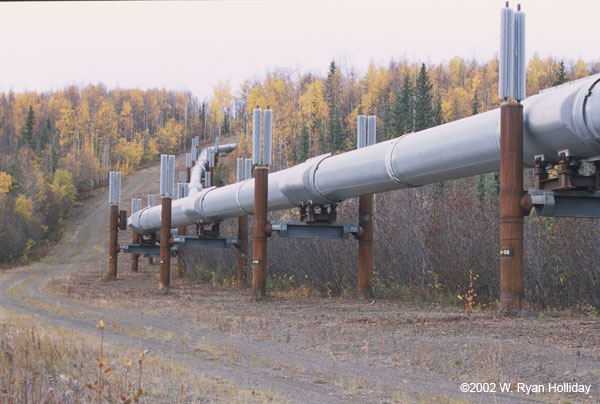
In 2007, a construction crew hired by the city of Burnaby, British Columbia, broke through a half-century-old pipe carrying petroleum products from Edmonton to the Burrard Inlet. It sent a black geyser into the air that spilled 250,000 liters of oil, covered homes and vehicles, and caused the evacuation of over 250 residents. The neighborhood of Westridge, home to some of the most expensive real estate in the city, instantly became a toxic waste site. Remarkably, few of the residents in the area knew that the ruptured pipeline had been there since 1953, or that it was an essential part of a larger network of energy and resource extraction connecting Burnaby to the Athabasca Tar Sands. Originally set in the ground by the Trans Mountain Oil Pipeline Co., a division of Bechtel Corporation, the 700-mile-long Trans Mountain Pipeline joins other pipelines that converge like a web underneath the city. Many of them reach their terminus at a series of refineries, tank farms and terminals from which jet fuel, natural gas, crude oil and diluted bitumen are distributed elsewhere – most of it placed on to tankers to be taken to the U.S. and overseas. On the western coast, Burnaby marks the end of the line before the Tar Sands leaves Canada.

TransCanada Considers Rail As Pipeline Progress Slows

TransCanada Corp is in talks with customers about shipping Canadian crude to the United States by rail as an alternative route as its Keystone XL pipeline project that has been mired in political delays, Chief Executive Russ Girling said on Wednesday. "We are absolutely considering a rail option," Girling told Reuters on the sidelines of a conference in New York. "Our customers have needed to wait for several years, so we're in discussions now with them over the rail option." The comments are the first to confirm growing speculation that TransCanada might use more costly railway shipments as a stopgap alternative to the proposed Keystone XL pipeline, whose approval has been delayed by the U.S. government. Girling said the firm was exploring shipping crude by rail from Hardisty in Canada, the main storage and pipeline hub, to Steele City, Nebraska, where it would flow into an existing pipeline to the Gulf refining hub. The Keystone XL pipeline would deliver crude from the oil sands of northern Alberta to the U.S. Gulf Coast. The Obama administration signaled last month that there would be further delays to the regulatory process, which requires approval from the State Department.

First Nations Prepare For Fight Against Pipeline

First Nations activists are turning their attention to TransCanada Corp.’s proposed Energy East project, vowing to mount the same kind of public opposition that threatens the Keystone XL pipeline in the United States and Enbridge Inc.’s Northern Gateway in British Columbia. Some 70 First Nations leaders met in Winnipeg recently to plan a strategy they hope will block TransCanada’s ambitious plan to ship more than 1 million barrels a day of crude from Western Canada to refiners and export terminals in the East, despite widespread political support for the $12-billion project. TransCanada has been holding consultations with communities across the country, including some 155 First Nations, to inform them of the Energy East project and seek their support. The company has hired Phil Fontaine, former chief of the Assembly of First Nations, to represent it in meetings. But one leading activist says the company has a tough sell. “In this era of the Harper Conservative government, there is dramatic pressure that has been placed on the shoulders of First Nations peoples, with our constitutionally protected rights, to defend Canada’s air, water and earth from the agenda of Big Oil and other extractive industries like the mining sector and the forestry sector,” Clayton Thomas-Muller, a Manitoba Cree who helped organize the Winnipeg session, said in an interview. “And so it will be First Nations’ interventions and the assertion of aboriginal and treaty rights that is going to stop the plan to build this 4,000-kilometre pipeline.”

Enbridge Pipeline Road Blocked By Protesters In Burlington

A group of protesters has blockaded the road to an exposed section of Enbridge’s Line 9 pipeline early this morning in Burlington, Ont. The protesters say they plan to continue the blockade for at least 12 hours. A news release says the 12-hour stay represents 12,000 "anomalies Enbridge has reported to exist on the line." “Enbridge calls these developments integrity digs,” said Danielle Boissineau, one of the protesters, “but to anyone watching the Line 9 issue, it’s clear Enbridge has no integrity. This work on the line is just a Band-Aid, a flimsy patch over the most outrageous flaws in the Line 9 plan. “Line 9 has a lot of similarities to Line 6B that erupted in the Kalamazoo River. The risk is just not worth it,” she said. Enbridge spokesman Graham White says the company plans "to continue the integrity digs elsewhere where there are no protesters." White says the protesters are "interfering with important safety maintenance for the line. If they're interested in this being a safe line, and for us to maintain that safety for the future, this is exactly counter to those efforts."

Group Challenges Restrictions At Pipeline Hearings

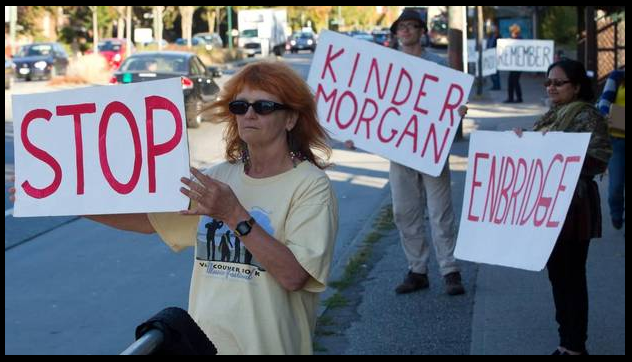
National Energy Board restrictions on who can participate in the Kinder Morgan pipeline review are being challenged by a group of people who say they have been robbed of their right to free speech. In a notice of motion, the NEB is being asked to reject as unconstitutional recent federal legislative changes to the National Energy Board Act that limit public participation in hearings on Kinder Morgan’s Trans Mountain pipeline expansion proposal. “As a result, NEB hearings have lost their essential purpose. If the public cannot be heard, the public interest cannot be assessed,” said David Martin, legal counsel to the applicants. The project would twin a pipeline that has been in operation for 60 years. It would nearly triple, from 300,000 to 890,000 barrels per day, the amount of oil being shipped. If it goes ahead, tanker traffic will increase through Vancouver harbour and around the southern tip of Vancouver Island.

Are you ready to win? Strategy for stopping pipelines!

It's been an exciting few weeks for the anti-pipeline movement. There is strong opposition to the Energy East and Line 9 proposals from the prairies to the east coast; west of the Rockies the fight against fracking and bitumen pipelines is heating up. People are busily preparing to intervene in the NEB's Kinder Morgan hearings. Hundreds attended weekend direct action workshops in Victoria and Vancouver. The traditional land defenders of the Unist'ot'en are gearing up in response to threats from the provincial government and corporations pushing their fracked gas project across the north. But among all this activity there is something missing: the sense of confidence that comes from having a clear and coherent strategy. The wind is in the sails but no one is at the helm. The good news is that when I was up north at the Unistoten blockade camp in February with other anti-pipeline activists we brainstormed the winning strategy.

Green Group Sues US Government For Hiding Tar Sands Plan

The National Wildlife Federation filed a lawsuit this week charging the U.S. State Department is refusing to disclose public information about a pipeline company's possible plans to transport dangerous tar sands oil from Montreal to the coast of Maine. The lawsuit takes aim at the oil industry's repeated claims that there is no plan to transport the dirty oil through New England, despite numerous indications that such a plan indeed exists. A 70-year-old, 236-mile pipeline, owned by Portland Pipeline Corporation (which is majority owned by Exxon-Mobile), currently transports crude oil from freighters in the city of South Portland, Maine to Montreal. Yet, environmental and community organizations say there are strong signs that PPL and parent company Montreal Pipe Line Company is planning to reverse the flow of the pipeline in order to transport tar sands oil from Canada to South Portland where it would then be distributed to international markets via oil tankers and an upgraded terminal.

Bold Nebraska: Black Snake Pipelines Bring Heartland Uprising

From CreativeResistance.org: Bold Nebraska is a grass-roots movement of families, farmers, cowboys, Indians and community members standing up to the energy extraction industry, resisting the Keystone Pipeline and protecting the Earth and the People using creative and imaginative tactics. The Website says: “Our state is currently dominated by one political voice– conservative. And it’s not the conservative voice many of us grew up with in our families. The conservative voice in our state is now dominated by far-right ideas and policies that are more about protecting big business, not fighting for our families.” “If you look back in our Nebraska history, you see a diverse set of political beliefs. You see room for all of us to build on each others ideas to get things done. We think there is a role for common-sense government and we need more progressive, independent and moderate voices in our state’s politics. Nebraskans are bold. We are pioneers. We are reformers. We are independent. Bold Nebraska is setting out to change the political landscape and restore political balance.”

Landslide Vote Against Enbridge Pipeline In Canadian Town

One of the most divisive issues in Kitimat, B.C., in a generation came to a head Saturday night as residents voted 'no' against Enbridge's Northern Gateway pipeline project. The ballot count from Saturday's vote was 1,793 opposed versus 1,278 who supported the multi-billion dollar project — a margin of 58.4 per cent to 41.6 per cent. "The people have spoken. That’s what we wanted — it’s a democratic process,” said Mayor Joanne Monaghan in a statement on Sunday. “We’ll be talking about this Monday night at Council, and then we’ll go from there with whatever Council decides.” More than 900 residents voted in advance polls on a question that has split the community.

‘No Enbridge’ Protesters Drown Out Mayor At Basketball Game

In an increasingly explosive political climate in the Kitimat area over a controversial vote on the Northern Gateway pipeline, the Mayor of Kitimat was flash mobbed by a group of mostly First Nations people, donning "No Enbridge" shirts at a Haisla girls basketball championship on Sunday. "No Enbridge! No Enbridge! No Enbridge!" yelled the packed gymnasium crowd, nearly all wearing black protest shirts. "When you're in politics for 36 years, I guess I kind of expected it," Mayor Joanne Monaghan told the Vancouver Observer Wednesday. "You don't mix church and state, and don't mix recreation and politics," she added. The Mayor was invited to the Haisla Village of Kitimaat, which neighbours her municipal district, to hand out a $2,000 prize for the victorious girls team - something she's done annually for years.

Stand With Indigenous Peoples, Stop The Pipelines

While half of the world’s species are disappearing, while the remaining 48 hunter/gatherer societies are literally fighting for their survival, while 32 million acres of rainforest are cut down a year, and while three hundred tons of topsoil are lost a minute, we are again at war with those who would destroy the planet. There have been many wars fought on behalf of our life-giving land in North America. The overwhelming majority of those killed in defense of the land have come from peoples like the Sioux, the Cheyenne, the Nez Perce, the Sauk, and the Apache. Native Americans have long stood in the way of this destructive culture. It is time that we join with Native Americans and other dominated peoples around the world who are at war. It is time that we, the privileged in this settler culture, step off our pedestal and onto the battlefield to place our bodies in harm’s way like so many indigenous people have before us and continue to do today.

First Nations Pipeline Protesters Vow To Maintain Blockade

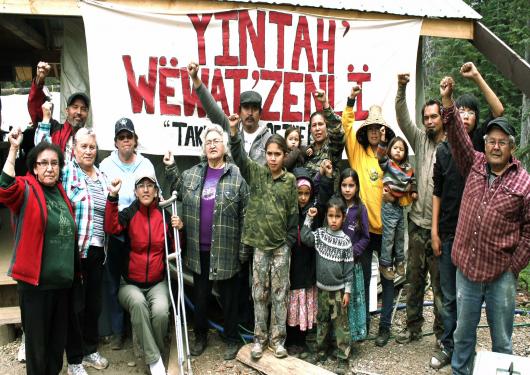
Leaders of a small native camp in central B.C. that is blocking the right-of-way of a proposed gas pipeline say they won’t be moving any time soon, even if a court orders them to. Freda Huson and her husband, Dini Ze Toghestiy, who are both Wet’suwet’en members, said they have been dug in so long on the Pacific Trail Pipeline Project route that they consider the camp their home now. In Vancouver over the weekend to attend “training workshops” for anti-pipeline protesters, Ms. Huson said she suspects an injunction may soon be brought against the camp, which is located about 60 kilometres south of Houston. “We don’t give a care about their injunction … the blockade is already in place … nobody has a right to remove me,” said Ms. Huson, who belongs to the Unis’tot’en clan of the Wet’suwet’en. “We actually live there … so basically they are trying to put an injunction on our home,” she said.

Elections, Pipelines, and Protests

PERIES: Jenny, why don't you go first? Let us know what's going on in Canada, in Vancouver in particular, and with The Vancouver Observer more specifically. UECHI: Sure. So this week The Vancouver Observer broke a story about how the premier of this province, Christy Clark, was found to--we found documents that say that she was listed as a partner in a lobbying firm which had among its clients Enbridge, the big pipeline company that's trying to build the Northern Gateway Pipeline right now. It's a big, controversial project that would bring Albertan oil from the tar sands through to B.C.'s coast. Now, the premier has said that she was in the company [incompr.] by the time that she joined the company, Enbridge was no longer listed as a client and that she personally has not done any lobbying. But, still, people are wondering why this was never made public.

New Jersey Get Ready To Protest, New Pipeline Proposed

A recently formed company is proposing a new pipeline through North Jersey’s Highlands — potentially along Route 287 — to move oil back and forth between a transportation hub in Albany, N.Y., and the Phillips 66 Bayway refinery in Linden. Map of the proposed pipeline by Pilgrim Pipeline Holdings. The company, Pilgrim Pipeline Holdings, has received only preliminary financing and has yet to file any documents or permit applications with regulatory agencies, a company spokesman said. But it has begun surveying land and contacting local officials in North Jersey to arrange presentations. The estimated 150-mile pipeline would most likely run along the New York State Thruway and I-287 as it proceeds through North Jersey’s environmentally sensitive Highlands before looping toward Linden.

It’s Not Just Keystone–Five Dirty Pipelines You’ve Never Heard Of

By now most people have heard of TransCanada’s Keystone XL pipeline and the fact that, after five years of deliberation and protest, its fate still hangs in the balance (the southern portion is already built, but the northern portion that crosses the Canadian-US border awaits a permitting decision). The issue has galvanized the environmental movement, inspired dozens of high-profile demonstrations and captured media attention. But while the impacts from Keystone XL are significant, it’s not the only tar sands pipeline project in town. Usually pipelines don’t draw much attention unless something goes wrong — like when a suburban Mayflower, Ark., neighborhood was flooded with heavy crude from the Alberta tar sands last May courtesy of a busted Exxon pipeline. But increasingly, communities aren’t waiting until catastrophe strikes to voice their opposition to new or expanded pipeline projects — partly because of environmental and public health risks from spills and partly out of concern for increasing the greenhouse gas emissions that contribute to climate change.
assetto corsa mods

Urgent End Of Year Fundraising Campaign

Online donations are back! Keep independent media alive. 

Due to the attacks on our fiscal sponsor, we were unable to raise funds online for nearly two years.  As the bills pile up, your help is needed now to cover the monthly costs of operating Popular Resistance.

Urgent End Of Year Fundraising Campaign

Online donations are back! 

Keep independent media alive. 

Due to the attacks on our fiscal sponsor, we were unable to raise funds online for nearly two years.  As the bills pile up, your help is needed now to cover the monthly costs of operating Popular Resistance.

Sign Up To Our Daily Digest

Independent media outlets are being suppressed and dropped by corporations like Google, Facebook and Twitter. Sign up for our daily email digest before it’s too late so you don’t miss the latest movement news.