Skip to content

Guantanamo Bay

Despair at Guantánamo: January Actions

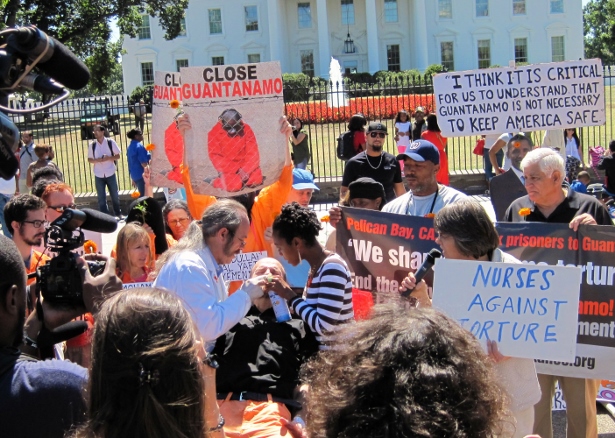
Witness Against Torture is planning a series of actions in January to continue to pressure the Obama administration to close the Guantanamo Bay prison. "The military says it will no longer report the number of prisoners on hunger strike, according to a report in the Miami Herald. A spokesman for the facility said the military “will not further their protests by reporting the numbers to the public.” Eighty-six of the remaining prisoners — more than half — were designated three years ago for transfer to another country, provided that security concerns could be satisfied. Yet the transfer plan was left adrift in the face of political combat. Even if the new defense bill spurs progress in reducing the detainee population, the delivery of credible justice for those at the Guantánamo prison camp is far from complete." (from NYTimes Editorial – Dec. 28, 2013)

Invitation To Join Fast In Solidarity With Guantanamo Prisoners

This particular form of the idea was inspired by Ben Griffin (Afghanistan, Northern Ireland, Iraq veteran, member Veterans For Peace UK) and 20 or so of his comrades. Ben and the others decided to fast everyFriday in solidarity with prisoners at Guantanamo and to bring attention to their situation. Fasting and long-term hunger strikes are nonviolent tactics used to bring attention to an issue of injustice. A one-day fast by many people on the same day each week can have an effect similar to that of a solitary long-term hunger strike. I have done both and recognize the significance of both. Not everyone can do a long-term hunger strike, but most of us in decent health can do a one-day weekly fast (no food) with no ill effects.

A New Day At Guantanamo Bay?

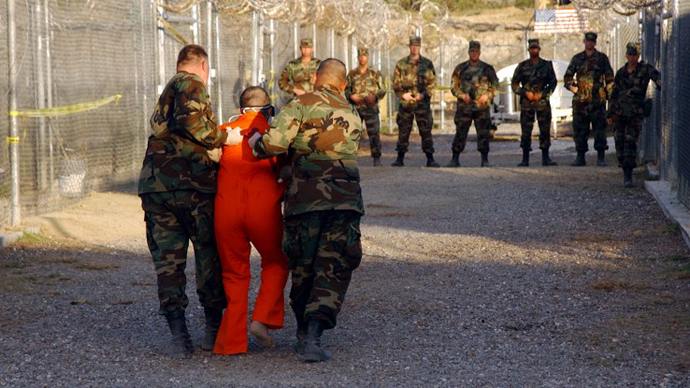
The detention facility at Guantanamo Bay is coming up on its 12th birthday. That will be 12 years of indefinite detention without charge or trial for 90 percent of the detainees held there and almost $5 billion wasted on the facility. That is almost $500 million spent in total and more than $2.87 million spent per detainee for 2013 alone. But there is cause for hope that we can soon stop tallying the injustices and mindless spending at Guantanamo. Michigan’s own Sen. Carl Levin has long been a strong advocate of closing the detention facility at Guantanamo Bay, and this year led the way to include strong Guantanamo transfer provisions in the final defense spending bill for fiscal year 2014 that just passed the Senate late Thursday night.

US Sends Two Guantanamo Detainees To Saudi Arabia

The Pentagon announced Sunday that it had transferred two detainees from the prison at Guantanamo Bay, Cuba, to the control of the government of the kingdom of Saudi Arabia. “As directed by the President’s Jan. 22, 2009, executive order, the interagency Guantanamo Review Task Force conducted a comprehensive review of these cases. As a result of that review, which examined a number of factors, including security issues, these men were designated for transfer by consensus of the six departments and agencies comprising the task force. In accordance with congressionally-mandated reporting requirements, the administration informed Congress of its intent to transfer these individuals,” the Pentagon said in a statement The Pentagon also identified the transferred prisoners in the statement. Saad Muhammad Husayn Qahtani, 35, and Hamood Abdulla Hamood, 48, both of which were recommended for transfer in a 2009 review of their cases, have been moved by a US interagency task force as reported by the Qatari-owned Al Jazeera news network.

Guantánamo Prisoner Protests Secret ‘CIA Prison’

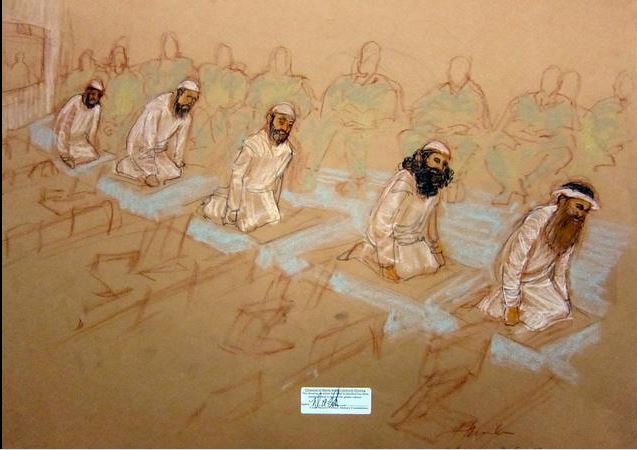
Army Col. James Pohl ordered guards to remove Ramzi Bin al Shibh from the maximum-security war court at this U.S. Navy base after the Yemeni captive ignored several warnings. Pohl was trying to get Bin al Shibh, 41, to acknowledge that he had the right to voluntarily skip the hearings. Bin al Shibh replied, mostly through his lawyer, that he had another sleepless night at the secret Camp 7 prison punctuated by guards banging on doors and other disruptions. At one point Bin al Shibh shouted, in fuzzy audio on a 40-second delay from the sealed war-court chamber, about a “secret CIA prison.” “Nobody knows it,” he said in English. “Nobody investigates it. Nobody sees it.” At issue is the long-running complaint by Bin al Shibh that guards cause vibrations and other noises at his Camp 7 cell in a form of military orchestrated sleep deprivation. Prosecutors deny the misbehavior has occurred at the clandestine prison camp run by a special guard force called Task Force Platinum.

Unending Torture

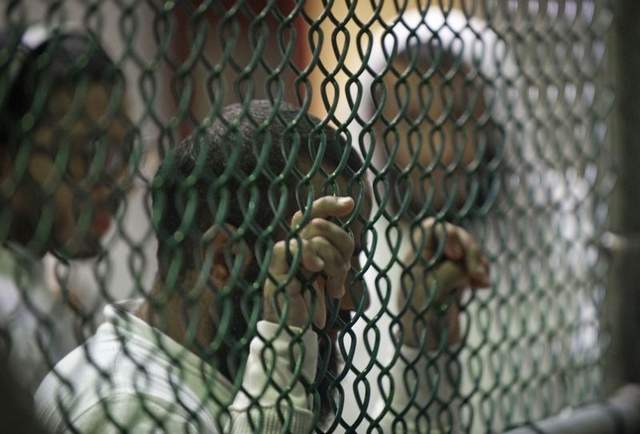
It was shortly after five on a Saturday morning last April. The prisoners in the communal cellblock at Camp 6 in Guantanamo Bay Prison had just gathered for morning prayers. Suddenly the overhead lights went out, the cell doors slammed shut and tear gas canisters exploded in the room. Military guards charged into the cellblock, firing shotguns loaded with plastic bullets toward the huddled detainees. Three men fell to ground, writhing in pain from being struck by the ‘non-lethal’ ammunition. The other prisoners, most of whom had long been cleared for release, were forced onto the floor with guns pointed at their heads and kept prone on their bellies for the next three hours. According to Guantanamo officials, the action was launched to quash a protest by the detainees, who had placed blankets over the surveillance cameras in their cells.

The Peaceful Protest US Govt Doesn’t Want World to Know About

First it was the force-feedings, genital searches, and transfers to solitary confinement. Then came the media blackout. In its latest bid to deprive Guantánamo Bay inmates of what Algerian prisoner Ahmed Belbacha has called their "sole peaceful means" of protest, the U.S. military announced it will stop providing information to the press about the ongoing hunger strikes within this notorious offshore prison. "The hunger strike has been the only way the prisoners can effectively protest and force world attention back on Guantánamo Bay," said Omar Farah, staff attorney for Center for Constitutional Rights, in an interview with Common Dreams. "The government has tried to undermine that in many ways. We saw that in the summer with raids on Camp 6 and forcing prisoners into solitary confinement. This is a new and different way to silence the protests." In an interview with Al Jazeera-America published Wednesday, Navy Commander John Filostrat acknowledged that the withholding of information is a deliberate move to undermine public knowledge of a protest that has garnered international support.

The Strange Censorship Of The Guantánamo Ministry of Information

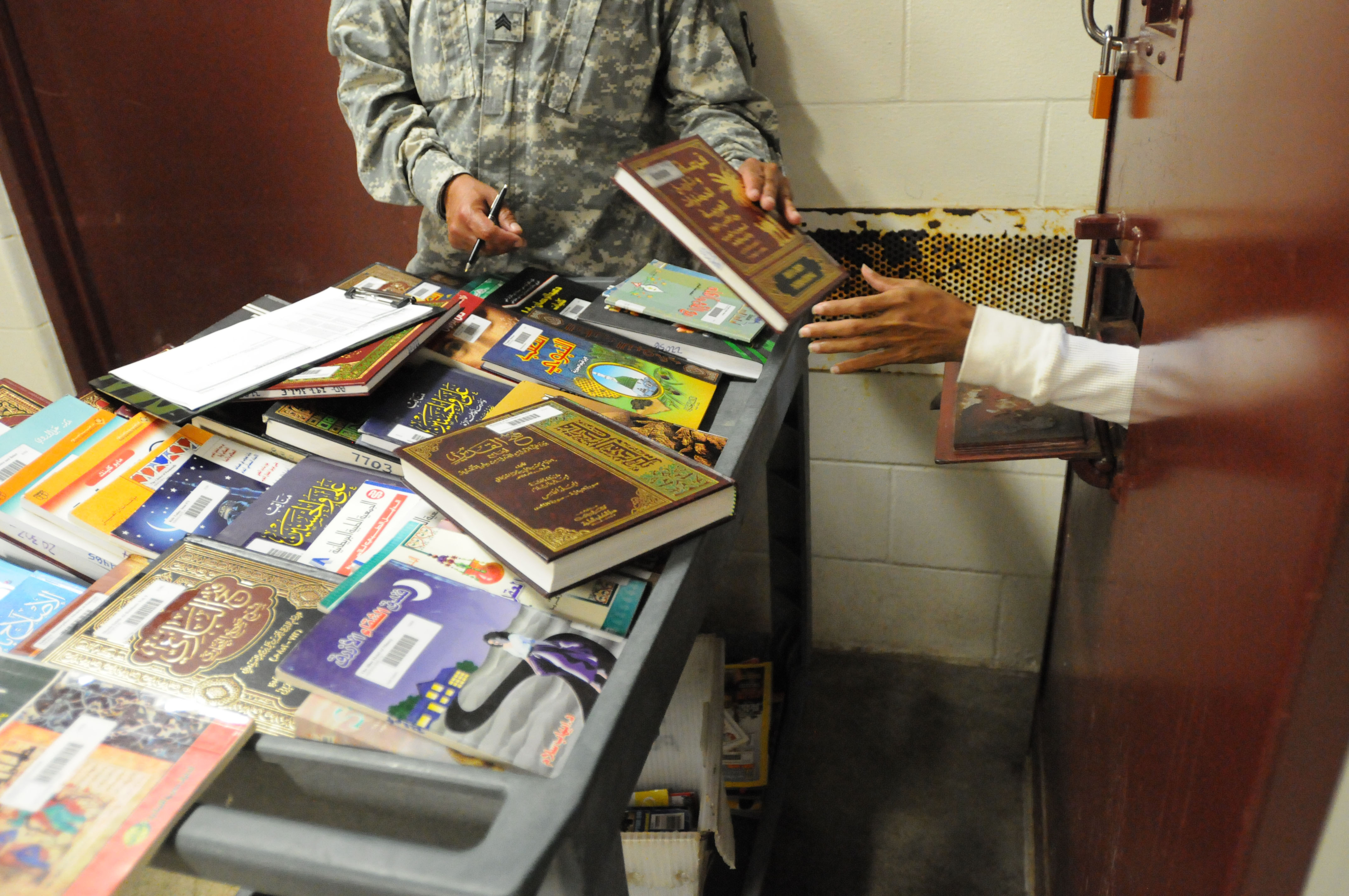
Clive Stafford Smith comes to see me every three months or so. I ask him to bring me books. When I am allowed to read, it lifts – for a short while – the heavy gloom that hangs over me. Clive amuses himself (and me) by testing what the censors will let through. It is difficult to identify any consistent or logical basis for the censorship: in months gone by, I have been allowed to readNineteen Eighty-Four by George Orwell, but Aleksandr Solzhenitsyn’s The Gulag Archipelago did not make it through. On his most recent visit in October, Clive gave me a list of the titles he had dropped off for me, so I could let him know later what had been banned by what I prefer to call the Guantánamo Ministry of Information. One was Booky Wook Two by Russell Brand. I understand that Brand uses too many rude words. I suppose you have to be amused by that: the US military is solicitous of my sensitive nature, and wants to protect me from swearing. These are the same people who say that all of us at Guantanamo are dedicated terrorists.

Reclaiming And Using “Terror”

Americans were shocked to learn former South African President and human rights icon Nelson Mandela was on the US terror watch list til 2008. This revelation should prompt us to ask: what is “terror” and how do we address it? A decade spent fighting and funding , with over $1 trillion, the Global War on Terror destabilized the world and left us more vulnerable. Ironically just after President Obama abandoned that term, Edward Snowden revealed a vast, costly telecommunications infrastructure representing its hidden counterpart. The National Security Agency created a dragnet that gathered the communications of world leaders and millions worldwide. Information on citizens’ phone calls, e-mails, and web activity was swept up, frequently with no evidence of violent plans.

Here’s Why It’s Long Past Time We Close Guantánamo

In 2002, I led the first Joint Task Force to Guantánamo and established the detention facility. Today, I believe it is time to close Guantánamo. In the coming week, Congress will lay the foundation for whether and to what extent Guantánamo can be closed. The annual defense bill appears to have compromise language that would give the president some additional flexibility to transfer detainees to their home or third countries, though it maintains an unwise and unnecessary ban on transferring detainees to the United States. Still, this is a step forward toward closing our nation’s most notorious prison — a prison that should never have been opened.

Emergency Demo At Algerian Embassy To Protect Djamel Ameziane

Join us between 2-3 P.M. on Tuesday, December 10, in front of the Algerian embassy in Washington, DC. We're demonstrating because the Center for Constitutional Rights' client Djamel Ameziane has been sent from Guantánamo to Algeria against his will and in violation of international law. Djamel is now being held in secret detention and is at risk. He is an innocent man who has suffered detention at Guantánamo for nearly twelve years, despite having been cleared by both President Bush and President Obama. Join us to call on the Algerian government to release Djamel Ameziane immediately, and to respect and protect his human rights.

Video: Obama Must Move To Close Guantanamo Now

I wanted to bring it up today, one, to remind people that Guantanamo is still open, and also because we have at least three events in the last week or so that are interesting with Guantanamo but not necessarily significant unless we actually get that place closed. I mean, obviously, Obama came into office, signed an order, said he would close it. Five years later, he hasn't closed it yet. But we have had a couple of pieces of movement on some other issues. The first was this week Congress actually had a vote, or the Senate had a vote on loosening the restrictions that have been imposed on the president with regard to sending people to the United States or to other countries from Guantanamo.

Guantánamo, The Aamer Appeal & the Passion of Andrés Thomas Conteris

“President Obama, stop the tortuuurrre,” bellowed Andrés Thomas Conteris, as a plastic tube snaked through his nose, down his throat, and into his stomach to deliver a bottle of Ensure nutrients to his starved body. Conteris, months into a grueling fast, voluntarily submitted to the nasogastric feeding in front of the US Court of Appeals in Washington, D.C. on October 18, 2013 to underscore the brutality of the continued forced-feeding of hunger strikers at Guantánamo Bay. Throughout the feeding, which simulated what some in Guantánamo endure twice daily, Conteris gagged and wailed. Cameras snapped. Observers winced. The spectacle inside the courthouse, concluded minutes before, had been in its own way grave. There, the Circuit Court of Appeals had considered oral arguments in a lawsuit contending that forced-feeding at Guantánamo was a violation of human rights and therefore should be stopped. Known as the Aamer Appeal, the case was brought on behalf of Shaker Aamer and others of his Guantánamo brethren. Aamer is the last UK resident held at the prison. Detained since 2002 . . . .

U.S. Court May Allow Suits Against Guantanamo Forced Feeding

A U.S. appeals court showed a potential willingness on Friday to allow Guantanamo Bay hunger strikers to sue over being force-fed, a practice the Obama administration says is necessary to keep order but that critics call inhumane. At a hearing of the U.S. Court of Appeals for the District of Columbia Circuit, two judges on a three-judge panel asked skeptical questions of a government lawyer who argued that the courts have no jurisdiction over conditions at a military prison such as the U.S. Navy base in Cuba. While the judges stopped short of agreeing that forced feeding is inhumane, they suggested that Guantanamo detainees might be able to get around a 2006 law that bars them from suing over living conditions in extreme cases that might include forced feeding. A decision is likely to be weeks or months away, but the skepticism appeared to be a fresh challenge to the administration's control over how it treats Guantanamo detainees.

Interview With Guantánamo Expert Andy Worthington

Andy Worthington: First of all, let me say that there are currently 164 prisoners, although 84 of them were approved for transfer out of the prison by a task force that President Obama established when he took office. This was high-level, involving officials in all the government departments and the intelligence agencies. They spent 2009 meeting every week, and they went through the files of all the prisoners. They made decisions about whether they were recommended for trial, recommended for release, or for ongoing detention without charge or trial in some cases. So President Obama has released 70 of the 156 prisoners cleared for release by the task force, but for the last three years he has released very few prisoners, mainly because Congress passed new laws making it very difficult for him to do that, but also because he couldn’t be bothered to spend the political capital to do something that could make him unpopular in Congress. Earlier this year, there were 86 men still held about whom the US government said, “we don’t want to hold these guys forever, we don’t want to put them on trial,” but they are still stuck in Guantánamo.
assetto corsa mods

Urgent End Of Year Fundraising Campaign

Online donations are back! Keep independent media alive. 

Due to the attacks on our fiscal sponsor, we were unable to raise funds online for nearly two years.  As the bills pile up, your help is needed now to cover the monthly costs of operating Popular Resistance.

Urgent End Of Year Fundraising Campaign

Online donations are back! 

Keep independent media alive. 

Due to the attacks on our fiscal sponsor, we were unable to raise funds online for nearly two years.  As the bills pile up, your help is needed now to cover the monthly costs of operating Popular Resistance.

Sign Up To Our Daily Digest

Independent media outlets are being suppressed and dropped by corporations like Google, Facebook and Twitter. Sign up for our daily email digest before it’s too late so you don’t miss the latest movement news.