Skip to content

Inequality

The 1% Battles Economic Inequality At Swiss Resort

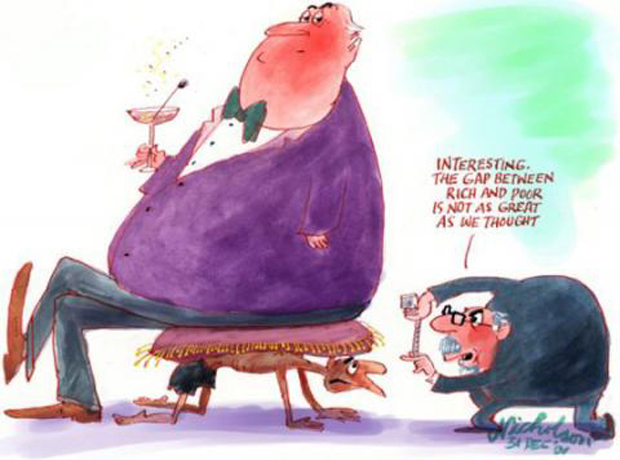
World and business leaders are flying to Davos, Switzerland this week to participate in the World Economic Forum, a gathering of the richest people in the world. This year, the 1% will be focusing on income inequality, among other issues. It’s a meeting that brings together the most powerful people in the world to talk and shmooze. This year, those attending include Shinzo Abe, the Japanese prime minister; Bill Gates; JP Morgan head Jamie Dimon; Matt Damon; Facebook CEO Sheryl Sandberg. There’s also a lot of buzz over the fact that Israeli Prime Minister Benjamin Netanyahu will be attending the same forum as Iranian President Hassan Rouhani.

#EndPoverty: Actions For Davos Meetings Of 0.00001%

This week, from 22 to 25 January the Davos forum will take place in Switzerland. Many of the wealthiest businessmen and top executives of the World's largest multinationals will be sharing conversations with more than 40 heads of state and government, representatives of multilateral organizations, scholars, leaders of a bunch of NGOs and a few union representatives. Also in Davos, there will be over 800 journalists from all over the world. The most important group of businessmen and top executives of Davos are + / -1,000 representing 0.00001 % of the world¡s population but handle most of the wealth, a high percentage of the economies and natural resources in all continents. This small and select group decides directly or indirectly how we, the other 99.99999% live.

Keep Our Focus On Economic Inequality: No Bait and Switch

At CounterPunch, Jason Hirthler identifies one of the most important dynamics in the modern political world: "For every social advance, an economic price paid." Hirthler examines the real-life aftermath of the social breakthroughs and advances represented by the social justice campaigns of Martin Luther King, the ending of apartheid under the aegis of Nelson Mandela, and racial symbolism in the election of the first black American president, Barack Obama. In every case, Hirthler notes, genuine social achievements were followed by a brutal and ruthless expansion and entrenchment of 'neoliberal' economics -- that is, the aggrandisement of elite power and privilege. One of the most glaring examples detailed by Hirthler is what happened after the genuinely astonishing and significant triumph of Mandela and the ANC: the share of South Africa's wealth owned by whites has actually increased since the ending of the apartheid, thanks to the ANC's betrayal of its own economic principles and its capitulation to the existing economic power structure.

900 Weathiest Finished Paying Social Security Tax On Jan 2

A small, elite group of US citizens has already met their 2014 financial obligation for Social Security two days into the New Year, and will no longer be required to contribute any of their income to the federal program. Nearly all working Americans will continue to pay the social security tax through the duration of 2014. The 900 wealthiest, however, have fulfilled their responsibility for the whole year on Thursday by earning $117,000 – the maximum total social security is allowed to take from an individual income each year - on the first and second days of the month. Teresa Ghilarducci, an economics professor at the New School for Social Research, wrote that if everyone eligible paid all year long, “the Social security system would be solvent indefinitely and they still would be the richest and prettiest in all the land.”

Antidotes To Economic Inequality: A 2013 Top Ten

A Year of Delightful Egalitarian Imagination: Nurses, philosophers, and UK trade unions have, over the past 12 months, all shared some fascinating ideas on how we can make our societies more equal — and much better — places to live. Economic inequality, we suspect, may have creeped into more conversations in 2013 than ever before. But people aren't just talking about how unequal we've become. They're talking about antidotes to the avarice all around us. We've assembled out of those discussions a list that samples 2013's most promising and provocative inequality-busting ideas, proposals, and campaigns. Some of these notions seek to make an immediate, politically practical impact. Others raise hopes that many might deride as pure “pie in the sky.” We like practical. We also like pie. We think you might, too. Read 'em and think!

You’re Severely Underpaid, And Here’s Proof

Ordinary Americans are paid too little considering the value of their labor, while CEOs are mostly overpaid, according to recent research. That's unlikely to change in 2014. Some argue that worker and CEO wages are dictated by what the market demandsand therefore, they're just what they should be. But there was a time, back in the mid-20th century, when employee and CEO pay grew in accordance with productivity -- or the dollar amount that's produced for the economy in an hour of work. That changed during the late 1980s and early 1990s, when CEO pay sky-rocketed and worker wages stagnated. “It’s not always been the case that the minimum wage or the wages of typical of workers or CEO pay were not that different from productivity growth,” said Josh Bivens, the research and policy directory at the Economic Policy Institute, a left-leaning think tank. “This spreading apart, where CEOs and other well-placed people are doing great while most workers and minimum wage workers are doing much much worse, that’s pretty recent.”

The Year In Inequality: Lots Of Words, Where’s Action?

In other words, the concept of inequality was so popular in 2013, because 2013 was a year of near-unprecedented income inequality. This year, there were revelations that median wages have remained flat for 10 years, that corporations continued to receive record-breaking tax breaks, that CEO pay has risen astronomically in the past few decades, and that the bottom and top income brackets continue togrow further apart. While there were some minor policy changes passed that could help lessen that gap — such as many local minimum-wage campaigns; there were many, such as repeated cuts to food stamps andunemployment benefits, that seem to promise to widen the chasm further.

Why Is the 1% So Much Richer Than Everyone Else?

It’s been nearly two years since Occupy Wall Street took over Zuccotti Park, and the academic establishment is still chewing through questions it raised about how to understand the 1 percent in America. In particular, how did they get so darn rich? And what would happen if we took some of their money away? That’s the focus of this month’s Journal of Economic Perspectives, which features several papers arguing a few sides of the debate, offering some fascinating windows into the nature of extreme wealth. Increasing income inequality is not disputed. The question of why the divide is widening, though, splits economists into two broad camps. One believes that people at the top have used their positions of influence to lock in excessive earnings. The other thinks that people with scarce and unique talents have simply been able to command a premium in markets that have gotten bigger over time.
assetto corsa mods

Urgent End Of Year Fundraising Campaign

Online donations are back! Keep independent media alive. 

Due to the attacks on our fiscal sponsor, we were unable to raise funds online for nearly two years.  As the bills pile up, your help is needed now to cover the monthly costs of operating Popular Resistance.

Urgent End Of Year Fundraising Campaign

Online donations are back! 

Keep independent media alive. 

Due to the attacks on our fiscal sponsor, we were unable to raise funds online for nearly two years.  As the bills pile up, your help is needed now to cover the monthly costs of operating Popular Resistance.

Sign Up To Our Daily Digest

Independent media outlets are being suppressed and dropped by corporations like Google, Facebook and Twitter. Sign up for our daily email digest before it’s too late so you don’t miss the latest movement news.