Skip to content

Labor

Grad Employees Re-Unionize At NYU—First In The Country

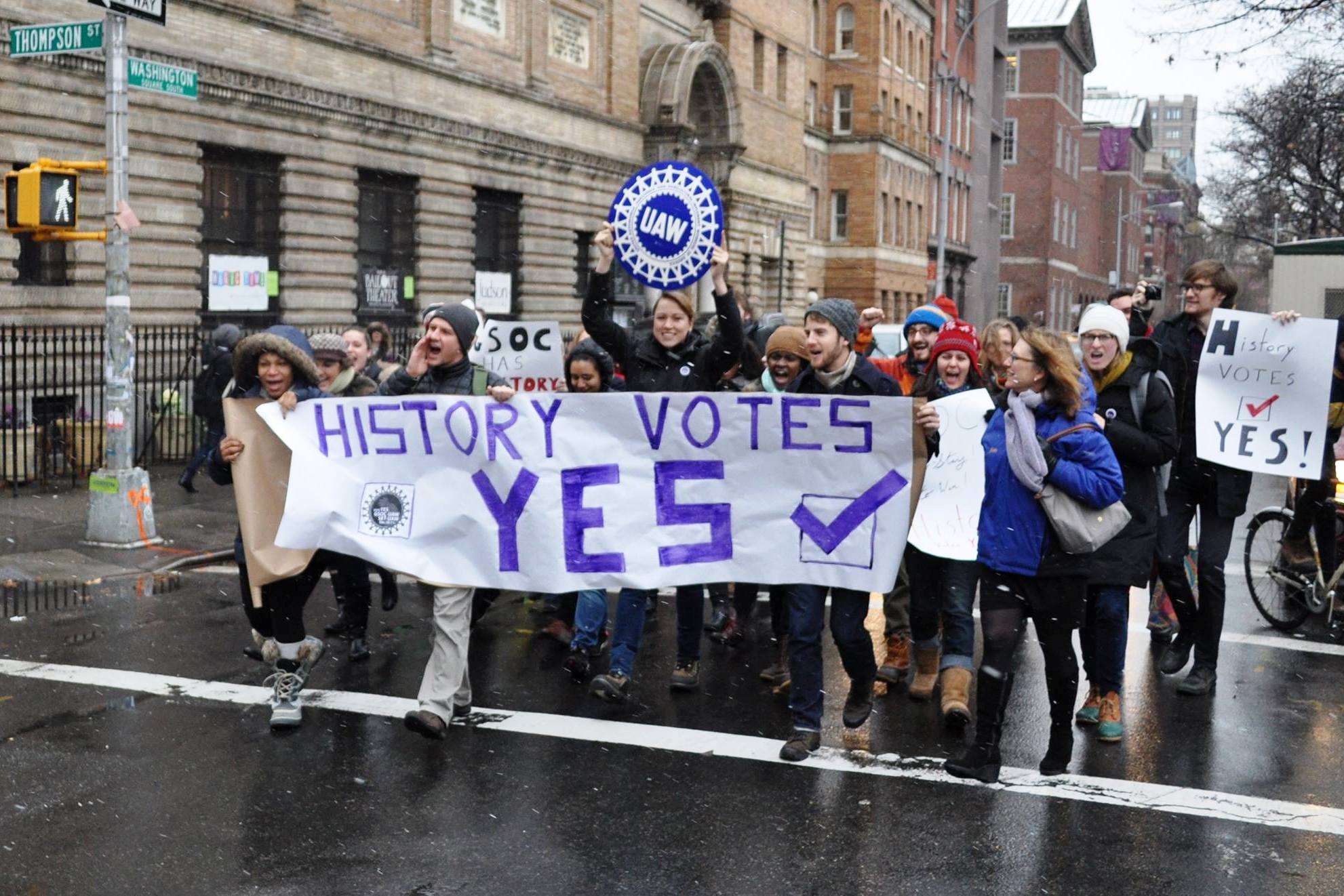
Victory cries rang out across campus the night of December 11. Tears of joy were shed. The American Arbitration Association had just announced that New York University graduate employees had voted 98.4 percent in favor of union representation—after eight years of struggle for recognition. This makes NYU once again the only private university with unionized graduate employees. The Graduate Student Organizing Committee/Science and Engineers Together (GSOC-UAW)—which brings together two organizing drives across NYU’s campuses—is affiliated with the United Auto Workers and includes more than 1,200 graduate employees. “We hope this inspires graduate employees at all universities to organize for their rights,” said Brady Fletcher, a PhD student in Cinema Studies.

Public Sector Unions Win When They Preach ‘Tax the Rich’

Congress is forcing federal workers to pay more toward their pensions while allocating almost nothing for cash-strapped cities and states. Mayors and governors are gearing up for their own round of budget wrangling over cuts versus taxes—the fifth since the financial meltdown. More than 700,000 city and state jobs have been cut since 2008. And politicians have more bitter medicine in store. Most public sector unions have failed to counter the conservative message that public workers’ pensions and pay are to blame for yawning budget gaps. Too many have offered preemptive concessions, hoping to fend off more severe cuts. Too few have been willing to defend their job standards or the services they provide, much less tackle the third rail of U.S. politics—raising taxes.

Little Holiday Cheer For IKEA Workers

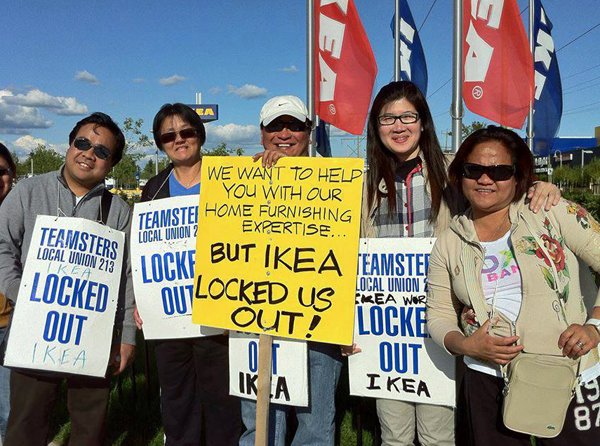
Canada has stronger legal protections for workers' rights than the United States and the "small differences" in labor policy clearly matter. Union density is 31 percent in Canada, compared with 12 percent in the United States, and it has fallen only slightly since the late 1990s, while US union density has declined steadily. Unionization and a more developed welfare state means, for example, that service sector workers in Vancouver are likely to enjoy a significantly higher standard of living than their counterparts south of the border in Seattle. But provincial law in BC still provides employers with considerable freedom to fight unionization, and IKEA management has taken full advantage of the loopholes in the law.

The Plight Of US Workers

In the aftermath of the Great Financial Crisis, and the rise of the Tea Party as a right-wing adjunct to the Republican Party, the assault on workers intensified still further. A report by the Economic Policy Institute that reviewed state-level legislative changes in labor policy and labor standards since 2010 found that "the changes undermine the wages, working conditions, legal protections, or bargaining power of either organized or unorganized employees.... The consequence of this legislative agenda is to undermine the ability of workers to earn middle-class wages and to enhance the power of employers in the labor market. These changes did not just happen but were the results of an intentional and persistent political campaign by business groups."

“Middle Class” Myth: Why Wages Are So Low Today

So why did Rob Stanley, an unskilled high school graduate, live so much better than someone with similar qualifications could even dream of today? Because the workers at Interlake Steel were represented by the United Steelworkers of America, who demanded a decent salary for all jobs. The workers at KFC are represented by nobody but themselves, so they have to accept a wage a few cents above what Congress has decided is criminal. The argument given against paying a living wage in fast-food restaurants is that workers are paid according to their skills, and if the teenager cleaning the grease trap wants more money, he should get an education. Like most conservative arguments, it makes sense logically, but has little connection to economic reality. Workers are not simply paid according to their skills, they’re paid according to what they can negotiate with their employers.

Nationwide Strike In Cambodia Over Low Wages

Employees at hundreds of garment factories walked off the job yesterday after five labour unions called for a nationwide strike in the wake of the Ministry of Labour’s decision to raise the sector’s minimum wage by $15 next year, rather than the $80 increase they desired. Yesterday morning, Labour Minister Ith Sam Heng announced that the monthly minimum wage for employees at garment and shoe factories – which now stands at $80, including a $5 health bonus – will rise to $95 in April. Wages will climb another $15 in 2015, then $16 in 2016 and $17 in both 2017 and 2018, reaching a total of $160 by 2018. The news was greeted with consternation by independent unions.

Last Non-Union Verizon Techs In New England Vote To Join IBEW

Core company workers and their union leaders made it a major issue while bargaining for a new contract. With an arbitration case pending charging that Verizon Business was doing bargaining unit work covered by contract, the company agreed to recognize the techs and negotiate a new contract. Their new agreement went into effect in late 2008. About 600 techs were covered by the first contract. However, thousands of Verizon Business workers throughout the rest of the country (including this small group in Maine) remained without a voice at work. Since winning their first contract, the newly organized Verizon Business techs have been reaching out to their co-workers about the benefits of uniting in a union. About 95,000 employees of Verizon are united in CWA and IBEW.

How Many Minimum Wage Hours Does It Take?

As bad as it is for the 44% of homeless people who have jobs and can't escape homelessness, climbing out of homelessness is virtually impossible for those without a job. For those with limited skills or experience, opportunities for jobs that pay a living wage are very limited. Additionally, many members of the homeless population have to combat barriers such as limited transportation and reduced access to educational and training programs (Long, Rio, & Rosen, 2007). In such a competitive environment, the difficulties of job seeking as a homeless person can be almost insurmountable barriers to employment. Mental or physical illnesses also play vital roles in the employment participation of homeless individuals or those at risk for becoming homeless. Research statistics illustrate that a disability, mental or physical, can result in difficulty acquiring work. In addition to mental illness and substance abuse, incarceration also serves as a barrier for employment. Incarceration can decrease the types of employment available to an individual after release from jail or prison. Along with the previously mentioned barriers, the lack of access to technology serves as a handicap for the homeless searching for work. In this job market, some knowledge of computers and technology is essential for every field. Although there are computers available through public access, some homeless individuals lack computer knowledge and fear failure.

Workers Take A Stand Against Boeing

What Boeing wants is very simple: to pay the people who make its airplanes as little money as it can get away with. It needs to do this, we’re told, to stay competitive. It has all the leverage, because enough states — and countries — are willing to give it everything it asks for. Who wouldn’t want a gleaming factory stuffed with jet assemblers, a payroll guaranteed for a generation? Boeing is on a roll, its stock at a record high despite the troubled rollout of its 787 Dreamliner, and the pay of its C.E.O. boosted 20 percent to a package totaling $27.5 million last year.

Walmart Workers Strike, Target Workers Threaten Walkout On Black Friday

Four days after the end of a Southern California strike, Seattle-area Wal-Mart workers plan to mount their own walkout this morning. The one-day strike is the latest in the lead-up to a larger day of strikes and protests planned for Black Friday, the high-profile post-Thanksgiving shopping day at the end of this month. “I don’t know if I’ll see it in my lifetime,” Washington Wal-Mart employee Mary Watkines told Salon in a pre-strike interview, but “I want all of the associates, including myself, to be able to walk into our workplace, you know, this place that they call our family … and not be physically ill, not just feel like you want to throw up or pass out or even just turn around and walk out” over “intimidation and humiliation.”

How To Protest In The Age Of Austerity

Aloof from official politics, non-party-aligned and sometimes distant from trade unionism, such movements reflect the growing prominence of issues and forms of profound social conflict that emerge outside the workplace. Capitalism has demonstrated a tendency to politicise ever-growing areas of life, from the environment to the genetic code, and the profusion of "new social movements" since the 1960s reflects this. This is something that filled conservatives with horror, and led to the "crisis of democracy" thesis according to which overactive citizens were overloading governments with demands and causing their breakdown. There was also some standoffishness in parts of the left, at least insofar as these were seen as displacing the central emphasis on class struggle. But the rise of the social movement is something the left should welcome.

Pension Theft Crime Wave

The nation’s union-haters have a juicy new target, Detroit’s public employees, ever since the city became the largest in history to file for bankruptcy. Detroit unions will wrangle with a bankruptcy judge this fall over how to handle $3.5 billion in pension obligations for 12,000 retirees. City retirees receive a princely sum of $19,213 per year on average. Pension obligations to these workers account for less than 20 percent of Detroit’s debt. But the facts haven’t kept retirees from bearing the brunt of the bankruptcy fallout. In fact, politicians across the country are seizing on Detroit’s hard times as an excuse to trim public pensions closer to home. For them—and for bankers angling for a piece of the action—this could be the breakthrough they’ve been waiting for.

Truckers, Supporters, ILWU Combine To Stop Port Activity

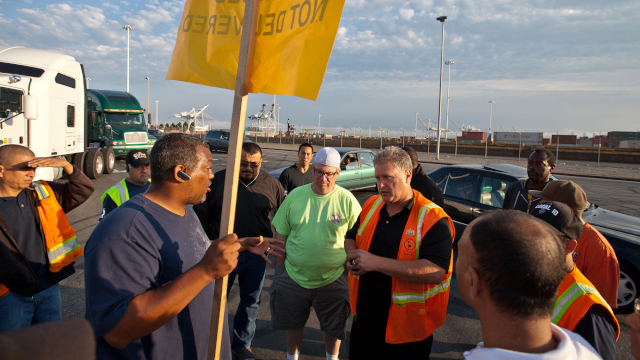
At about 7:45 AM battalions of police surrounded Port Truckers and their supporters, forcing them back up against the fence separating the road from the port facilities. Picketers had been walking the gate there at 1717 Middle Harbor Road since 5:00 AM, police continually harassing them and threatening them with arrest. This new, massive show of force by police – some with batons drawn – apparently had the opposite of its intended effect. According to tweets sent out subsequently ILWU members decided that they would have none of this and refused to work, effectively closing Port operations. Things are happening fast. It appears as if the Port has acceded to at least one of the truckers’ demands (see last tweet and image), and is now willing to negotiate other terms.

Longshoreman Strike Shuts Down Port Of Baltimore

Well, what's happening here is a local strike which is part of a nationwide negotiation, East Coast negotiation by the Longshoremen's Association. And as I said, it's intensified by the expanding of the Panama Canal and the changing of the industry, because ships will now, which normally would only go to the Pacific Coast ports, will now come here. And so the Maritime Institute seems to have felt that this is a time where they need to go after the union, both on a national level on issues of wages and benefits, and then on a local level. And the strike here is over local issues. And every large national negotiations involves two levels, one of which is the money and the benefits, which is done industry-wide, and in this case up and down the East Coast, plus local issues, which vary from region to region, local to local.

The New AFL-CIO

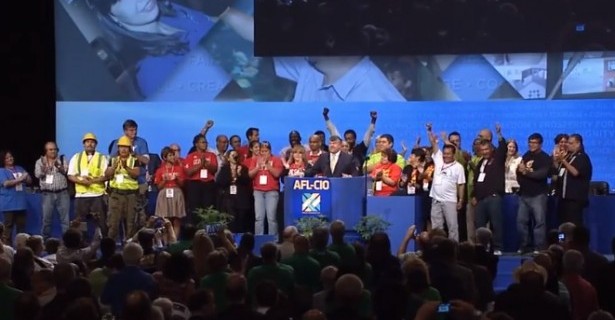
Dream. Innovate. Act. That was the slogan for the AFL-CIO’s convention held in Los Angeles last month. It would have captured the mood of the gathering better if it had started with the word “crisis.” The convention reflected a continuing struggle by labor leaders to find new strategies, triggered by a sense that the ongoing decline in size and power of their movement has undermined its ability to fight trends toward record economic inequality, more insecure workplaces, and stingy public provision of rights and rewards for working people. AFL–CIO President Richard Trumka expressed hope that a new working class movement, using tactics and organizational forms both old and new, can reach and include every working person in the country. All workers need a collective voice, Trumka said: “They have to have a voice in the workplace, they have to have a voice in the economy, and they have to have a voice in politics.”
assetto corsa mods

Urgent End Of Year Fundraising Campaign

Online donations are back! Keep independent media alive. 

Due to the attacks on our fiscal sponsor, we were unable to raise funds online for nearly two years.  As the bills pile up, your help is needed now to cover the monthly costs of operating Popular Resistance.

Urgent End Of Year Fundraising Campaign

Online donations are back! 

Keep independent media alive. 

Due to the attacks on our fiscal sponsor, we were unable to raise funds online for nearly two years.  As the bills pile up, your help is needed now to cover the monthly costs of operating Popular Resistance.

Sign Up To Our Daily Digest

Independent media outlets are being suppressed and dropped by corporations like Google, Facebook and Twitter. Sign up for our daily email digest before it’s too late so you don’t miss the latest movement news.